Editorial Team
5 min read
Avicena has raised over $100 million for microLED connections between AI chips, with a new CEO targeting a first product in 2027. Chipmaker backing strengthens its commercialization effort, but deployment economics remain unproven in the announcement.
Avicena, a privately held optical-interconnect developer in Sunnyvale, California, says it has raised over $100 million to commercialize LightBundle, its laser-free technology for moving data between AI chips. Its November 24 financing announcement also names a new chief executive and targets a first product in 2027, following evaluation-kit shipments this year.
The company is addressing connections between accelerators, memory and switches—the components that process, store and route data. Avicena says copper links increasingly constrain distance, routing density and energy efficiency, while memory bandwidth and capacity limit system performance. Its proposal is to replace those electrical connections with many parallel optical channels powered by tiny LEDs.
The money funds a transition from evaluation hardware to a commercial product. It also renews a production ambition Avicena described in its previous funding round, while laser-based competitors pursue the same opportunity with different optical components.
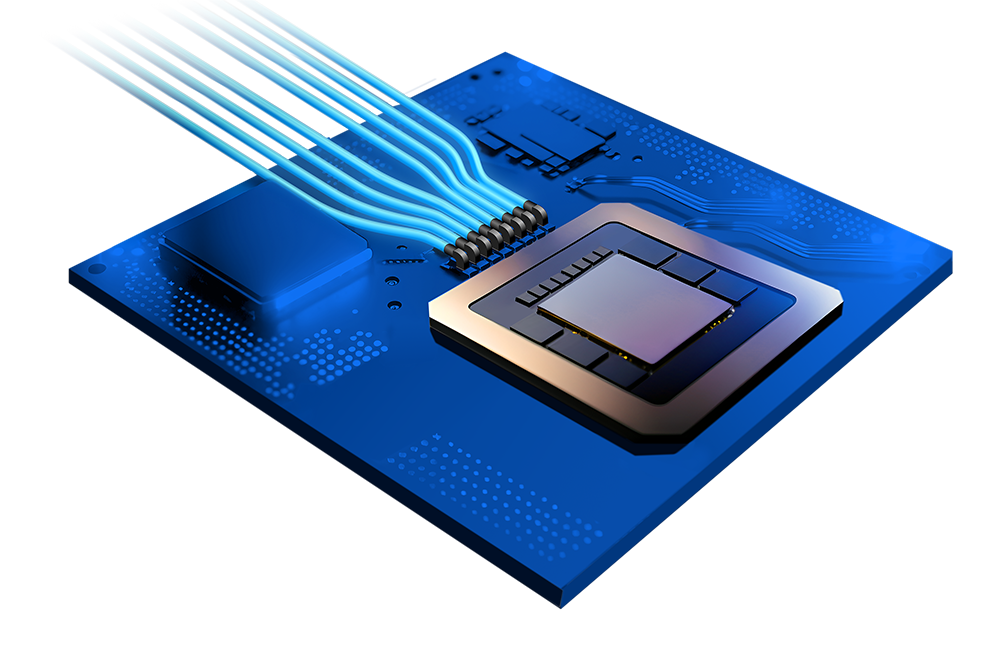
Avicena’s illustration of its LightBundle chiplet platform for die-to-die interconnects. Credit: Avicena. Source: Avicena Series B announcement.
InterVest led the Series C, and its director John Dongwoo Ha will join Avicena’s board. Participants include Tiger Global, Cerberus Capital Management, SK hynix Ventures, Samsung Catalyst Fund, AMD Ventures, Prosperity7 Ventures, Mitsubishi Chemical’s Diamond Edge Ventures and Hitachi Ventures. A separate financing report lists the same lead and participants and gives the amount as $100 million. Avicena gives no valuation or individual ownership stakes.
Two Dutch court actions seek restrictions on Meta’s camera glasses, including a sales ban, over covert recording and disputed AI data practices. The cases test how much responsibility belongs to the companies that design and operate the glasses, rather than their wearers.
The chipmaker investors have a direct interest in improving the connections used by compute and memory systems. SK hynix Ventures said it hopes to explore collaboration on next-generation memory interconnects. Its interest, also described in coverage of the financing, is not an announced customer order.
Incoming CEO Kevin Pope, whom Avicena credits with technology and operations experience and guiding multiple companies to successful exits, succeeds Marco Chisari. The release does not name those previous businesses. A report on the transition says Chisari had held the job for just over a year. Avicena says Pope will lead commercialization; he says the funding will expand hiring, product development and engineering ahead of the launch.
Avicena’s May 14, 2025 Series B announcement reported $65 million raised, bringing total capital at that point to $120 million. Tiger Global led that round, which already included SK hynix, Cerberus, Prosperity7 and Hitachi Ventures. The stated purpose included expanding the team and ramping the first product into production. SK hynix also expressed interest in potential memory-interconnect collaboration then.
The optics.org report puts that earlier round at $75 million, conflicting with the dated company announcement’s $65 million. The Series C release does not reconcile the difference or give a new cumulative funding total. The earlier production plan also carried no launch date that would establish a missed deadline.
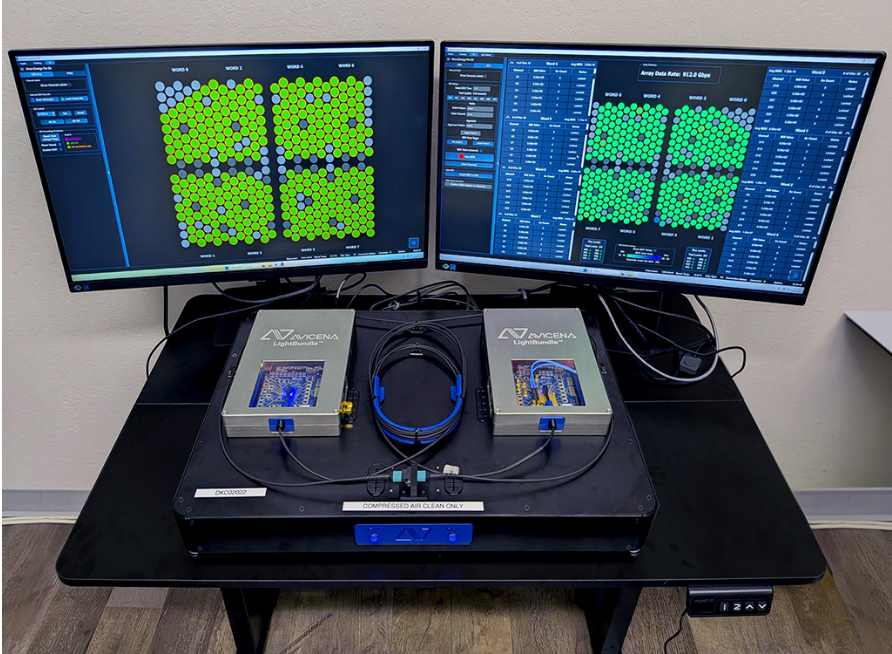
Avicena’s connectorized LightBundle evaluation setup, pictured in its September 2026 announcement. Credit: Avicena. Source: Avicena.
LightBundle combines microLED transmitter arrays, silicon photodetectors, purpose-built silicon transceivers and multicore fiber. Instead of concentrating bandwidth in a few very fast channels, it distributes data across many slower channels. Avicena says that reduces the need for data-rate conversion and complex signal processing. It targets connections within and between chip packages, as well as links across accelerator systems.
There is a manufacturing argument alongside the power claim. In its Series B announcement, Avicena described gallium nitride, or GaN, microLED arrays that draw on the large display-industry ecosystem and can be integrated onto high-performance silicon chips. The report on the CEO transition also says the architecture avoids indium phosphide photonic components, which it describes as being in short supply. Neither source quantifies the resulting manufacturing cost or production yield.
Avicena says it began shipping 1-terabit-per-second LightBundle evaluation kits in August 2026, then announced a connectorized version in September. The connectors address assembly, testing and serviceability, practical steps toward incorporating optics into customer systems.
Its ECOC exhibitor announcement specifies 335 microLED channels operating at up to 3 gigabits per second each. Multiplying those specifications gives about 1 terabit per second of aggregate channel capacity. This is a kit specification, not measured application throughput in a deployed AI system. The optics.org article prints 3 megabits per second per channel; the calculation here uses Avicena’s exhibitor specification.
Avicena argues that laser-based optical links can introduce power, thermal, cost, packaging and reliability difficulties, particularly near hot compute and memory chips. Those concerns, relayed in the report on the CEO transition, explain its choice of microLEDs. They do not establish a complete-system advantage over every laser-based design.
Optical-interconnect developer Ayar Labs, for example, announced its TeraPHY optical chiplet in March 2025. It combines silicon photonics with chip manufacturing processes for use inside multi-chip packages, using a SuperNova laser light source. Its UCIe—Universal Chiplet Interconnect Express—electrical interface is intended to ease integration and interoperability with other vendors’ chiplets.
Ayar Labs claimed 8 terabits per second of bandwidth for that chiplet and described a model of an external laser-source array with hot-swap capability. Those details show that competing designs also address integration and serviceability. The 8-terabit chiplet claim and the 1-terabit kit specification do not establish relative system performance: the announcements provide no common test setup or benchmark for cost, power or deployed throughput.
Avicena’s next test is whether its evaluation hardware becomes a product customers can integrate and manufacture economically. The financing announcement names no deployment customer and supplies no product price, production volume or comparable whole-link energy measurement.
A useful comparison would account for the transmitters, receivers, electronics, fiber packaging and integration into the customer’s system. Evidence from that complete connection would help customers decide whether microLEDs deliver a cost or energy benefit over copper and competing optical designs. The Series C finances the effort to reach that decision; the evaluation milestones and investor support do not yet settle it.
Dante Security has raised a $10 million seed round for AI agent monitoring and human accountability. Its founders bring enterprise-security experience, but existing vendor controls and limited deployment evidence complicate the pitch.
Sber has released two GigaChat 4 language models for multistep work with million-token context windows. The flagship has an MIT license, while the smaller model restricts commercial use. Sber’s tests show substantial gains over GigaChat 3.5 alongside regressions and gaps against rivals, while deployment economics remain unclear.
JPMorgan and Citi are reportedly marketing AI loan portfolios as banks seek to manage risk or make room for more lending. The Bank of England warns that increasingly complex financing obscures exposures, while the undisclosed deal terms leave the extent of any protection unclear.
Polymarket’s H100 rental-price perpetual offers up to 3x leverage and a $30,000 launch reward pool that can grow to $120,000. Its spot benchmark excludes long-term capacity contracts, limiting the scope of potential hedges.
Bank of England governor Andrew Bailey says newer AI models are worrying their developers. The central bank wants financial firms to strengthen cyber defence and recovery while preparing for quantum-resistant cryptography, with the most systemically important firms moving ahead of national migration milestones.
Huawei’s ISSCC 2027 paper lists a custom memory interface twice HBM4’s width. Its commercial significance depends on bandwidth, manufacturing scale and cost, as China’s AI chipmakers face expensive, restricted memory supplies.
Ubisoft employees say new project pitches must explain how generative AI will be used or why it is unsuitable. The Assassin’s Creed publisher denies mandatory use, leaving questions about how teams secure approval without it.
Stanford physicist Venkatesa Chandrasekaran reports finite gravitational calculations and months of work with GPT-6 Astra. An early critique challenges the construction’s symmetry, finite-state and classical-limit claims.
SAP reportedly weighs at least 10,000 job cuts as it shifts toward AI. Labor negotiations, an earlier restructuring and a growing cloud business complicate the eventual employment and savings tally.
Poland plans to sign a Palantir software agreement on November 27 after years of military trials. Officials promise Polish control of data and access, but the available reporting gives no price, rollout timetable or comparative performance results.
Major software stocks rallied as chips fell, but an estimated $65 billion of software loans comes due in 2028–29. Higher loan yields and slower refinancing threaten indebted borrowers even as established vendors report revenue growth and expanding AI businesses.
Christophe Fouquet argues that selling China older lithography tools can preserve Western leverage. ASML’s commercial exposure and China’s ability to stretch older technology complicate that case.
Savage Technology is taking reservations for its first product: $799 Orrorin glasses promising displays for both eyes and gestures without a wristband. Meta’s display-and-band bundle launched at the same price; Savage still faces engineering validation and estimated 2027 delivery.
Z.AI’s next flagship model is reportedly behind schedule as rival providers tighten distillation defenses. US licensing rules for overseas computing threaten further delays, with Moonshot forecasting longer release cycles if its access is cut off entirely. Interim releases and alternative suppliers complicate the picture.
Capita is seeking fresh equity and creditor support after replacing its chief executive. Pension recovery costs are only part of its profit downgrade, while government figures show unresolved cases still growing.
Provisional CBS figures show AI use more than doubled among Dutch businesses with at least two workers in 2026. Text generation spread rapidly, while reported productivity gains leave the size of the economic payoff unresolved.
The Global Electronics Association says AI servers are absorbing scarce circuit-board materials and crowding out other industries. New factories are coming, but upstream constraints and uncertain demand complicate the response.
Google says Gemini Live’s Guided Vision is available on iOS, extending visual descriptions and spoken camera-framing help to iPhone users. Device eligibility and regional coverage remain unclear, and Google warns against using it for navigation.
The Dutch government wants Congress to keep the MATCH Act out of its annual defence bill. The proposal would tighten controls on ASML’s China business, including servicing, despite existing Dutch restrictions on advanced chipmaking equipment.