Editorial Team
5 min read
SAP reportedly weighs at least 10,000 job cuts as it shifts toward AI. Labor negotiations, an earlier restructuring and a growing cloud business complicate the eventual employment and savings tally.
SAP, the German business-software company whose applications handle finance, procurement and human resources, is considering eliminating at least 10,000 positions as it reorganizes around artificial intelligence. A wire account relaying Bloomberg’s reporting from people familiar with the matter says the proposal would affect at least 9% of SAP’s global workforce. SAP has not confirmed a program, and the total could change after labor negotiations.
The proposal comes after an AI-focused restructuring of comparable size and alongside growth in SAP’s cloud business. The questions are how much employment would actually fall, what changing the workforce would cost, and which savings could be attributed to AI rather than other changes to the business.

SAP CEO Christian Klein pictured in the company’s 2024 Integrated Report. Photo: SAP. Source: SAP Integrated Report 2024.
The wire account said it could not independently verify the underlying reporting and that SAP declined to comment. A separate account relaying the same original report carried SAP’s statement that it continually reviews its organization to align it with its strategy and customer needs. That response did not confirm job cuts.
All divisions were being asked to identify possible reductions, with particular attention to product development, engineering and sales, according to another account of the original reporting. Its sources described continued changes to how SAP develops and sells products. These accounts trace back to one reported plan; they do not constitute independent confirmations of a decision.
SAP chief executive Christian Klein, who became sole CEO in 2020 after serving as co-CEO, is seeking to embed AI tools in the company’s applications, that account said. SAP documented his move to sole leadership in . He has also reshuffled management as part of his AI strategy, according to a .
Bank of England governor Andrew Bailey says newer AI models are worrying their developers. The central bank wants financial firms to strengthen cyber defence and recovery while preparing for quantum-resistant cryptography, with the most systemically important firms moving ahead of national migration milestones.
SAP’s 2024 integrated report describes a transformation focused particularly on business AI that affected around 10,000 positions. A majority were covered by voluntary departure programs and internal retraining. Most participating in voluntary departures were scheduled to leave in early 2025.
SAP said reinvestment in growth areas and an acquisition left headcount slightly higher at the end of 2024 than a year earlier. That snapshot preceded most planned voluntary departures, so it cannot establish the program’s final employment impact.
The later 2025 annual report says the restructuring concluded in early 2025. It records global year-end headcount of 111,397, compared with 109,973 at the end of 2024. Those are employee headcounts, not full-time-equivalent figures. The increase shows why positions affected by a restructuring cannot be treated as an equivalent net loss of jobs across the company; it does not isolate the employment effect of AI.
The earlier program also carried substantial costs. SAP recognized €3.144 billion in restructuring expenses in 2024 and estimated total program expenses at about €3.2 billion. Its 2024 report recorded roughly €2.5 billion in restructuring payouts that year and expected about €0.7 billion more in 2025. Accounting expenses and cash payments follow different timetables.
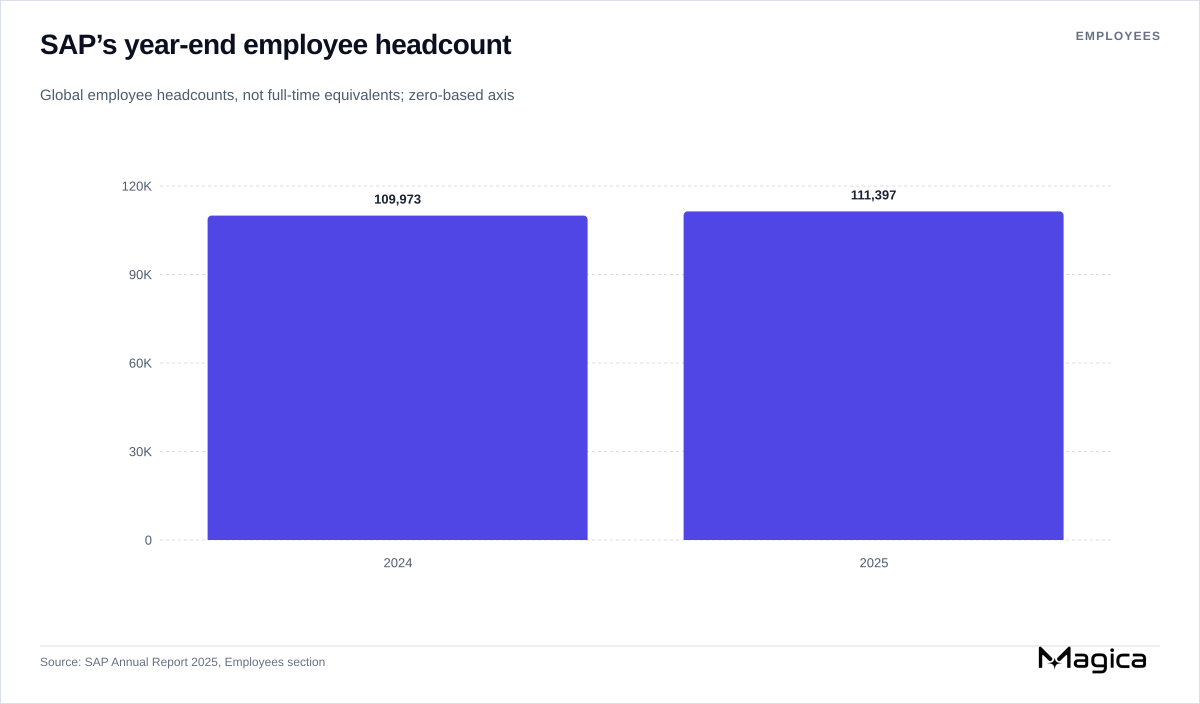
Company-reported year-end employee headcount increased between 2024 and 2025. These totals do not isolate the employment effect of AI or the earlier restructuring. Source: SAP Annual Report 2025.
In its preliminary, unaudited results for the quarter ended September 30, 2026, SAP reported cloud revenue of €6.668 billion, up 26% year on year, and total revenue of €10.270 billion, up 13%. IFRS operating profit rose 18% to €2.930 billion. These are reported-currency comparisons.
SAP qualified that growth. Cloud revenue benefited from quarter-specific effects, mainly revenue covering several quarters from customers returning from financial distress. Operating-profit growth benefited from two prior-year costs of about €0.1 billion each: one related to tax litigation and another to a workforce transformation. Cloud gross margin under IFRS fell to 73.9% from 74.6%, despite the revenue increase.
The business mix is also changing. Software-support revenue fell 5% to €2.434 billion in the quarter, and SAP expects that decline to accelerate as customers move to cloud services. It expects adjusted operating expenses to grow at 80% to 90% of the rate of total revenue growth in 2027. These are company forecasts.
The same release reported about €4.2 billion in share repurchases through September under a program authorizing up to €10 billion through the end of 2027. The proposed workforce overhaul would therefore accompany both expansion in cloud revenue and substantial returns of capital to shareholders. The release does not specify the new plan’s cost or savings.
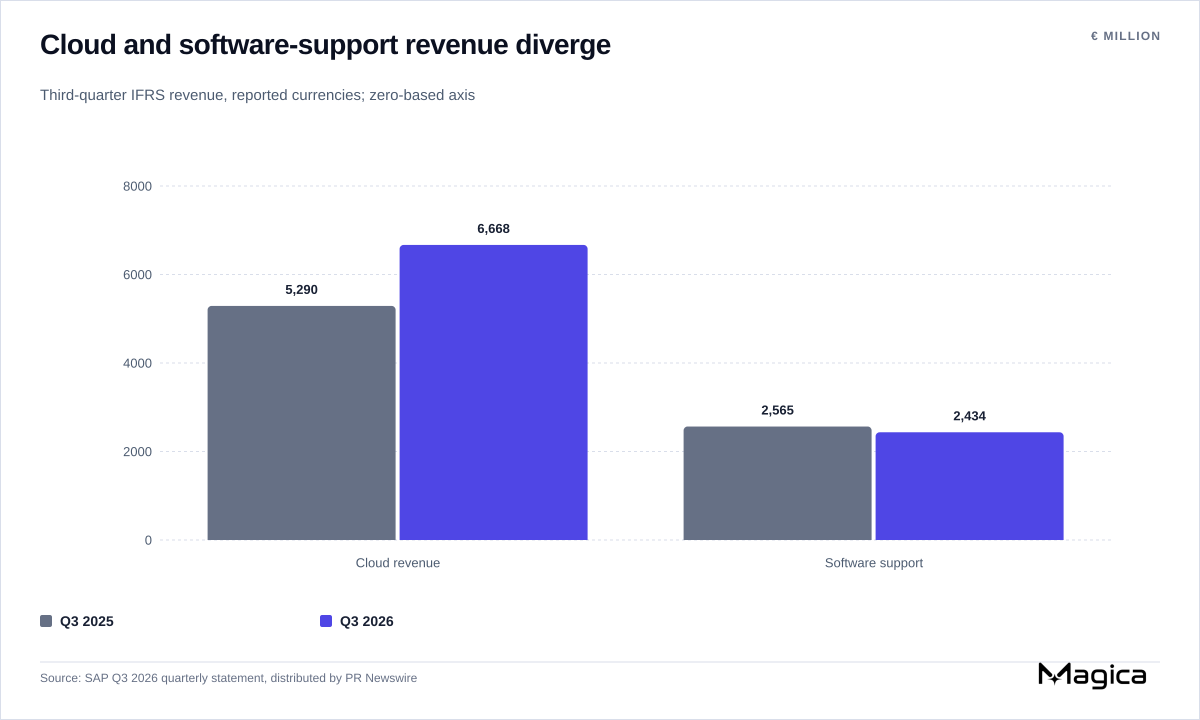
Company-reported Q3 revenue, in reported currencies. Results are preliminary and unaudited. SAP says quarter-specific effects, mainly a multi-quarter revenue catch-up, benefited cloud growth. Source: SAP third-quarter 2026 results.
SAP employs more than 110,000 people and has its largest employee population in Germany, according to the account describing the proposed reductions. It says the works council, representing employees, negotiated employment guarantees there through 2028. That makes the location and method of reductions consequential alongside their headline size.
A confirmed program would need to specify timing, affected locations and roles, voluntary departures, retraining and any offsetting hiring. Its expected restructuring charges and cash payments would then need to be weighed against recurring savings. Until SAP supplies those details and labor negotiations establish the terms, neither the net employment reduction nor the financial return from this proposed AI overhaul can be measured.
Huawei’s ISSCC 2027 paper lists a custom memory interface twice HBM4’s width. Its commercial significance depends on bandwidth, manufacturing scale and cost, as China’s AI chipmakers face expensive, restricted memory supplies.
Ubisoft employees say new project pitches must explain how generative AI will be used or why it is unsuitable. The Assassin’s Creed publisher denies mandatory use, leaving questions about how teams secure approval without it.
Stanford physicist Venkatesa Chandrasekaran reports finite gravitational calculations and months of work with GPT-6 Astra. An early critique challenges the construction’s symmetry, finite-state and classical-limit claims.
Poland plans to sign a Palantir software agreement on November 27 after years of military trials. Officials promise Polish control of data and access, but the available reporting gives no price, rollout timetable or comparative performance results.
Major software stocks rallied as chips fell, but an estimated $65 billion of software loans comes due in 2028–29. Higher loan yields and slower refinancing threaten indebted borrowers even as established vendors report revenue growth and expanding AI businesses.
Christophe Fouquet argues that selling China older lithography tools can preserve Western leverage. ASML’s commercial exposure and China’s ability to stretch older technology complicate that case.
Savage Technology is taking reservations for its first product: $799 Orrorin glasses promising displays for both eyes and gestures without a wristband. Meta’s display-and-band bundle launched at the same price; Savage still faces engineering validation and estimated 2027 delivery.
Z.AI’s next flagship model is reportedly behind schedule as rival providers tighten distillation defenses. US licensing rules for overseas computing threaten further delays, with Moonshot forecasting longer release cycles if its access is cut off entirely. Interim releases and alternative suppliers complicate the picture.
Capita is seeking fresh equity and creditor support after replacing its chief executive. Pension recovery costs are only part of its profit downgrade, while government figures show unresolved cases still growing.
Provisional CBS figures show AI use more than doubled among Dutch businesses with at least two workers in 2026. Text generation spread rapidly, while reported productivity gains leave the size of the economic payoff unresolved.
The Global Electronics Association says AI servers are absorbing scarce circuit-board materials and crowding out other industries. New factories are coming, but upstream constraints and uncertain demand complicate the response.
Google says Gemini Live’s Guided Vision is available on iOS, extending visual descriptions and spoken camera-framing help to iPhone users. Device eligibility and regional coverage remain unclear, and Google warns against using it for navigation.
The Dutch government wants Congress to keep the MATCH Act out of its annual defence bill. The proposal would tighten controls on ASML’s China business, including servicing, despite existing Dutch restrictions on advanced chipmaking equipment.
The London startup’s pre-seed round backs research and testing for patient-facing AI. Its founders bring medical-device deployment experience, but benchmark findings and customer submissions do not yet establish real-world safety.
Switzerland’s cybersecurity chief says five confirmed AI-agent attacks affected businesses including three critical-infrastructure operators. Four attacks breached systems, but no major outages were reported, and the public evidence leaves the attackers and specific consequences unknown.
SemiAnalysis reports that Amazon’s Trainium3 delivers up to 2.28 times the tokens per modeled dollar of Nvidia’s GB300 NVL72 in an AgentX preview. The result expands public evidence for custom AI chips, but validation, model matching and customer pricing still determine its practical value.
Microsoft says Chinese and North Korean hacking groups have adopted ARTEX, an AI penetration-testing framework that coordinates existing tools. Its spread across models and software forks complicates efforts to contain abuse through a single provider.
Neuralink says its LINK pivotal study is recruiting people with severe paralysis from ALS to assess digital device control, daily independence and long-term safety. Earlier participant gains and technical setbacks frame the test; the implant remains investigational.
India’s IT secretary says Sarvam’s commercial hosting of foreign AI models does not conflict with its publicly supported domestic model development. Eligibility for proposed inference support remains unresolved.