Editorial Team
5 min read
Taiwan forecasts 6.51% economic growth in 2027 after a projected 13.28% surge in 2026, as AI hardware demand drives exports and capacity expansion despite risks to infrastructure investment.
Taiwan’s Directorate General of Budget, Accounting and Statistics (DGBAS), the Executive Yuan agency producing the national accounts and economic outlook, raised its 2027 real GDP growth forecast to 6.51% on November 27. It expects demand for artificial intelligence infrastructure to sustain exports and investment after a projected 13.28% expansion in 2026.

DGBAS’s revised annual GDP growth results and forecasts. Figures for 2026 and 2027 are projections. Source: Directorate General of Budget, Accounting and Statistics.
The agency’s November release raised the 2026 forecast by 2.23 percentage points. It describes demand for AI infrastructure and equipment as still exceeding supply.
The 2027 upgrade is smaller, but consequential: it assumes growth can continue after the sharp acceleration already recorded in Taiwan’s economy. Revised annual growth was 5.29% in 2024 and 8.94% in 2025. The preliminary estimate for the third quarter of 2026 is 14.39% growth from a year earlier.
The changes from the August forecasts, detailed in the report on the announcement, show how much the outlook has strengthened:
| Year | August real GDP growth forecast | November forecast | Revision |
|---|---|---|---|
| 2026 | 11.05% | 13.28% | +2.23 percentage points |
| 2027 | 6.04% |
Delaware’s unintroduced AI-company proposal would pair owner liability protections with continuing funding duties, shutdown controls and a supervised trial. Lawmakers still face questions about the need for a new legal form, recoverable capital and public access to the test results.
| 6.51% |
| +0.47 percentage points |
The August levels in the table are calculated by subtracting the reported revisions from the November forecasts. If realized, the 2026 expansion would be Taiwan’s strongest in 48 years, according to the report. These remain full-year forecasts, rather than completed annual results.
DGBAS describes how global AI spending translates into domestic investment. As cloud service providers expand computing infrastructure, major customers have secured future production capacity through multiyear supply agreements and strategic partnerships. Taiwanese suppliers are responding with additional capacity across semiconductors, packaging and testing, memory, integrated-circuit substrates and equipment.
In its 2026 outlook, the agency forecasts real private fixed capital formation will increase 14.90%, supported by spending on plants, equipment and research and development. Real exports of goods and services are projected to rise 23.96%.
That investment channel matters because the forecast is supported by commitments to future capacity as well as current shipments. It also ties Taiwan’s expansion to customers’ ability to carry out their infrastructure plans.
DGBAS attributes the export surge to advances in AI agents and inference—the operation of AI models—which are increasing demand for computing power. It separately points to shortages pushing up prices for memory and integrated-circuit substrates. Traditional industries’ exports have picked up too, broadening the improvement beyond AI-related electronics. The real export growth forecast strips out price changes; it is not a measure of the increase in export receipts.
The third-quarter preliminary accounts show the difference in pace across the economy. Real exports of goods and services rose 21.65% from a year earlier, alongside a 21.10% increase in imports. Manufacturing output grew 21.39%, led by semiconductors, computers, electronics and optical products. Private consumption increased 5.50%. These are quarterly year-on-year estimates, distinct from the full-year forecasts.
The agency also credits an earlier change in Taiwan’s production base. In a reported explanation of its forecasts, DGBAS linked the acceleration to Taiwanese businesses returning and increasing investment after the U.S.–China trade war, followed by strong AI demand meeting available supply and production capacity. This account places the current expansion in a longer investment cycle.
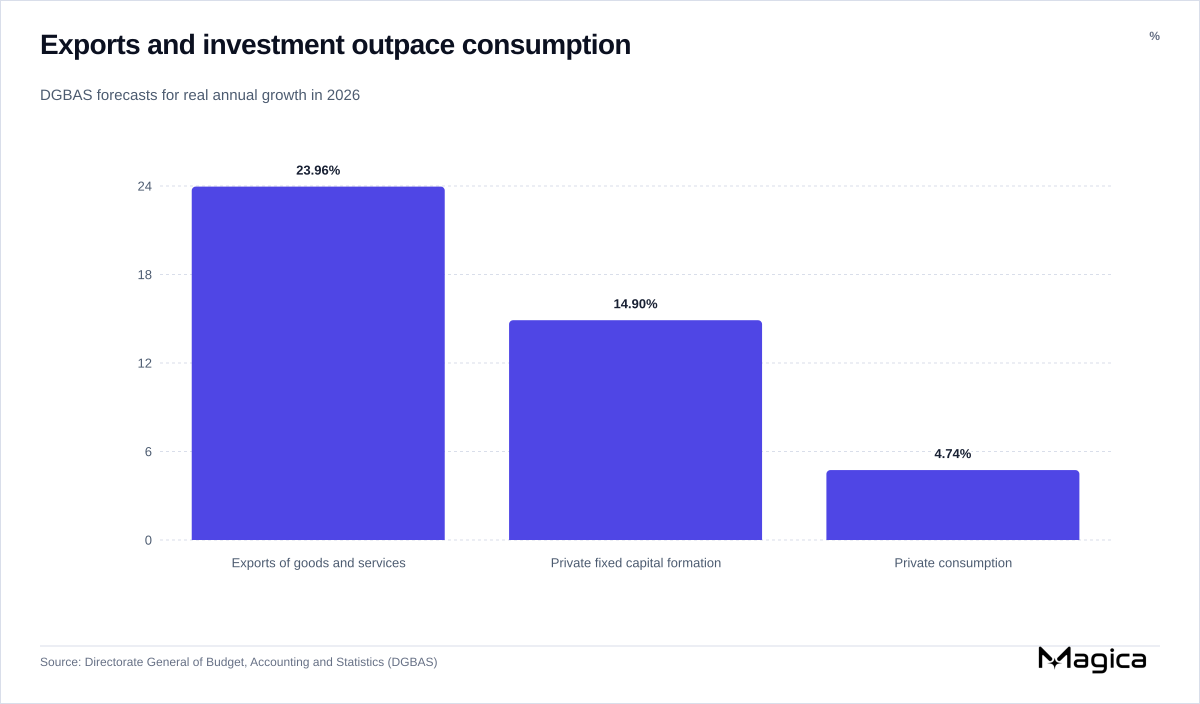
DGBAS’s 2026 forecasts compare real growth rates, rather than shares of GDP or contributions to GDP growth. Source: Directorate General of Budget, Accounting and Statistics.
DGBAS forecasts per-capita GDP of US$46,767 in 2026 and US$50,779 in 2027, according to the forecast report and a separate account of the agency’s projections. Taiwan passed US$10,000 in 1992, US$20,000 in 2011 and US$30,000 in 2021. The agency now expects it to cross US$40,000 in 2026 and US$50,000 just a year later.
The agency’s figures also put Taiwan’s GDP per person above Japan’s in 2024 and South Korea’s in 2025. These comparisons describe output per person; they do not establish how much a typical household earns or how evenly the gains are distributed.
DGBAS expects real private consumption to grow 4.74% in 2026. It says strong corporate earnings support wage increases and dividend payments, but recent sharp financial-market volatility has offset part of the consumption growth. For 2027, it expects a stable labor market and the government’s universal cash handout to support spending.
The agency’s price outlook puts consumer-price inflation at 2.07% in 2026 and 1.96% in 2027. Even as global commodity prices stabilize, it expects dining-out costs and residential rents to keep rising amid economic growth and wage gains. A lower overall inflation rate would therefore still leave pressure on recurring household expenses.
The official 2027 outlook flags expanded U.S. AI export controls and potentially tighter local regulation prompted by residents’ opposition to data center construction. DGBAS says those constraints could affect investment costs and timelines; it does not describe all such regulation as already enacted.
Its forecast nevertheless assumes demand for AI infrastructure and equipment continues to exceed supply as cloud providers, computing suppliers and governments increase investment. Domestic capacity expansion and manufacturing-process upgrades are expected to sustain Taiwan’s exports and investment, with traditional industries also benefiting from AI-related opportunities.
The next test is whether customer commitments translate into completed infrastructure and sustained equipment orders on the schedules suppliers expect. The release does not quantify how much GDP growth would be lost if export controls or construction restrictions intensify. Future orders, investment spending and revisions to the national accounts will help establish whether the projected expansion is being realized.
Germany wants generative AI providers to compensate rights holders for competing output through collecting societies. Eligibility would depend on allowing free training use, while fee levels and enforcement remain unresolved.

Iran’s semi-official Mehr News Agency circulated simulated attacks on technology company headquarters, demanding reparations over alleged military involvement. Public Pentagon agreements establish supplier ties, but do not substantiate the video’s accusations about attacks on Iran.
Elliot Callender’s hunger strike outside Anthropic reached its fifth day on November 27. His demands range from product warnings to a development halt, while the Claude developer has argued that a meaningful pause requires verifiable cooperation among competing labs.
Starting January 1, Rhode Island will require an open manual checkout for every three operating grocery self-checkouts, with separate protections for monitors’ workload. Stores’ responses elsewhere and limited research leave the effects on employment, prices and theft unsettled.
The German consumer organization wants an injunction against ChatGPT subscription cancellation hurdles and a price-change clause. The clause promises advance notice, but the claimant says it leaves the grounds for increases insufficiently defined.
Moonshot AI is accepting applications for Kimi for Science through December 8. Selected researchers can receive model-use credits and technical support, but the company has not disclosed the program’s total budget or cohort size.
Nvidia's proposed $290 million shareholder settlement would end disputed claims over cryptocurrency demand within gaming sales. The fund equals about 14% of plaintiffs' estimated maximum damages before fees and costs; court approval and individual payouts remain pending.
TrueLayer says an AI agent’s Papa John’s order was a UK first for direct bank payments to a retailer. The trial used customer-set, bank-enforced limits and human approval; merchant savings and readiness for wider use remain unproven.
Two Dutch court actions seek restrictions on Meta’s camera glasses, including a sales ban, over covert recording and disputed AI data practices. The cases test how much responsibility belongs to the companies that design and operate the glasses, rather than their wearers.
Dante Security has raised a $10 million seed round for AI agent monitoring and human accountability. Its founders bring enterprise-security experience, but existing vendor controls and limited deployment evidence complicate the pitch.
Avicena has raised over $100 million for microLED connections between AI chips, with a new CEO targeting a first product in 2027. Chipmaker backing strengthens its commercialization effort, but deployment economics remain unproven in the announcement.
Sber has released two GigaChat 4 language models for multistep work with million-token context windows. The flagship has an MIT license, while the smaller model restricts commercial use. Sber’s tests show substantial gains over GigaChat 3.5 alongside regressions and gaps against rivals, while deployment economics remain unclear.
JPMorgan and Citi are reportedly marketing AI loan portfolios as banks seek to manage risk or make room for more lending. The Bank of England warns that increasingly complex financing obscures exposures, while the undisclosed deal terms leave the extent of any protection unclear.
Polymarket’s H100 rental-price perpetual offers up to 3x leverage and a $30,000 launch reward pool that can grow to $120,000. Its spot benchmark excludes long-term capacity contracts, limiting the scope of potential hedges.
Bank of England governor Andrew Bailey says newer AI models are worrying their developers. The central bank wants financial firms to strengthen cyber defence and recovery while preparing for quantum-resistant cryptography, with the most systemically important firms moving ahead of national migration milestones.
Huawei’s ISSCC 2027 paper lists a custom memory interface twice HBM4’s width. Its commercial significance depends on bandwidth, manufacturing scale and cost, as China’s AI chipmakers face expensive, restricted memory supplies.
Ubisoft employees say new project pitches must explain how generative AI will be used or why it is unsuitable. The Assassin’s Creed publisher denies mandatory use, leaving questions about how teams secure approval without it.
Stanford physicist Venkatesa Chandrasekaran reports finite gravitational calculations and months of work with GPT-6 Astra. An early critique challenges the construction’s symmetry, finite-state and classical-limit claims.
SAP reportedly weighs at least 10,000 job cuts as it shifts toward AI. Labor negotiations, an earlier restructuring and a growing cloud business complicate the eventual employment and savings tally.