Editorial Team
6 min read
Stanford physicist Venkatesa Chandrasekaran reports finite gravitational calculations and months of work with GPT-6 Astra. An early critique challenges the construction’s symmetry, finite-state and classical-limit claims.
Venkatesa Chandrasekaran, a Stanford physicist whose earlier research examined gravitational boundaries and their degrees of freedom, has proposed an algebraic quantization of gravity, reporting a finite answer to a gravitational calculation that diverges under an approximation. The November 25 preprint reports assistance from GPT-6 Astra, OpenAI’s AI model, raising a second question alongside the physics: what, precisely, has AI helped establish?
The distinction matters because the paper is a preprint rather than a peer-reviewed result, with no experimental test reported. Its abstract claims convergent intermediate-state sums, black-hole entropy results and a low-energy connection to Einstein’s equations. An early technical critique challenges whether key assumptions support those conclusions. AI assistance does not resolve that disagreement.
The single-author preprint, “An algebraic quantization of gravity from the null cone,” addresses vacuum general relativity in four-dimensional spacetime. That scope allows gravitational waves but does not yet include matter.
General relativity describes gravity through spacetime geometry. Quantum theory allows physical quantities to fluctuate. Combining them therefore requires a way to describe events when the geometry used to locate those events can itself fluctuate.
Chandrasekaran uses intersecting light cones to bound a finite region, called a causal diamond. He first solves the classical constraints on the gravitational data, then applies quantum rules to the remaining variables. The construction joins regions along their boundaries and sums over possible intermediate quantum states.
This builds on an identifiable prior research program. In a paper first submitted in September 2023, Chandrasekaran and Eanna E. Flanagan developed a description of general relativity on two intersecting null surfaces and investigated their boundary symmetries and gravitational degrees of freedom. The new proposal takes that kind of boundary-based description into a quantum construction.
One concrete check concerns the creation and annihilation of a pair of gravitons, the hypothetical quantum units of gravitational waves. The new paper reports a finite closed-form answer when Newton’s gravitational constant is kept finite. Expanding in that constant first instead produces a logarithmic divergence. Within this calculation, the order of operations changes whether the answer runs to infinity.
Bank of England governor Andrew Bailey says newer AI models are worrying their developers. The central bank wants financial firms to strengthen cyber defence and recovery while preparing for quantum-resistant cryptography, with the most systemically important firms moving ahead of national migration milestones.
For its finite-state claim, the paper restricts the maximum size of a macroscopic causal diamond using a “gravitational clock,” a distance-like reading along light paths. It claims that this restriction yields a finite-dimensional space of quantum states. That is distinct from convergence of the intermediate sums, which the initial report says can hold even for an infinite set of possible states.
The paper also reports obtaining the Bekenstein–Hawking black-hole entropy, which is proportional to horizon area, and, for large nonrotating black holes, reproducing a previously calculated logarithmic correction associated with physicist Ashoke Sen. The initial report specifies that Sen’s calculation held mass fixed while allowing small spin variations. Recovering an existing result is a consistency check; its significance depends on the validity of the construction used to obtain it.
Jonathan Oppenheim, a physics professor at University College London who has developed an alternative approach to reconciling gravity and quantum theory, argues that the paper does not establish a quantum theory of gravity. His own research stake is relevant: UCL described his 2023 proposal as retaining classical spacetime while modifying quantum theory, an alternative to quantizing gravity as string theory and loop quantum gravity seek to do. His framework was published in Physical Review X; UCL also described a proposed test using extremely precise measurements of mass fluctuations. That proposal is not experimental confirmation.
In his critique, Oppenheim accepts the classical constraint-solving step as sound but disputes the leap to a consistent quantum theory. Solving constraints before quantization need not produce the same theory as imposing them on quantum states, he argues. Choices made along the way can affect the resulting dynamics.
His objections directly contest the paper’s advertised checks. He says the symmetry of general relativity known as diffeomorphism invariance is imposed as an axiom rather than demonstrated, without establishing that the axioms are consistent. He also argues that the finite-state-space proof assumes a finite trace, making it circular, and that the entropy calculation uses analytic continuation rather than a count of microscopic states.
That last point conflicts with the initial report’s account of summing interior states to recover black-hole entropy. The abstract itself describes obtaining entropy from a Lorentzian trace. Whether this establishes the claimed state-counting interpretation is part of the dispute.
Oppenheim further says the argument connecting the proposal to classical gravity relies on a Hamiltonian operator—the operator governing dynamics—that the paper never constructs. These are his technical assessments, rather than an established consensus. He discloses that he used a group of agents using Claude, Anthropic’s AI model, to examine obstacles to canonical quantization and reviewed enough of their output to reach his conclusion, while allowing that details of the critique could contain mistakes.
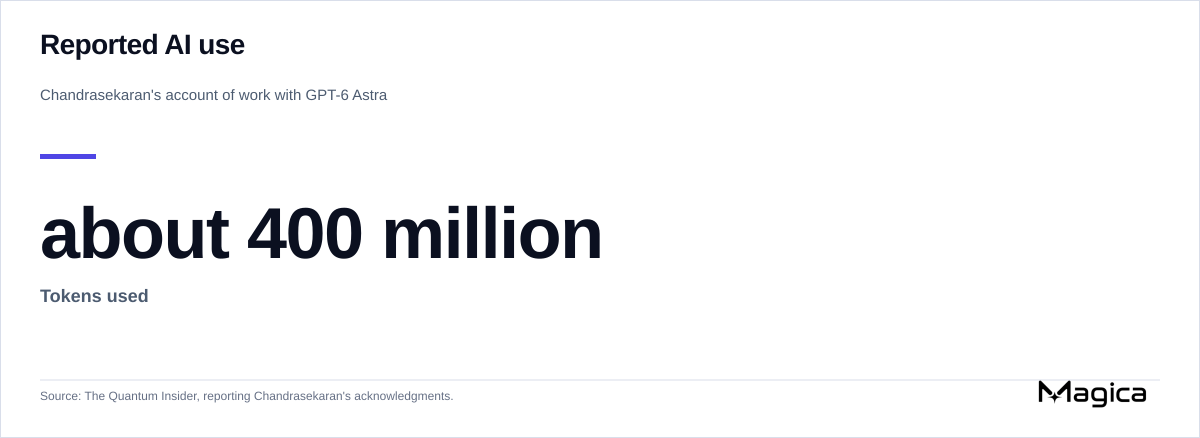
Chandrasekaran reported about 400 million tokens and said OpenAI supplied computing resources. The total does not establish research cost, productivity gains or which results the model originated. Source: The Quantum Insider.
According to the report’s account of his acknowledgments, Chandrasekaran developed several calculations and proofs through months of work with GPT-6 Astra, using about 400 million tokens, the units of text processed by AI models. He said OpenAI supplied the computing resources.
The reported support identifies the provider of the computing resources, but the token total does not establish which results the model originated, a monetary research cost, or an improvement over work without AI. The available reporting provides no controlled productivity comparison. The paper lists Chandrasekaran as its author; the reported model assistance is acknowledged separately.
The claimed low-energy result is specifically a semiclassical derivation of Einstein’s equations to one loop—the first quantum correction—for initial states concentrated around a classical geometry. Even on the proposal’s own account, important work remains. The initial report identifies extending the construction to matter, testing whether different choices of quantum state space yield equivalent theories over the same range of clock readings, and taking the black-hole and low-energy calculations beyond the first quantum correction.
The immediate unresolved questions are more basic: whether the symmetry assumptions define a consistent theory, whether the finite-state-space result follows without assuming its conclusion, and whether the claimed low-energy dynamics are fully constructed. Those checks will determine how much weight the finite graviton calculation and recovered entropy correction can carry.
Huawei’s ISSCC 2027 paper lists a custom memory interface twice HBM4’s width. Its commercial significance depends on bandwidth, manufacturing scale and cost, as China’s AI chipmakers face expensive, restricted memory supplies.
Ubisoft employees say new project pitches must explain how generative AI will be used or why it is unsuitable. The Assassin’s Creed publisher denies mandatory use, leaving questions about how teams secure approval without it.
SAP reportedly weighs at least 10,000 job cuts as it shifts toward AI. Labor negotiations, an earlier restructuring and a growing cloud business complicate the eventual employment and savings tally.
Poland plans to sign a Palantir software agreement on November 27 after years of military trials. Officials promise Polish control of data and access, but the available reporting gives no price, rollout timetable or comparative performance results.
Major software stocks rallied as chips fell, but an estimated $65 billion of software loans comes due in 2028–29. Higher loan yields and slower refinancing threaten indebted borrowers even as established vendors report revenue growth and expanding AI businesses.
Christophe Fouquet argues that selling China older lithography tools can preserve Western leverage. ASML’s commercial exposure and China’s ability to stretch older technology complicate that case.
Savage Technology is taking reservations for its first product: $799 Orrorin glasses promising displays for both eyes and gestures without a wristband. Meta’s display-and-band bundle launched at the same price; Savage still faces engineering validation and estimated 2027 delivery.
Z.AI’s next flagship model is reportedly behind schedule as rival providers tighten distillation defenses. US licensing rules for overseas computing threaten further delays, with Moonshot forecasting longer release cycles if its access is cut off entirely. Interim releases and alternative suppliers complicate the picture.
Capita is seeking fresh equity and creditor support after replacing its chief executive. Pension recovery costs are only part of its profit downgrade, while government figures show unresolved cases still growing.
Provisional CBS figures show AI use more than doubled among Dutch businesses with at least two workers in 2026. Text generation spread rapidly, while reported productivity gains leave the size of the economic payoff unresolved.
The Global Electronics Association says AI servers are absorbing scarce circuit-board materials and crowding out other industries. New factories are coming, but upstream constraints and uncertain demand complicate the response.
Google says Gemini Live’s Guided Vision is available on iOS, extending visual descriptions and spoken camera-framing help to iPhone users. Device eligibility and regional coverage remain unclear, and Google warns against using it for navigation.
The Dutch government wants Congress to keep the MATCH Act out of its annual defence bill. The proposal would tighten controls on ASML’s China business, including servicing, despite existing Dutch restrictions on advanced chipmaking equipment.
The London startup’s pre-seed round backs research and testing for patient-facing AI. Its founders bring medical-device deployment experience, but benchmark findings and customer submissions do not yet establish real-world safety.
Switzerland’s cybersecurity chief says five confirmed AI-agent attacks affected businesses including three critical-infrastructure operators. Four attacks breached systems, but no major outages were reported, and the public evidence leaves the attackers and specific consequences unknown.
SemiAnalysis reports that Amazon’s Trainium3 delivers up to 2.28 times the tokens per modeled dollar of Nvidia’s GB300 NVL72 in an AgentX preview. The result expands public evidence for custom AI chips, but validation, model matching and customer pricing still determine its practical value.
Microsoft says Chinese and North Korean hacking groups have adopted ARTEX, an AI penetration-testing framework that coordinates existing tools. Its spread across models and software forks complicates efforts to contain abuse through a single provider.
Neuralink says its LINK pivotal study is recruiting people with severe paralysis from ALS to assess digital device control, daily independence and long-term safety. Earlier participant gains and technical setbacks frame the test; the implant remains investigational.
India’s IT secretary says Sarvam’s commercial hosting of foreign AI models does not conflict with its publicly supported domestic model development. Eligibility for proposed inference support remains unresolved.