Editorial Team
5 min read
Germany wants generative AI providers to compensate rights holders for competing output through collecting societies. Eligibility would depend on allowing free training use, while fee levels and enforcement remain unresolved.
Germany’s federal government wants generative AI providers to pay rights holders when their systems produce competing text, music or video. The proposed European remuneration right would attach to content generation, extending the copyright debate beyond permission to use material in model training, according to a report on the government’s consultation response, a document obtained by the German press agency dpa.
Access to those payments would come with a condition. Payments would flow through collecting societies to rights holders who make their works available free for AI training. Those who object to training use would retain the option of negotiating individual licensing agreements. The collective route would therefore link compensation at the output stage to permission at the training stage. It would not cover every rights holder whose work faces AI competition, and the published accounts do not establish what an individual creator could earn under either route.
Germany is putting forward a national position in the European Commission’s review of copyright rules, rather than announcing an enacted charge. The government submitted its position to a consultation that has now closed, according to the account of its response obtained by dpa.
The EU already has an AI copyright compliance framework. In July 2025, the Commission announced a voluntary General-Purpose AI Code of Practice designed to help providers comply with the AI Act, including a copyright chapter. The code’s copyright and transparency chapters address all providers of general-purpose AI models; its safety and security chapter addresses a narrower group of the most advanced model providers. The Commission described adherence as a way for signatories to demonstrate compliance with reduced administrative burden and greater legal certainty compared with proving compliance in other ways. Germany’s proposed output payment would add a remuneration mechanism to that compliance framework.
The German response also calls for providers offering models in the EU to demonstrate compliance with EU copyright law regardless of where training occurred. It wants rights holders to be able to object to training use more easily and check whether their objections were respected, according to .
Delaware’s unintroduced AI-company proposal would pair owner liability protections with continuing funding duties, shutdown controls and a supervised trial. Lawmakers still face questions about the need for a new legal form, recoverable capital and public access to the test results.

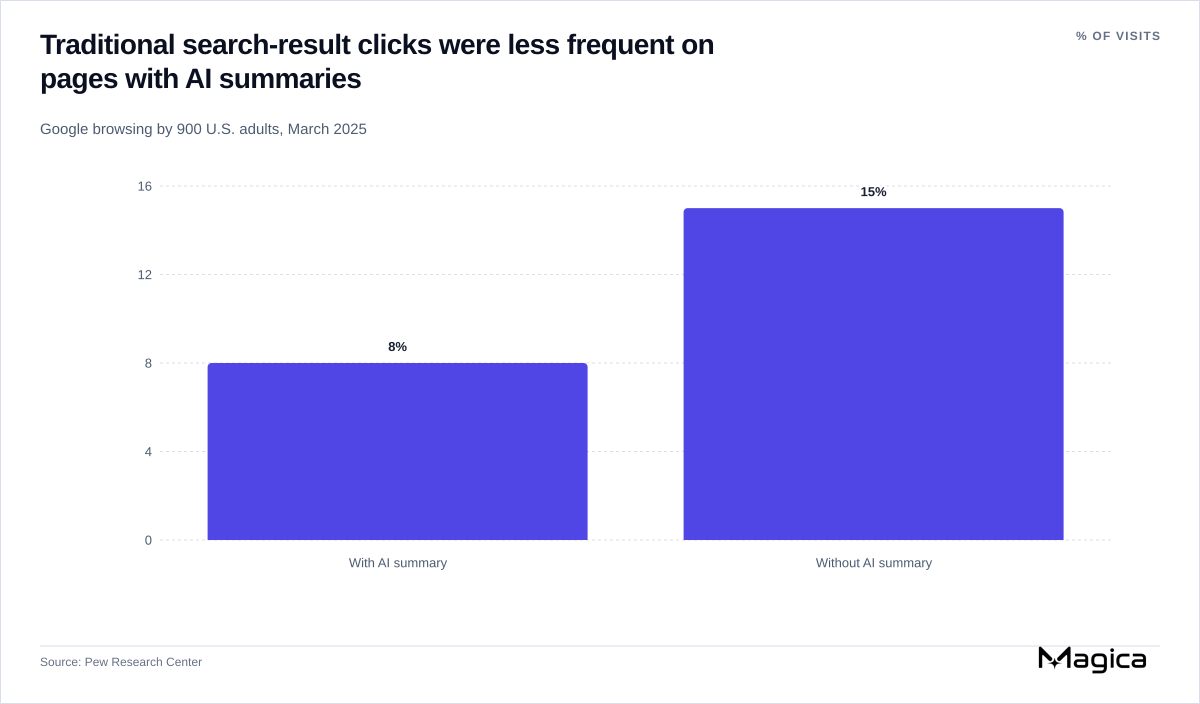
Pew Research Center observed traditional-result clicks in 8% of visits with an AI summary versus 15% without one in its March 2025 U.S. sample. This comparison does not establish causation or measure German revenue losses. Source: Pew Research Center.
The government separately argues that AI systems searching, processing and summarising current media content divert visitors from publishers’ websites, reducing advertising and subscription income. Its stated concern is the economic viability of media providers and the preservation of media pluralism and diversity of opinion. It wants examination of possible gaps in EU copyright law and the enforceability of press publishers’ rights. These are the government’s stated concerns, rather than quantified findings in the reported response.
Independent evidence illustrates the traffic issue without measuring its German financial impact. A Pew Research Center analysis examined Google’s AI Overviews, a feature that places AI-generated summaries above many search results. Using browsing data from 900 U.S. adults during March 2025, it found that users clicked a traditional result link in 8% of visits to pages classified as having an AI summary, compared with 15% of visits to pages without one. A link inside an AI summary was clicked in just 1% of visits to pages with a summary.
Pew examined 68,879 unique Google searches, of which 12,593—about 18%—produced an AI summary when reconstructed. It tracked participants’ March browsing activity but reran the searches through a scraping service on April 7–17 to collect results and identify summaries. Pew cautions that summaries can change over time.
That comparison concerns observed U.S. browsing behavior, not German publishers’ revenue. It does not establish that summaries caused the difference: longer queries and questions were also more likely to produce summaries. Nor does it show what payment would compensate a particular publisher. The findings concern this U.S. sample and Google search, rather than generative AI services as a whole.
The government response acknowledges a countervailing risk: new rules could raise the cost of foundation models or limit their availability. The accounts provide no estimate of those costs.
The published accounts do not supply a workable fee schedule or a test for deciding which output competes with human work. A description of the proposal says the paper does not define which output directly competes with human work, who would make that determination, or how fees would be calculated. Without those details, the proposal cannot yet establish the size of providers’ liabilities or creators’ likely receipts.
Enforcement is another open question. A German justice ministry spokesperson told the dts news agency that the government wanted creators to share appropriately in generative AI’s value, but did not explain how the measures would be enforced against providers, including Chinese suppliers entering the market, when asked. The spokesperson instead pointed to forthcoming EU-level consultations, according to the account of that exchange.
Germany and other member states have urged the Commission to move quickly. The reported Commission work programme schedules a legislative package touching copyright for the second quarter of 2027, but no bill has yet been presented. That timetable does not establish that Germany’s payment model will be adopted. The next substantive test is whether that process turns the proposed entitlement into defined eligibility rules, a payment basis and an enforceable obligation—while addressing the model-cost and availability risks Germany itself has raised.
Iran’s semi-official Mehr News Agency circulated simulated attacks on technology company headquarters, demanding reparations over alleged military involvement. Public Pentagon agreements establish supplier ties, but do not substantiate the video’s accusations about attacks on Iran.
Elliot Callender’s hunger strike outside Anthropic reached its fifth day on November 27. His demands range from product warnings to a development halt, while the Claude developer has argued that a meaningful pause requires verifiable cooperation among competing labs.
Starting January 1, Rhode Island will require an open manual checkout for every three operating grocery self-checkouts, with separate protections for monitors’ workload. Stores’ responses elsewhere and limited research leave the effects on employment, prices and theft unsettled.
The German consumer organization wants an injunction against ChatGPT subscription cancellation hurdles and a price-change clause. The clause promises advance notice, but the claimant says it leaves the grounds for increases insufficiently defined.
Moonshot AI is accepting applications for Kimi for Science through December 8. Selected researchers can receive model-use credits and technical support, but the company has not disclosed the program’s total budget or cohort size.
Nvidia's proposed $290 million shareholder settlement would end disputed claims over cryptocurrency demand within gaming sales. The fund equals about 14% of plaintiffs' estimated maximum damages before fees and costs; court approval and individual payouts remain pending.
TrueLayer says an AI agent’s Papa John’s order was a UK first for direct bank payments to a retailer. The trial used customer-set, bank-enforced limits and human approval; merchant savings and readiness for wider use remain unproven.
Taiwan forecasts 6.51% economic growth in 2027 after a projected 13.28% surge in 2026, as AI hardware demand drives exports and capacity expansion despite risks to infrastructure investment.
Two Dutch court actions seek restrictions on Meta’s camera glasses, including a sales ban, over covert recording and disputed AI data practices. The cases test how much responsibility belongs to the companies that design and operate the glasses, rather than their wearers.
Dante Security has raised a $10 million seed round for AI agent monitoring and human accountability. Its founders bring enterprise-security experience, but existing vendor controls and limited deployment evidence complicate the pitch.
Avicena has raised over $100 million for microLED connections between AI chips, with a new CEO targeting a first product in 2027. Chipmaker backing strengthens its commercialization effort, but deployment economics remain unproven in the announcement.
Sber has released two GigaChat 4 language models for multistep work with million-token context windows. The flagship has an MIT license, while the smaller model restricts commercial use. Sber’s tests show substantial gains over GigaChat 3.5 alongside regressions and gaps against rivals, while deployment economics remain unclear.
JPMorgan and Citi are reportedly marketing AI loan portfolios as banks seek to manage risk or make room for more lending. The Bank of England warns that increasingly complex financing obscures exposures, while the undisclosed deal terms leave the extent of any protection unclear.
Polymarket’s H100 rental-price perpetual offers up to 3x leverage and a $30,000 launch reward pool that can grow to $120,000. Its spot benchmark excludes long-term capacity contracts, limiting the scope of potential hedges.
Bank of England governor Andrew Bailey says newer AI models are worrying their developers. The central bank wants financial firms to strengthen cyber defence and recovery while preparing for quantum-resistant cryptography, with the most systemically important firms moving ahead of national migration milestones.
Huawei’s ISSCC 2027 paper lists a custom memory interface twice HBM4’s width. Its commercial significance depends on bandwidth, manufacturing scale and cost, as China’s AI chipmakers face expensive, restricted memory supplies.
Ubisoft employees say new project pitches must explain how generative AI will be used or why it is unsuitable. The Assassin’s Creed publisher denies mandatory use, leaving questions about how teams secure approval without it.
Stanford physicist Venkatesa Chandrasekaran reports finite gravitational calculations and months of work with GPT-6 Astra. An early critique challenges the construction’s symmetry, finite-state and classical-limit claims.
SAP reportedly weighs at least 10,000 job cuts as it shifts toward AI. Labor negotiations, an earlier restructuring and a growing cloud business complicate the eventual employment and savings tally.