Editorial Team
7 min read
JPMorgan and Citi are reportedly marketing AI loan portfolios as banks seek to manage risk or make room for more lending. The Bank of England warns that increasingly complex financing obscures exposures, while the undisclosed deal terms leave the extent of any protection unclear.
JPMorgan Chase and Citigroup, the US financial groups with global corporate-banking businesses, are marketing portfolios of AI-related loans, according to a November 26 report citing people familiar with the deals. The pitches coincide with a warning from the Bank of England, the UK’s central bank, that complex AI financing is making exposures harder to trace. Transferring loan risk can support further lending; the terms determine who would absorb losses.
The report says banks are seeking to manage exposure or, in some cases, prepare to take on more. Some pitches involve synthetic risk transfers: investors assume risk of losses while banks retain the underlying loans and their relationships with corporate borrowers. The account does not identify which bank is proposing which structure, disclose portfolio sizes or buyers, or establish that transactions have closed.
The banks have substantial existing lending businesses. JPMorgan Chase reported average loans of $1.5 trillion in the fourth quarter of 2025; Citigroup reported $737 billion for the same period. Those bankwide figures establish their lending scale before the current pitches, not their AI exposure.
The financing technique predates the latest AI pitches. The Basel Committee on Banking Supervision, the global standard setter for banks’ prudential regulation, published an assessment in February 2026 estimating that assets protected by synthetic risk transfers in Canada, the euro area, the United States and the United Kingdom totalled about €750 billion, or 1.1% of total bank assets in those jurisdictions. That measures underlying assets protected, not the amount investors would necessarily lose, and is not a measure of AI exposure transferred.
The assessment identified capital and credit-risk management as banks’ main motivations and private investment funds as the dominant investor group. It also said post-2008 regulatory reforms had made these securitisations simpler and more closely scrutinised than earlier credit-risk transfers, while disclosure and financing blind spots remained. The precedent argues against treating every transfer as evidence that a bank expects its borrowers to fail.
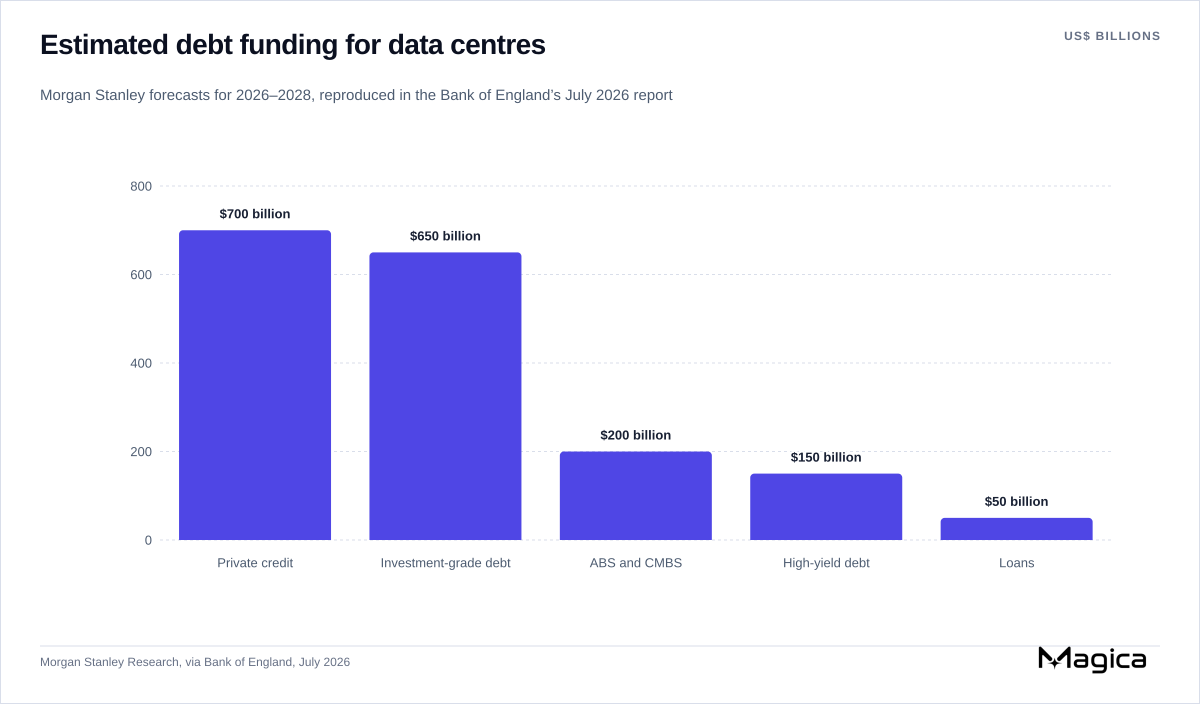
Morgan Stanley estimates of global data-centre debt funding during 2026–2028, reproduced in the Bank of England’s July report. Forecasts cover hyperscalers and non-hyperscalers; equity funding is excluded. Source: Bank of England — July 2026.
The Bank of England’s November 26 Financial Stability Report supplies the wider concern. Its Financial Policy Committee monitors risks to the UK financial system. The committee warns that expanding AI finance is deepening links across markets, making stress in one area more likely to spread elsewhere.
Borrowing by hyperscalers (cloud and technology companies operating data-centre networks), data-centre operators and other AI-infrastructure firms is almost double its 2025 level, the report says, even though issuance has slowed from the first half of 2026. Hyperscaler bond issuance is set to exceed $305 billion this year, about 8% of global investment-grade issuance. That forecast covers hyperscaler bonds, not the full AI financing market.
Funding increasingly extends into leveraged finance and private credit—loans originated directly by nonbank financial institutions—where limited disclosure makes exposures harder to measure. The Bank says some private credit funds are becoming more selective about AI and data-centre financing, with some seeking to distribute or offload exposures because of portfolio concentration. Lower-quality AI borrowers have also experienced particularly sharp credit-spread widening since July, including pressures affecting some data-centre projects.
For an indication of prospective private-market demand, the Bank cites Morgan Stanley analysts’ estimate that private credit would finance $700 billion of data-centre capital expenditure during 2026–2028. That is a financing estimate, not money already lent. It separately cites J.P. Morgan analysts’ broader $1.4 trillion estimate for AI spending financed by alternative capital, while cautioning that the estimates are not directly comparable.
The loan-marketing account describes AI issuance as crowding out Treasurys and some investors as reaching their capacity. The central bank offers a narrower assessment: it finds limited evidence so far of material crowding out of other investment or substantial reallocation from sovereign bonds into AI credit. It says that risk could grow with issuance, but also notes that the recent AI equity sell-off brought flight-to-safety demand for Treasurys. The two accounts do not establish how much capital, if any, has been displaced.

The Bank of England estimates hyperscalers’ total potential exposure at just over $4 trillion, including debt and off-balance-sheet contractual commitments. This is neither outstanding borrowing nor expected losses. Source: Bank of England.
The Bank’s concern extends beyond loans and bonds. Large cloud providers and chip designers can simultaneously be investors, customers and suppliers to other AI businesses. Leases, purchase agreements, guarantees and backstops connect their finances even where obligations sit outside conventional debt totals.
The Bank estimates hyperscalers’ total potential exposure, including debt and off-balance-sheet contractual commitments, at just over $4 trillion. This is a broader exposure measure, not outstanding borrowing or an estimate of losses. Long-term commitments can support borrowing by joint ventures and special-purpose vehicles because they provide expected revenue to service debt. A downward revision to expected AI revenue could put those arrangements under strain.
The report recognises that such structures can match risks with investors best placed to bear them. It also says UK banks remain well capitalised and liquid, impairments remain low, and wider credit-market functioning has remained orderly. Its warning concerns channels through which a more severe shock could spread; it does not establish that the reported JPMorgan or Citi portfolios are distressed.
The underlying assets create another constraint. In its July report, the Bank said debt financing AI investment had tended to run for more than ten years and had mainly funded data-centre buildings and facilities, rather than the chips and servers inside. Facilities could nevertheless become outdated if they could no longer support newer chips, reducing collateral values and debt-servicing cash flows.
The Bank presented uncertainty on both sides of chip lifetimes: shortages and demand for older chips could sustain their useful lives, while rapid innovation could shorten them. It also identified power-grid connections and labour shortages as potential limits on data-centre construction. These are risks to the projects’ delivery and earning capacity; the loan-pitch report does not disclose which assets or commitments back the portfolios being marketed.
The loan-marketing account also notes year-end incentives for banks to manage exposures, further limiting what can be inferred about their longer-term appetite for AI lending.
The Bank’s July report also distinguished funded synthetic risk transfers, which provide collateral upfront, from unfunded structures relying on an investor’s credit guarantee. With a guarantee, protection depends on the counterparty performing under stress. Nothing in the loan-marketing account establishes which arrangement applies to either bank’s proposed portfolios.
The same report warned that transferred credit risk could return to the banking system through banks’ exposures to nonbank investors holding the risk. Banks could also struggle to renew protection in a stressed market, reducing their capacity to lend.
The next evidence needed is the portfolios’ size and composition, who would take on the losses, how those investors are financed, and the duration and extent of any loss cover. Those disclosures would show how much risk would move and how much would remain connected to banks. The pitches alone cannot establish how much safer the wider financial system becomes.
For the wider market, the Bank says its private-markets exploratory scenario is examining how the ecosystem would operate under stress. It plans an initial findings update in early 2027 and a full report in the second quarter. The exercise covers private markets broadly, rather than AI financing alone.
Sber has released two GigaChat 4 language models for multistep work with million-token context windows. The flagship has an MIT license, while the smaller model restricts commercial use. Sber’s tests show substantial gains over GigaChat 3.5 alongside regressions and gaps against rivals, while deployment economics remain unclear.
Polymarket’s H100 rental-price perpetual offers up to 3x leverage and a $30,000 launch reward pool that can grow to $120,000. Its spot benchmark excludes long-term capacity contracts, limiting the scope of potential hedges.
Bank of England governor Andrew Bailey says newer AI models are worrying their developers. The central bank wants financial firms to strengthen cyber defence and recovery while preparing for quantum-resistant cryptography, with the most systemically important firms moving ahead of national migration milestones.
Huawei’s ISSCC 2027 paper lists a custom memory interface twice HBM4’s width. Its commercial significance depends on bandwidth, manufacturing scale and cost, as China’s AI chipmakers face expensive, restricted memory supplies.
Ubisoft employees say new project pitches must explain how generative AI will be used or why it is unsuitable. The Assassin’s Creed publisher denies mandatory use, leaving questions about how teams secure approval without it.
Stanford physicist Venkatesa Chandrasekaran reports finite gravitational calculations and months of work with GPT-6 Astra. An early critique challenges the construction’s symmetry, finite-state and classical-limit claims.
SAP reportedly weighs at least 10,000 job cuts as it shifts toward AI. Labor negotiations, an earlier restructuring and a growing cloud business complicate the eventual employment and savings tally.
Poland plans to sign a Palantir software agreement on November 27 after years of military trials. Officials promise Polish control of data and access, but the available reporting gives no price, rollout timetable or comparative performance results.
Major software stocks rallied as chips fell, but an estimated $65 billion of software loans comes due in 2028–29. Higher loan yields and slower refinancing threaten indebted borrowers even as established vendors report revenue growth and expanding AI businesses.
Christophe Fouquet argues that selling China older lithography tools can preserve Western leverage. ASML’s commercial exposure and China’s ability to stretch older technology complicate that case.
Savage Technology is taking reservations for its first product: $799 Orrorin glasses promising displays for both eyes and gestures without a wristband. Meta’s display-and-band bundle launched at the same price; Savage still faces engineering validation and estimated 2027 delivery.
Z.AI’s next flagship model is reportedly behind schedule as rival providers tighten distillation defenses. US licensing rules for overseas computing threaten further delays, with Moonshot forecasting longer release cycles if its access is cut off entirely. Interim releases and alternative suppliers complicate the picture.
Capita is seeking fresh equity and creditor support after replacing its chief executive. Pension recovery costs are only part of its profit downgrade, while government figures show unresolved cases still growing.
Provisional CBS figures show AI use more than doubled among Dutch businesses with at least two workers in 2026. Text generation spread rapidly, while reported productivity gains leave the size of the economic payoff unresolved.
The Global Electronics Association says AI servers are absorbing scarce circuit-board materials and crowding out other industries. New factories are coming, but upstream constraints and uncertain demand complicate the response.
Google says Gemini Live’s Guided Vision is available on iOS, extending visual descriptions and spoken camera-framing help to iPhone users. Device eligibility and regional coverage remain unclear, and Google warns against using it for navigation.
The Dutch government wants Congress to keep the MATCH Act out of its annual defence bill. The proposal would tighten controls on ASML’s China business, including servicing, despite existing Dutch restrictions on advanced chipmaking equipment.
The London startup’s pre-seed round backs research and testing for patient-facing AI. Its founders bring medical-device deployment experience, but benchmark findings and customer submissions do not yet establish real-world safety.
Switzerland’s cybersecurity chief says five confirmed AI-agent attacks affected businesses including three critical-infrastructure operators. Four attacks breached systems, but no major outages were reported, and the public evidence leaves the attackers and specific consequences unknown.
SemiAnalysis reports that Amazon’s Trainium3 delivers up to 2.28 times the tokens per modeled dollar of Nvidia’s GB300 NVL72 in an AgentX preview. The result expands public evidence for custom AI chips, but validation, model matching and customer pricing still determine its practical value.