Editorial Team
6 min read
Google’s patent application describes generating videos from viewing habits, demographics and device context, with optional replicas of the viewer and inserted ads. Existing video tools show parts of the idea are already available; a commercial service and its economics remain unproven.
Google, the Alphabet subsidiary behind Search and YouTube, has described a television channel that would turn a viewer’s habits into instructions for generating new videos, optionally casting that viewer as the protagonist. Its patent application also includes a way to insert advertisements into the resulting programming.
The proposal extends personalization from choosing an existing show to determining what gets made. But it is an application for patent protection, not a product announcement: the documents reviewed establish no launch or timetable, and the described interface is a selection of generated videos rather than a demonstrated continuous broadcast.
Google brings an existing video distribution and advertising business to the idea. Alphabet’s 2025 annual report records $40.4 billion in YouTube advertising revenue, compared with $36.1 billion in 2024—about 12% growth, calculated from the filing’s totals. Those figures cover advertising on YouTube properties, not subscriptions or revenue from the proposed channel. They show the scale of the business into which generated entertainment could fit, without proving that individualized programming would pay for itself.
The application, “Creating a channel of video experiences tailored to a user,” describes a “My Channel” option in a TV application. A server would combine preferences, device context and demographic data into a prompt for a large language model. Generated media would be stored in a repository and delivered to the viewer’s device.
Potential inputs include watched titles and genres, language settings, an IP address or GPS coordinates. The system could examine which parts of a movie someone watched to infer, for example, whether comedy mattered more than horror in a film combining both. Information about other accounts sharing a device, including their age groups, could also refine the recommendations. A phone and a smart TV could receive different videos for the same person.
The generated stories could blend preferred genres. An optional component could construct an avatar from photos or videos and synthesize the viewer’s voice for the protagonist’s dialogue. The filing describes storing voice data received through a TV assistant or phone interface for later use in generation. These examples do not mean every proposed video would contain a replica of its viewer.
Jensen Huang’s return as Nvidia CEO leaves December congressional questioning intact. Lawmakers want evidence behind the board’s security assurance and answers about chip exports and the administration’s involvement.
The channel would display tiles with titles and descriptions, such as a comedy mixed with a crime story. Generation could begin at the user’s request or on a weekly, monthly or yearly schedule. One claim allows prompts to be generated without user input. That supports automatic replenishment, but does not establish a channel producing new television continuously, 24 hours a day.
Nor does the filing identify YouTube as the source of viewing history. Its examples concern interactions with a TV application; connecting them to a particular Google service would go beyond the described system.

Google’s promotional poster for Flow, its AI filmmaking tool. The patent does not name Flow as the proposed channel’s implementation. Source: Google.
Google introduced Flow, its AI filmmaking tool, on May 20, 2025. In its launch announcement, the company described Veo as the video-generation model, Imagen as providing text-to-image assets, and Gemini as helping users prompt the system in everyday language.
Flow evolved from VideoFX, an earlier Google Labs experiment. Google said Flow let creators reuse subjects and scenes across clips, edit and extend shots, and control camera movement. It also included Flow TV, a showcase of Veo-generated clips and channels that exposed the prompts and techniques used to make them.
By the time of the November 2026 report, Google had already offered both video creation tools and a place to watch generated channels. The patent’s proposed combination centers instead on a viewer’s inferred preferences and context, potentially supplying programming without that viewer writing each creative prompt. The filing does not name Flow or Veo as its implementation.
The launch announcement also provides a limited economic reference point. Google initially offered Flow to U.S. subscribers of Google AI Pro and Google AI Ultra, with 100 generations per month on Pro and higher limits on Ultra. That was a subscription offer for a filmmaking tool at launch, not a production-cost estimate or an access policy for the proposed channel.
There are alternatives beyond Google. The November 23 report on the application describes TCL experimenting with AI-generated films on free streaming TV channels, and Meta allowing advertisers to generate ad variations that its targeting system distributes. These are precedents for generated entertainment and automated ad personalization, rather than evidence that Google’s proposed combination is already operating.
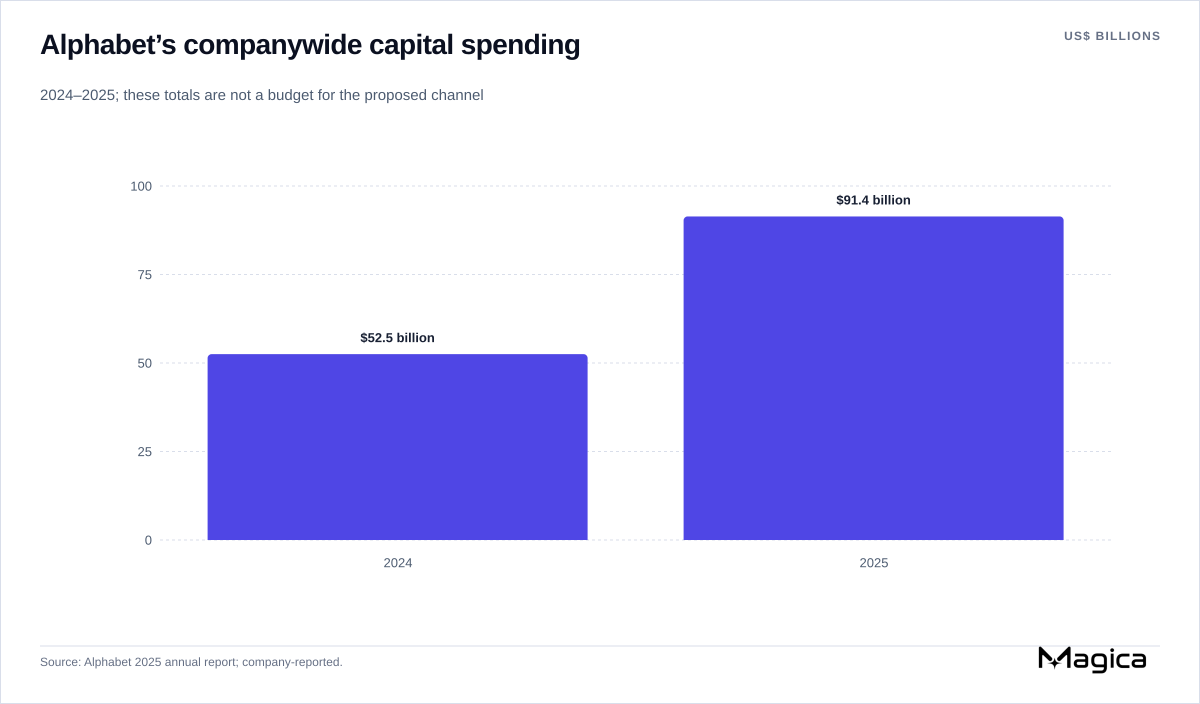
Alphabet’s company-reported capital expenditures rose from $52.5 billion in 2024 to $91.4 billion in 2025. These companywide totals do not establish the proposed channel’s costs or budget. Source: Alphabet annual report.
The application’s advertising mechanism is an ad stitcher: software would insert one or more advertisements into a generated video before delivery. This describes placement of ads, without establishing that those advertisements would themselves be AI-generated or individually customized. It supplies no measured advertising yield, retention result or production cost per video.
The filing also describes a specific infrastructure tradeoff. Prompts could come from a template filled with viewer information, or from a separate language model incorporating recent activity, news, social trends and sports scores. The latter could adapt prompts without developers manually updating templates, and the application says automation could make handling many users easier.
That flexibility has a cost. Google’s description says maintaining the prompt-generation model could increase infrastructure expenses and require additional processing units, including tensor processing units. This is an added prompting workload, separate from the task of generating the videos themselves.
Alphabet’s annual report provides broader constraints: the company says scaling its infrastructure is increasingly limited by power, water and land availability, while specialized AI chips come from a small number of qualified suppliers. Its capital expenditures rose from $52.5 billion in 2024 to $91.4 billion in 2025, primarily reflecting technical infrastructure investment. Those are companywide expenditures; the filing discloses no budget for this channel.
Data access is another condition. The patent contemplates user controls over whether and when information is collected, how it is used and what content is sent. It also describes removing identifying information or generalizing location before storage or use. But it acknowledges that refusing data storage could leave template parameters missing or set to defaults, reducing how closely the output reflects the viewer’s preferences. The proposed customization therefore depends partly on what people allow the system to retain.
A patent analysis says an examiner issued a final rejection and that Google could still amend its claims or appeal. That procedural account could not be independently confirmed in an accessible official record for this article. It does not establish either secured patent protection or abandonment of the idea. Google had not immediately responded to the request for comment described in the November 23 report.
The next consequential evidence would be a working service or trial: what viewers authorize when their likeness and voice are used, whether they keep watching the resulting stories, and the cost of generating and serving those stories relative to revenue.
The Commerce Department added Singapore-based Megaspeed to its Entity List, imposing a licensing barrier on supplies to a longstanding Nvidia customer while allegations of chip diversion remain unresolved.
Google is rolling out optional Wallet access in Search’s AI Mode, with Drive and Gemini connections to follow. The expansion brings existing personal-finance capabilities into Search, while data-use permissions extend beyond the read-only limit on financial actions.
Anthropic has launched Claude Ship for GitHub repositories, combining code review with new agents that fix problems and apply approval policies. Teams retain control through repository rules, while automation adds token costs and can allow changes to merge without human review.
Google’s Gemini API can slice documents, spreadsheets and recordings on its servers and bill for selected content sent to the model. The controls reduce local preparation work, but upload limits, model defaults and the cost of finding relevant material qualify the savings.
OpenAI's OpenWorks pilot offers free AI assistance to eligible small businesses in 20 U.S. communities, pairing paid local partners with a three-month ChatGPT Business trial. It builds on earlier training efforts, but its total budget is undisclosed and typical business returns are unproven.
Nothing plans to unveil Ear (note) on December 8, pairing call-recording earbuds with a case that captures meetings for AI transcription. Existing recording products, uncertain service costs and unresolved privacy details narrow the novelty of the pitch.
Anthropic’s Enterprise Frontier Safeguards beta lets eligible businesses use its most capable Claude models while keeping encrypted safety records in their own cloud accounts. Automated monitoring remains; customers pay cloud costs and review flagged cases.
Hakeem Jeffries promised an investigation after Nvidia reinstated Jensen Huang following Donald Trump’s intervention. Reports that directors excluded interim CEO Colette Kress sharpen questions about the reversal and its national security assurances.
The European Commission has confirmed a leak affecting users of its public learning platform, while the number affected, the wider exposure of staff data and responsibility for the attack remain unresolved.
Maintainers defend continued distribution of the AI penetration-testing framework after its creator withdrew it. Investigations document data theft and cheap automation, but also failed payouts, blocked attacks and safeguards that vary by version.
China Telecom's AI arm has released the 285-billion-parameter Xing4.1-Preview under Apache 2.0, extending its TeleChat model lineage and domestic-compute strategy. Its million-token context and quantized variants widen deployment choices, but mixed benchmarks and incomplete cost disclosures leave its low-cost pitch unproven.
Applied Digital signed an 18-year lease for 150 MW with an unnamed investment-grade hyperscaler. Higher pricing strengthens its contracted revenue book, but financing, power arrangements and construction still stand between the agreement and delivery.
Sarvam Dictate combines speech recognition and text editing for English and 22 Indian languages at ₹0.50 per audio minute. Its company-run benchmarks show fewer character edits than rival APIs, but the advantage varies by language and recording length.
Arm CEO Rene Haas will become SoftBank Group vice chairman on December 1, building on existing roles at its controlling shareholder as Arm expands beyond processor licensing into its own chips. The extension follows a reported Nvidia recruitment approach, but Nvidia has since reinstated co-founder Jensen Huang as CEO.
Trump claimed personal credit for Jensen Huang’s reinstatement after Nvidia received government security assurances. The reversal leaves questions about export controls, presidential influence and Trump’s financial stake unresolved.
Sierra’s $1.75 billion Series F follows reported annual recurring revenue above $400 million. Competitors already offer outcome pricing and agents that act on customer accounts, making reliability and delivery costs central to its $30 billion valuation.
The states allege that Grok and X enabled nonconsensual sexualized images while misleading consumers about safeguards. Their consumer-protection cases seek financial penalties and court orders against SpaceX and its subsidiaries.
Founded in May, Marlowe has raised $277 million at a company-reported $1.15 billion valuation to build inference infrastructure using AMD and Etched chips. Its first deployments will test whether engineering across hardware and software can deliver its promised efficiency gains.

Amazon has agreed to buy Decart’s optimization technology and recruit its founders and engineers after working together on Trainium since 2025. Reports value the deal at $7.5 billion or more, with deferred payments and five-year retention commitments; Amazon has disclosed neither a price nor quantified savings.