Editorial Team
4 min read
Nothing plans to unveil Ear (note) on December 8, pairing call-recording earbuds with a case that captures meetings for AI transcription. Existing recording products, uncertain service costs and unresolved privacy details narrow the novelty of the pitch.
Nothing plans to turn an earbud charging case into a meeting recorder with Ear (note), due to be unveiled on December 8. The consumer hardware maker supplied Bloomberg with an image and initial details of the product, according to an account of the preview. Microphones in the case will capture in-person conversations, while the earbuds will record phone calls when used as a headset.
The pitch puts an AI recording tool into something people already carry. But Nothing already sells recording earbuds, and Plaud has announced earbuds with a recording case. Ear (note)’s value will depend on how well its recording, transcription and assistant features work together—and what buyers must pay to use them.
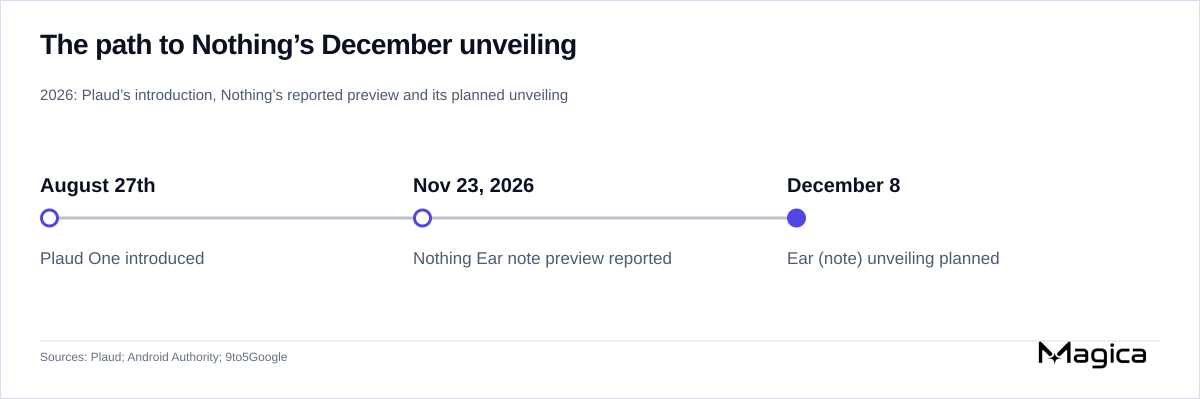
Plaud introduced its competing earbuds before Nothing’s November preview. Nothing’s December 8 unveiling remains scheduled. Source: Plaud.
The case has separate Talk and Record buttons: the former captures the user’s own voice, while the latter enables conversation recording and transcription. Meetings can be recorded with the earbuds still inside the case. A companion app will organize recordings, transcripts and summaries; planned support for multiple AI agents, including Nothing’s own voice assistant, will enable back-and-forth conversations, according to a second account drawing on Bloomberg’s reporting.
Nothing founder Carl Pei, who previously co-founded smartphone maker OnePlus in 2013, is presenting the product as a way to give AI assistants more information about their users without another dedicated gadget. In a social-media post described in that account, he said the goal was to make devices people already wear more intelligent, with AI operating in the background.
Jensen Huang’s return as Nvidia CEO leaves December congressional questioning intact. Lawmakers want evidence behind the board’s security assurance and answers about chip exports and the administration’s involvement.
There is a longer hardware strategy behind that claim. Nothing announced wireless earbuds called Ear (1) as its first product in 2021. In an interview ahead of that launch, Pei said he chose the category for its scope for design differentiation and business potential. He also described an ambition to connect devices more seamlessly. Ear (note) extends that existing audio business into collecting context for AI.
The new hardware is also described as programmable, with buttons and microphones usable to control third-party software and send commands to an assistant on a connected smartphone. That leaves a material distinction to establish at launch: which integrations will actually work, rather than merely being possible.

Plaud’s promotional rendering of Plaud One earbuds and their case; voice-action capabilities are company-reported. Image: Plaud. Source: Plaud.
Nothing’s Ear (3) already has a Talk button, while Ear (3a) can record through the earbuds, according to the preview based on the company’s Bloomberg discussion. The second account also says Ear 3a supports AI transcription and identifies Plaud’s recording-enabled earbud case as a competing product. The new case therefore expands Nothing’s recording options rather than creating the category. Dedicated AI recording and transcription products from Amazon and Plaud are alternatives too.
Plaud, a maker of AI recording devices, offers a concrete comparison. In its November 2 announcement, the company priced its limited Plaud One Explorer Edition at $249.99, including $200 in credits for agent capabilities and other AI features, with shipments expected in the fourth quarter of 2026. That announcement does not establish whether shipments have since begun.
Nothing’s price remains unconfirmed. The preview interprets Pei’s comments as suggesting a subscription in some form; it does not establish the charges or allowances. Plaud’s credits and Nothing’s possible subscription cannot yet support a like-for-like comparison of ongoing costs.
Pei also expects AI gadgets to remain niche products for now, while aiming for Nothing to supply hardware for a variety of agents over time. The second account, citing Bloomberg, says planned smartwatch and smart-glasses products have been delayed without revised launch dates. The wider platform remains an ambition whose execution cannot yet be judged across those devices.
The next decision is whether the combined recorder and earbuds justify their cost and the handling of other people’s conversations. Pei told Bloomberg that Nothing had worked with legal experts, obtained privacy certifications and established a London-based security team, according to the account of his assurances. The account does not name those certifications or set out detailed recording and data-handling safeguards.
The unveiling is expected to clarify specifications, price and availability. Buyers will also need service limits, recurring charges, supported integrations and an explanation of how recordings are stored and shared. Those details will determine whether combining familiar recording functions in an everyday accessory produces a useful alternative to the devices already announced.
The Commerce Department added Singapore-based Megaspeed to its Entity List, imposing a licensing barrier on supplies to a longstanding Nvidia customer while allegations of chip diversion remain unresolved.
Google is rolling out optional Wallet access in Search’s AI Mode, with Drive and Gemini connections to follow. The expansion brings existing personal-finance capabilities into Search, while data-use permissions extend beyond the read-only limit on financial actions.
Anthropic has launched Claude Ship for GitHub repositories, combining code review with new agents that fix problems and apply approval policies. Teams retain control through repository rules, while automation adds token costs and can allow changes to merge without human review.
Google’s patent application describes generating videos from viewing habits, demographics and device context, with optional replicas of the viewer and inserted ads. Existing video tools show parts of the idea are already available; a commercial service and its economics remain unproven.
Google’s Gemini API can slice documents, spreadsheets and recordings on its servers and bill for selected content sent to the model. The controls reduce local preparation work, but upload limits, model defaults and the cost of finding relevant material qualify the savings.
OpenAI's OpenWorks pilot offers free AI assistance to eligible small businesses in 20 U.S. communities, pairing paid local partners with a three-month ChatGPT Business trial. It builds on earlier training efforts, but its total budget is undisclosed and typical business returns are unproven.
Anthropic’s Enterprise Frontier Safeguards beta lets eligible businesses use its most capable Claude models while keeping encrypted safety records in their own cloud accounts. Automated monitoring remains; customers pay cloud costs and review flagged cases.
Hakeem Jeffries promised an investigation after Nvidia reinstated Jensen Huang following Donald Trump’s intervention. Reports that directors excluded interim CEO Colette Kress sharpen questions about the reversal and its national security assurances.
The European Commission has confirmed a leak affecting users of its public learning platform, while the number affected, the wider exposure of staff data and responsibility for the attack remain unresolved.
Maintainers defend continued distribution of the AI penetration-testing framework after its creator withdrew it. Investigations document data theft and cheap automation, but also failed payouts, blocked attacks and safeguards that vary by version.
China Telecom's AI arm has released the 285-billion-parameter Xing4.1-Preview under Apache 2.0, extending its TeleChat model lineage and domestic-compute strategy. Its million-token context and quantized variants widen deployment choices, but mixed benchmarks and incomplete cost disclosures leave its low-cost pitch unproven.
Applied Digital signed an 18-year lease for 150 MW with an unnamed investment-grade hyperscaler. Higher pricing strengthens its contracted revenue book, but financing, power arrangements and construction still stand between the agreement and delivery.
Sarvam Dictate combines speech recognition and text editing for English and 22 Indian languages at ₹0.50 per audio minute. Its company-run benchmarks show fewer character edits than rival APIs, but the advantage varies by language and recording length.
Arm CEO Rene Haas will become SoftBank Group vice chairman on December 1, building on existing roles at its controlling shareholder as Arm expands beyond processor licensing into its own chips. The extension follows a reported Nvidia recruitment approach, but Nvidia has since reinstated co-founder Jensen Huang as CEO.
Trump claimed personal credit for Jensen Huang’s reinstatement after Nvidia received government security assurances. The reversal leaves questions about export controls, presidential influence and Trump’s financial stake unresolved.
Sierra’s $1.75 billion Series F follows reported annual recurring revenue above $400 million. Competitors already offer outcome pricing and agents that act on customer accounts, making reliability and delivery costs central to its $30 billion valuation.
The states allege that Grok and X enabled nonconsensual sexualized images while misleading consumers about safeguards. Their consumer-protection cases seek financial penalties and court orders against SpaceX and its subsidiaries.
Founded in May, Marlowe has raised $277 million at a company-reported $1.15 billion valuation to build inference infrastructure using AMD and Etched chips. Its first deployments will test whether engineering across hardware and software can deliver its promised efficiency gains.

Amazon has agreed to buy Decart’s optimization technology and recruit its founders and engineers after working together on Trainium since 2025. Reports value the deal at $7.5 billion or more, with deferred payments and five-year retention commitments; Amazon has disclosed neither a price nor quantified savings.