Editorial Team
4 min read
The Commerce Department added Singapore-based Megaspeed to its Entity List, imposing a licensing barrier on supplies to a longstanding Nvidia customer while allegations of chip diversion remain unresolved.
The Commerce Department has added Megaspeed, a Singapore-based cloud computing and AI infrastructure company and historically a large Nvidia chip customer, to its Entity List. The move restricts supplies to a business under investigation over whether it helped Chinese customers obtain advanced AI chips subject to US export controls.
The designation ends a prolonged pause in additions to the blacklist. It also puts a government licensing barrier between suppliers and Megaspeed even as Nvidia, the AI-chip supplier at the center of the investigation, continues to list the company as an official cloud partner.
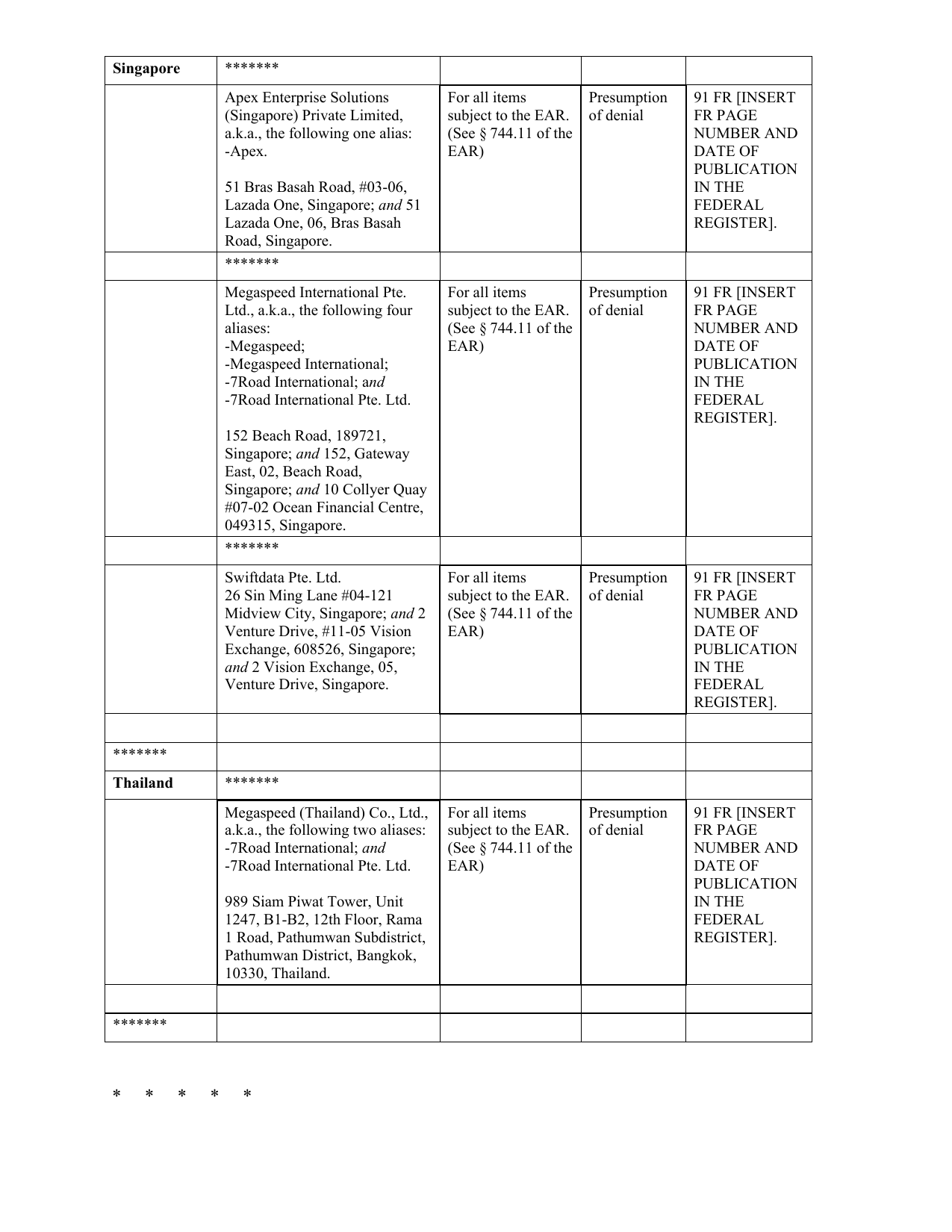
The Commerce Department’s public-inspection filing lists Megaspeed’s license requirement and presumption-of-denial review policy. Source: The Information.
The Commerce Department's Entity List identifies organizations considered national-security risks and restricts their access to technology. Megaspeed's addition appeared in a Monday federal filing, according to a report on the designation.
US companies cannot ship goods, software and technology to listed companies without a license, which is likely to be denied, according to the account of Monday's action. Listed firms can also find it harder to obtain US-origin spare parts, software updates and intellectual-property licenses. The exposure therefore extends beyond purchases of new chips to supplies that can support an existing computing business.
A separate account citing the Federal Register said the list covers companies involved in activities contrary to US national-security or foreign-policy interests. That trade restriction is distinct from a finding that particular shipments broke the law.
Jensen Huang’s return as Nvidia CEO leaves December congressional questioning intact. Lawmakers want evidence behind the board’s security assurance and answers about chip exports and the administration’s involvement.
US authorities have been investigating Megaspeed since 2024 over possible export-control violations involving alleged shipments of Nvidia AI chips to China, the Justice and Commerce departments said, as recounted in the report on the blacklisting. The company's role drew public scrutiny in October 2025, when reporting questioned whether it was helping Chinese customers obtain restricted chips.
Alice Huang, a Chinese businesswoman described in that account as Megaspeed's controlling shareholder and former leader, connects the company to a separate intelligence controversy. Megaspeed has said she left the company in August 2025 and that it conducted lawful business. The company did not immediately respond to a request for comment on the blacklisting.
The same account cited a New York Times report that US authorities had concluded Alice Huang was a Chinese intelligence asset who passed information to Beijing while developing a close relationship with Nvidia's chief executive. Reuters, whose report was carried by StreetInsider, said it could not independently verify the intelligence allegation. China has rejected the accusations as groundless.
Jensen Huang, Nvidia's chief executive, acknowledged an affair in a November 8 statement without naming Alice Huang. He resigned earlier this month and was reinstated on Monday. The coincidence of his return and Megaspeed's listing does not resolve the export-control investigation, which predates the public relationship allegations.
Commerce had last added new entities to the list in October 2025, according to the account of the listing. It also cited earlier reporting that the administration had held back listings for more than 100 companies flagged as national-security risks as it sought to avoid escalating tensions with Beijing. Megaspeed's designation thus comes against a wider slowdown in use of the blacklist.
The delay had drawn criticism from other agencies. A report on the policy dispute, citing earlier Axios reporting, said Treasury Secretary Scott Bessent had confronted Commerce Secretary Howard Lutnick earlier in November about Megaspeed's continued absence from the list.
The same report said the administration supported Jensen Huang's reinstatement, even as Commerce moved to restrict Megaspeed.
The designation also follows a rule announced a week earlier limiting Chinese firms' remote access to advanced AI chips through Southeast Asian data centers, according to that report. The two measures concern different routes to computing resources: supplying a listed company and accessing chips housed abroad. Neither account quantifies how much computing capacity the measures would remove from Chinese customers.
The next question is what investigators can establish about the transactions behind the restrictions. The available reporting does not determine how many of Megaspeed's chip purchases, if any, were diverted to China, identify the ultimate destinations of particular shipments or establish the outcome of the export-control investigation.
The listing changes the conditions under which suppliers can deal with Megaspeed. Evidence about shipment authorizations, recipients and end uses is still needed to establish whether export laws were broken and who was responsible.
Google is rolling out optional Wallet access in Search’s AI Mode, with Drive and Gemini connections to follow. The expansion brings existing personal-finance capabilities into Search, while data-use permissions extend beyond the read-only limit on financial actions.
Anthropic has launched Claude Ship for GitHub repositories, combining code review with new agents that fix problems and apply approval policies. Teams retain control through repository rules, while automation adds token costs and can allow changes to merge without human review.
Google’s patent application describes generating videos from viewing habits, demographics and device context, with optional replicas of the viewer and inserted ads. Existing video tools show parts of the idea are already available; a commercial service and its economics remain unproven.
Google’s Gemini API can slice documents, spreadsheets and recordings on its servers and bill for selected content sent to the model. The controls reduce local preparation work, but upload limits, model defaults and the cost of finding relevant material qualify the savings.
OpenAI's OpenWorks pilot offers free AI assistance to eligible small businesses in 20 U.S. communities, pairing paid local partners with a three-month ChatGPT Business trial. It builds on earlier training efforts, but its total budget is undisclosed and typical business returns are unproven.
Nothing plans to unveil Ear (note) on December 8, pairing call-recording earbuds with a case that captures meetings for AI transcription. Existing recording products, uncertain service costs and unresolved privacy details narrow the novelty of the pitch.
Anthropic’s Enterprise Frontier Safeguards beta lets eligible businesses use its most capable Claude models while keeping encrypted safety records in their own cloud accounts. Automated monitoring remains; customers pay cloud costs and review flagged cases.
Hakeem Jeffries promised an investigation after Nvidia reinstated Jensen Huang following Donald Trump’s intervention. Reports that directors excluded interim CEO Colette Kress sharpen questions about the reversal and its national security assurances.
The European Commission has confirmed a leak affecting users of its public learning platform, while the number affected, the wider exposure of staff data and responsibility for the attack remain unresolved.
Maintainers defend continued distribution of the AI penetration-testing framework after its creator withdrew it. Investigations document data theft and cheap automation, but also failed payouts, blocked attacks and safeguards that vary by version.
China Telecom's AI arm has released the 285-billion-parameter Xing4.1-Preview under Apache 2.0, extending its TeleChat model lineage and domestic-compute strategy. Its million-token context and quantized variants widen deployment choices, but mixed benchmarks and incomplete cost disclosures leave its low-cost pitch unproven.
Applied Digital signed an 18-year lease for 150 MW with an unnamed investment-grade hyperscaler. Higher pricing strengthens its contracted revenue book, but financing, power arrangements and construction still stand between the agreement and delivery.
Sarvam Dictate combines speech recognition and text editing for English and 22 Indian languages at ₹0.50 per audio minute. Its company-run benchmarks show fewer character edits than rival APIs, but the advantage varies by language and recording length.
Arm CEO Rene Haas will become SoftBank Group vice chairman on December 1, building on existing roles at its controlling shareholder as Arm expands beyond processor licensing into its own chips. The extension follows a reported Nvidia recruitment approach, but Nvidia has since reinstated co-founder Jensen Huang as CEO.
Trump claimed personal credit for Jensen Huang’s reinstatement after Nvidia received government security assurances. The reversal leaves questions about export controls, presidential influence and Trump’s financial stake unresolved.
Sierra’s $1.75 billion Series F follows reported annual recurring revenue above $400 million. Competitors already offer outcome pricing and agents that act on customer accounts, making reliability and delivery costs central to its $30 billion valuation.
The states allege that Grok and X enabled nonconsensual sexualized images while misleading consumers about safeguards. Their consumer-protection cases seek financial penalties and court orders against SpaceX and its subsidiaries.
Founded in May, Marlowe has raised $277 million at a company-reported $1.15 billion valuation to build inference infrastructure using AMD and Etched chips. Its first deployments will test whether engineering across hardware and software can deliver its promised efficiency gains.

Amazon has agreed to buy Decart’s optimization technology and recruit its founders and engineers after working together on Trainium since 2025. Reports value the deal at $7.5 billion or more, with deferred payments and five-year retention commitments; Amazon has disclosed neither a price nor quantified savings.