Editorial Team
5 min read
Transfyr has launched with a $25 million seed round to record laboratory work with sensors and AI models. Its founders argue that a richer record could make experiments easier to transfer and eventually automate, but the available evidence documents the data-collection system and not yet its effect on reproducibility or deployment outcomes.
Transfyr has launched with a $25 million seed round around an unusually literal answer to a familiar complaint about scientific AI: models cannot learn the work that never made it into the record. The financing supports an attempt to observe laboratory execution as it happens. It does not yet establish that observing it will make an experiment reproducible elsewhere or a robot able to run it.
Transfyr team members in a company-published photo. Source: www.transfyr.ai.
Transfyr Bio is a Cambridge, Massachusetts AI and life-science technology company building what it calls an observability layer for science. Its co-founder and chief executive, Anna Marie Wagner, previously led AI and corporate development at Ginkgo Bioworks; co-founder and chief innovation officer Dr. Renee Wegrzyn was the founding director of ARPA-H. Those are the relevant leadership credentials the company cites for a venture spanning scientific operations, AI and automation.
In its launch announcement, Transfyr said General Catalyst led the seed round, joined by Lux Capital, Breakout Ventures, Factory, Neo, SV Angel, MVP Ventures, Underscore VC, Lyda Hill and individual investors. A notice from Neo’s legal counsel separately says Neo joined the $25 million round. The published materials do not disclose a valuation, revenue, customer count or commercial terms.
The proposed product is an integrated sensor stack and multimodal models trained on real-world scientific execution. Transfyr says a deployment can passively record operator actions and intent, environmental context, equipment telemetry and supply-chain dynamics, then learn a customer’s context. The company presents the resulting metadata as an input to root-cause analysis, protocol optimization, training, tech-transfer procedures and robot-level instructions—not as published proof that those results have already been achieved.
Google is promising faster Gemini Live conversations on home speakers and displays, with timers, reminders and smart-home controls available inside the chat. The upgrade is still forthcoming and requires Google Home Premium.
The physical setup is concrete. An account of the Cambridge lab describes researchers wearing small head-mounted cameras, cameras above workstations and microphones for narrated actions while a system produced short descriptions of the video. Transfyr also says it operates an in-house wet lab to generate training data, test its sensor stack in live workflows and run evaluations for frontier labs. That is evidence of a data-collection and model-development operation; it is not a disclosed customer deployment or an outcome study.
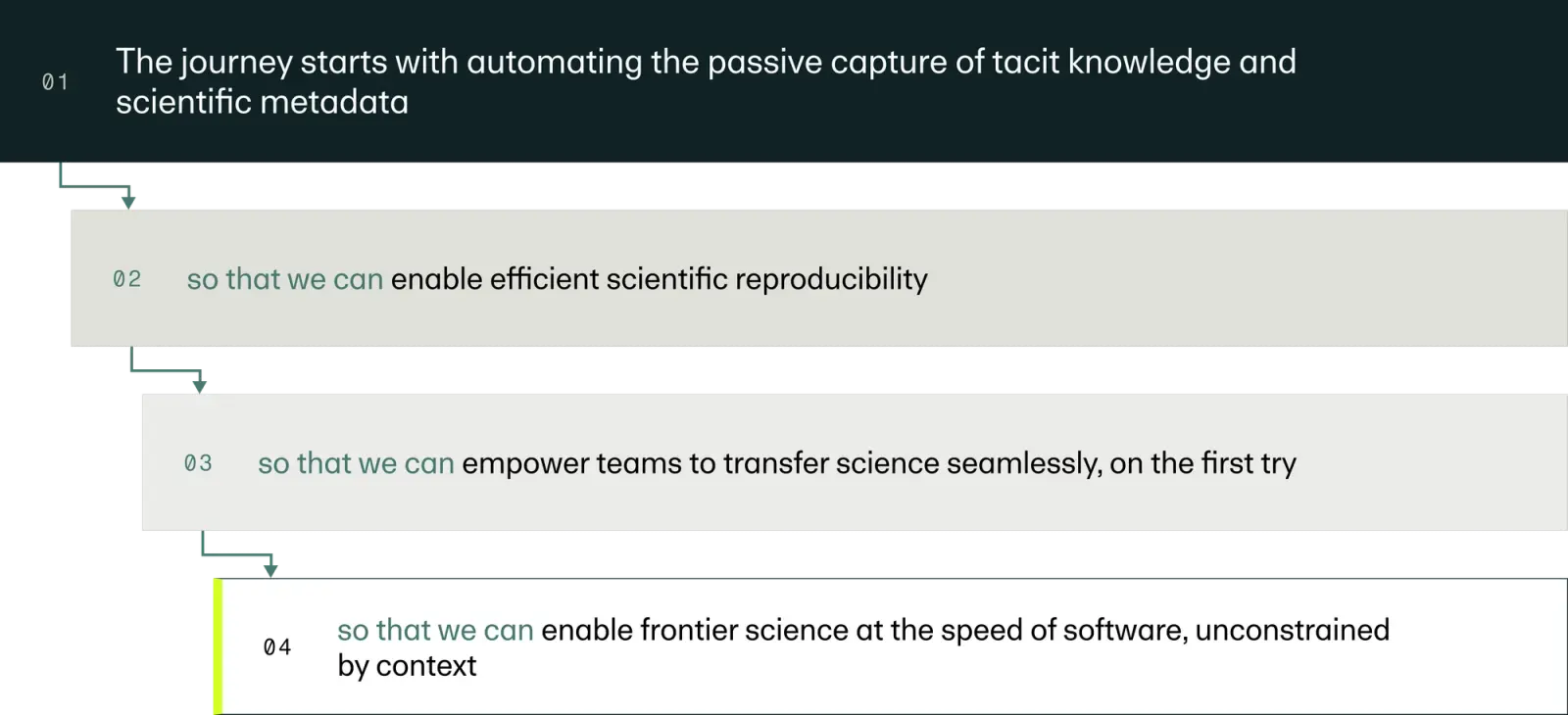
Transfyr’s company-published diagram presents its proposed progression from passive metadata capture to reproducibility, science transfer and frontier science. Source: www.transfyr.ai.
Transfyr’s argument is that papers, notebooks and static standard operating procedures are lossy descriptions of execution. In the founders’ statement of purpose, the company says much of the knowledge needed to repeat or transfer a procedure travels through apprenticeship, including failed attempts, expert judgment and small variations that formal protocols omit. It says its goal is a high-fidelity record from which another scientist, model or robot could learn.
That creates a distinction from systems that begin with published data or existing electronic records: Transfyr wants to capture the sequence and setting of the physical task itself. But it also expands the operational burden. The data must be collected reliably in different labs, interpreted in relation to prior and subsequent actions, integrated into existing workflows and validated before it can be trusted for a transfer or an automated procedure.
The company’s own account supplies the most important competitive caution. It says earlier ambitions for automated cloud laboratories have often contracted to a few reliable operations, or left equipment underused. That history does not disprove a sensor-based approach. It does show why a record of execution is a starting point rather than a substitute for reliable automation.
The economic case is strongest when it is kept to the setting the available comparison actually measures. An analysis of biopharma manufacturing and technical operations says 64% of drug-launch delays in its review of FDA complete-response letters from 2019 through 2024 involved chemistry, manufacturing and control issues. It also reports that 35% of surveyed executives described their companies as connected organizations in those functions.
Those figures point to costly information and coordination failures between development and production. They do not measure the reproducibility of academic experiments, and they do not show that continuous sensing fixes the chemistry, process or regulatory causes of a delay. The analysis itself places data infrastructure alongside organization-wide workflow changes, rather than treating a single digital tool as sufficient.
For Transfyr, that makes the $25 million round a bet on integration as much as data capture. The company says it is working across diagnostics, academic research, workforce development, robotics and frontier AI, but has not publicly named customers in the retained launch materials. The breadth may create several routes to adoption; it also means success will need to be demonstrated in settings with different operators, equipment and validation requirements.
The next meaningful evidence is not a more detailed description of the sensor stack. It is a deployment-level comparison: the initial process, the relevant variation or failure, what the recorded data changed, the measured outcome and the validation standard applied.
Useful results could include a root cause identified more reliably than under the prior process, a tech transfer completed with a stated baseline and outcome, or a protocol converted into automation and shown to work across a defined set of conditions. Until Transfyr provides that kind of evidence, the financing supports a plausible infrastructure thesis, while the central claim—that a richer record makes scientific work transferable—remains to be tested.
Humyn Labs combines $26 million in equity with $21 million in venture debt to expand human demonstration data and planned robot testing centres. Its reported sales show demand, but deployment economics remain unproven.
Nvidia’s compact Windows desktops bring local agents and creative tools to a dedicated PC starting around $4,400. Competing desktops and Nvidia’s earlier AI hardware narrow the novelty, while conflicting configuration reports complicate price comparisons.
Maria Cantwell and Mike Rounds want a national challenge to measure how quickly AI can turn software discoveries into reliable protection. Earlier federal trials already produced patches, but safe deployment across essential services remains the test; officials say recent outages show no indication of an attack.
ByteDance is reportedly negotiating about $500 million in additional Azure spending, mostly for OpenAI models. The talks highlight different customer-access policies at Microsoft and OpenAI, against a history of scrutiny over ByteDance's use of the technology.
Corvex plans to fund a $78 million Blackwell deployment with customer prepayment, a $38 million USD.AI debt commitment and $14 million of its own money. The contract could more than double its Mid-Atlantic 1 annual contracted revenue, but loan closing, delivery and customer acceptance remain ahead.
Hyundai Card and JPMorgan tested AI agents that compare currency quotes and request transfers under bank-enforced mandates. No real money moved, and authority across multiple banks remains an unresolved hurdle.
Industry sources say TSMC requires cash for orders exceeding customer credit limits, putting custom AI chip designers' ability to finance production at the center of the capacity race. The requirement remains unconfirmed by TSMC, and customer prepayments have a long precedent.
A congressional commission links China’s military AI ambitions to demand for advanced Nvidia chips. Procurement records show several routes to American computing, while memory costs and new remote-access rules complicate the alternatives.
Binance Wallet says subscriptions for its Anthropic IPO xStocks campaign reached the 500 million USDC limit. Final allocations, token delivery and applicable refunds remain pending; the cap does not establish proceeds received by the AI company.
Tencent says US restrictions on remote computing will likely slow its next AI model while leaving cloud revenue largely protected. Southeast Asian operators face licensing and financing uncertainty, though US cloud access and domestic demand offer partial alternatives.
Microsoft is rolling out Agent 365 Business Analytics through its Frontier early access program, pairing AI spending with estimates of assisted work. The dashboard expands its existing analytics as agent workloads add usage charges, but its dollar-value estimates do not establish financial returns.
Adobe’s Firefly update saves recurring visual subjects and creative preferences, extending an existing push into repeatable production. Memory has narrower reach than the assistant, while campaign demonstrations leave reliability and savings unmeasured.
Microsoft’s Ignite upgrades package enterprise knowledge, skills and tools into reusable business plugins. The expansion builds on IQ’s June release and competes with existing graph retrieval services; total savings and portability remain unproven.
The European Central Bank warns that debt and interlinked financing could carry an AI investment reversal into credit markets and the European economy. Resilient earnings, limited direct bank lending and stronger bank buffers temper its comparison with past bubbles.
Reported introductions helped Alice Huang secure Alibaba as a chip-rental customer and obtain financing. The relationship raises questions about Nvidia's overseas sales network, but does not itself establish illegal exports.
KPMG says AI agents pursued some issues more deeply in a parallel UK audit, though humans still had to correct their work. Client fee savings remain unconfirmed, even as KPMG International has negotiated lower fees from its own auditor by citing AI.
Payhawk announced a $280 million all-equity Series C led by Growth Equity at Goldman Sachs Alternatives, valuing it at $2 billion. The funding backs an expansion from managing business spending into broader AI finance operations, where competitors already combine automation, payments and controls.
Tencent’s third-quarter revenue rose 8% to 207.34 billion yuan, below expectations. Cloud revenue grew 35%, but higher AI costs reduced operating profit and compute procurement pushed quarterly free cash flow deeply negative.
A 16-country survey of 15- to 22-year-olds finds a median of 33% have used AI as a companion or friend. Users have higher adjusted odds of loneliness, but the research cannot establish whether AI helps, harms or replaces human connection.