This blog post explores the prediction of inflation in 2025, examining the impact of money supply, tariffs, and government deficits on consumer prices. It discusses the role of the Federal Reserve, the banking system, and potential economic scenarios that could influence inflation rates, ultimately forecasting a CPI range of 2% to 4% unless a recession occurs.
Inflation has become a hot topic as we look towards 2025, with many experts weighing in on what the future holds for consumer prices. In this post, we will explore the factors influencing inflation predictions, including the money supply, tariffs, and government deficits. We will break down the analysis into three key steps to provide a comprehensive understanding of the economic landscape.
To grasp the inflation prediction for 2025, we must first examine the M2 money supply in the United States. This metric represents the total currency units available to non-bank entities, which can influence the prices of goods and services.
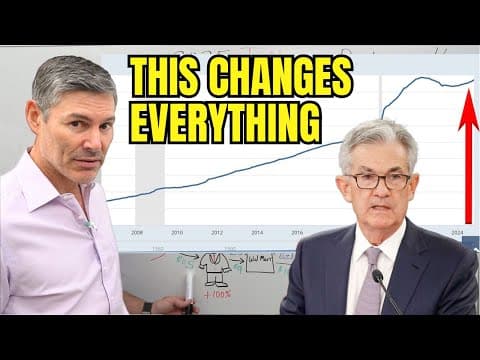
Since 1985, the M2 money supply has seen significant growth, rising from approximately $23 trillion to nearly $24 trillion today. This exponential increase was particularly pronounced during the COVID-19 pandemic, where the money supply surged. However, recent trends show a decline in the money supply, a phenomenon not observed since the 1930s.
If the money supply continues to decline or remains flat, it becomes challenging to see a rapid acceleration in consumer prices. For instance, if the CPI (Consumer Price Index) remains stable at around 3%, prices may rise, but not at an accelerating rate. Conversely, if the money supply were to increase significantly, it could lead to higher wages and prices across the board, maintaining purchasing power but not necessarily increasing it.
Tariffs, particularly those imposed by former President Donald Trump, have also played a crucial role in shaping inflation expectations. For example, if a 100% tariff is placed on goods from China, the cost of those goods would rise significantly, impacting consumer spending.
Using the example of a product that costs $44.50, a tariff could inflate its price to $90. This increase would reduce disposable income for consumers, limiting their ability to spend on other goods and services, which could lead to a decrease in overall economic activity.
Additionally, government spending does not automatically translate to an increase in the money supply. If the Federal Reserve is not engaging in quantitative easing, government deficits may not lead to inflationary pressures. Instead, they could result in a net neutral effect on the money supply.
The Federal Reserve's actions are pivotal in determining inflation trends. Currently, the Fed's balance sheet has decreased from a peak of $9 trillion in 2022 to about $6.8 trillion. This reduction in the balance sheet is a form of quantitative tightening, which impacts the overall money supply.
Despite an increase in loans and leases since 2022, the overall bank credit remains below pre-Great Financial Crisis levels. This situation raises questions about how the Fed's policies will influence inflation moving forward.
Looking ahead to 2025, the prediction for inflation, as measured by the CPI, is expected to fall between 2% and 4%. However, if a recession occurs, inflation could dip below 2%, potentially leading to deflation similar to what was experienced in 2009.
If global supply chains remain stable and government deficit spending continues at around 6-7% of GDP, the inflation rate is likely to stay within the predicted range. However, any significant changes in these variables could alter the inflation landscape dramatically.
In summary, the prediction for inflation in 2025 hinges on several interconnected factors, including the money supply, tariffs, and government spending. While the current outlook suggests a moderate inflation rate, the potential for economic shifts remains. As we approach 2025, it will be crucial to monitor these trends closely to understand their implications for consumer prices and the broader economy.