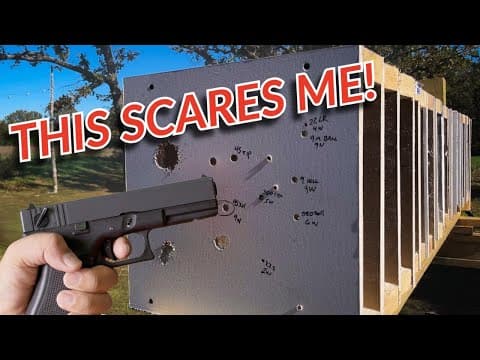
In a fascinating and thorough experiment, 18 miniature sheetrock walls were constructed to determine how many walls different types of bullets can penetrate. This test provides valuable insights into the penetration capabilities of various calibers and ammunition types, ranging from small .22 short rounds to powerful .50 caliber bullets and 12-gauge shotgun shells.
The Setup
The test involved shooting bullets from various firearms through a series of 18 sheetrock walls arranged in a line. The goal was to observe how many walls each bullet could pass through before stopping.
Testing Different Calibers and Ammunition
.22 Short
- Energy: Approximately 70 ft-lbs
- Result: The .22 short bullet penetrated through two walls. This was surprising as it was initially predicted to penetrate only one or possibly none.
.22 Long Rifle (CCI Stinger)
- Result: The .22 long rifle round penetrated through four walls and lodged in the fifth. This was more than the initial prediction of three walls.
.380 ACP (Smith & Wesson Bodyguard)
- Muzzle Energy: About 200 ft-lbs
- Ammunition Types Tested: Full metal jacket and RIP (Rapidly Invasive Projectiles) rounds
- Results:
- Full metal jacket penetrated six walls.
- RIP rounds penetrated five walls but did not expand as expected.
9mm (Glock 43X)
- Ammunition Types Tested: Ball and hollow point
- Results:
- Ball round penetrated nine walls, stopping at the tenth.
- Hollow point also penetrated nine walls but exited the side of a wall due to tumbling.
.45 ACP (1911)
- Muzzle Energy: Around 350-400 ft-lbs
- Ammunition Types Tested: Ball and RIP rounds
- Results:
- Ball round penetrated five walls.
- RIP round penetrated six walls.
- Observation: Despite the larger caliber, the .45 ACP did not outperform the 9mm in wall penetration.
12 Gauge Shotgun
- Ammunition Types Tested: Birdshot, double aught buckshot, and slug
- Energy:
- Birdshot: Approximately 1,200 ft-lbs
- Buckshot: Approximately 1,900 ft-lbs
- Slug: Approximately 2,500 ft-lbs
- Results:
- Birdshot penetrated two walls, creating a large hole and significant dust.
- Buckshot penetrated eight walls.
- Slug penetrated nine walls.
- Additional Notes: The birdshot round was noted as an excellent home defense round due to limited penetration.
.223 Remington and .50 Caliber
- .223 Remington penetrated nine walls.
- .50 caliber hollow point penetrated 15 walls, mushrooming well and tumbling sideways.
Observations and Insights
- The .22 short and .22 long rifle rounds surprised with their penetration capabilities.
- The .380 ACP rounds, despite having more muzzle energy than the .22, did not penetrate as many walls as the 9mm rounds.
- The 9mm rounds, both ball and hollow point, showed excellent penetration, going through nine walls.
- The .45 ACP rounds underperformed compared to the 9mm, penetrating fewer walls.
- The 12 gauge shotgun rounds varied widely, with birdshot penetrating the least and slugs penetrating up to nine walls.
- The .50 caliber round demonstrated the highest penetration, going through 15 walls.
Practical Implications for Home Defense
- The 12 gauge birdshot round was highlighted as an ideal home defense round due to its limited penetration, reducing the risk of over-penetration and collateral damage.
- Larger calibers and higher energy rounds penetrate more walls, which could be a concern in residential settings.
- The choice of ammunition should consider the balance between stopping power and the risk of penetrating multiple walls.
Fun and Safety Notes
- The test included humorous anecdotes, such as accidental discharges and challenges with aiming certain firearms.
- Safety was emphasized, with reminders about proper gun handling.
Conclusion
This comprehensive test reveals the varying penetration capabilities of different bullets through sheetrock walls. The results challenge some common assumptions, such as the .45 ACP being superior in penetration to the 9mm. The findings are valuable for understanding bullet behavior in home defense scenarios and highlight the importance of selecting appropriate ammunition to balance effectiveness and safety.
Whether for educational purposes or practical considerations, this test provides a detailed look at how bullets interact with common building materials, offering insights for gun owners, enthusiasts, and safety professionals alike.