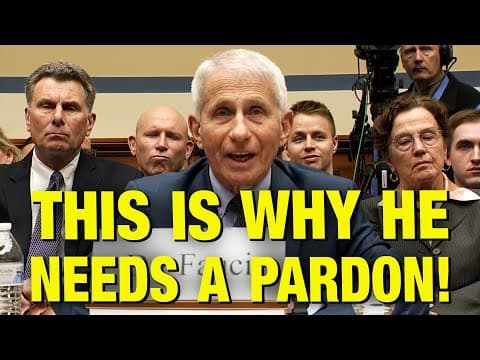
This blog post delves into the controversies surrounding Dr. Anthony Fauci's handling of the COVID-19 pandemic, highlighting contradictions in his statements, the implications of his recommendations, and the broader impact on public health and trust in science.
The COVID-19 pandemic has been a defining moment in modern history, and at the forefront of the United States' response has been Dr. Anthony Fauci. While many view him as a trusted authority, others have raised serious concerns about his actions and statements throughout the crisis. This post aims to dissect the contradictions, alleged misrepresentations, and the broader implications of Fauci's guidance during the pandemic.
Dr. Fauci has faced accusations of lying and misrepresenting scientific data. Critics argue that he has provided inconsistent information regarding vaccination efficacy, mask mandates, and herd immunity. A compilation of his statements reveals a pattern of contradictions that has fueled public skepticism.
One of the most contentious points has been Fauci's claims about the effectiveness of vaccines in preventing COVID-19 transmission. Initially, he stated that vaccinated individuals would not need to worry about serious illness or transmitting the virus. However, as the pandemic progressed, it became evident that vaccinated individuals could still contract and spread the virus. This shift in messaging has led many to question the reliability of his statements.
Fauci's assertion that vaccinated people had an extremely low chance of transmitting the virus was later contradicted by evidence showing that vaccinated individuals were indeed capable of spreading COVID-19. Critics argue that this inconsistency undermined public trust in health guidelines.
Fauci's guidance on mask-wearing has also been a source of confusion. He initially suggested that masks might provide a psychological benefit during outbreaks but later emphasized their importance in preventing transmission. His statement that masks work at the margins—suggesting only a 10% effectiveness—left many questioning the rationale behind strict mask mandates.
Another area of concern has been Fauci's shifting targets for achieving herd immunity. He initially suggested that a vaccination rate of 50% would suffice, only to later raise the threshold to 60%, then 70%, and eventually 80%. This evolving narrative has led to accusations that he was not being straightforward with the American public about the realities of herd immunity.
The decision to close schools during the pandemic has had lasting repercussions on children's mental health and education. Fauci's recommendations regarding school closures have been criticized as overly cautious, with many arguing that the negative effects on children were not adequately considered. The U.S. Surgeon General has labeled the mental health crisis among adolescents as an urgent public health issue, highlighting the consequences of prolonged school closures.
The origins of COVID-19 have been a topic of intense debate, particularly the theory that the virus may have leaked from a laboratory in Wuhan, China. Fauci has denied that the National Institutes of Health (NIH) funded gain-of-function research at the Wuhan Institute, a claim that has been challenged by emerging evidence. Critics argue that his denial may constitute a significant misrepresentation of the facts, raising questions about accountability and transparency.
As the pandemic continues to evolve, the actions and statements of public health officials like Dr. Fauci remain under scrutiny. The contradictions in his messaging, the implications of his recommendations, and the broader impact on public trust in science and health authorities are critical issues that need to be addressed. The call for accountability is not just about one individual; it reflects a broader need for transparency and honesty in public health communication.
In a time when trust in science is paramount, it is essential for leaders to provide clear, consistent, and truthful information to the public. The lessons learned from this pandemic will shape future responses to public health crises, making it imperative that we critically examine the actions of those in positions of authority.