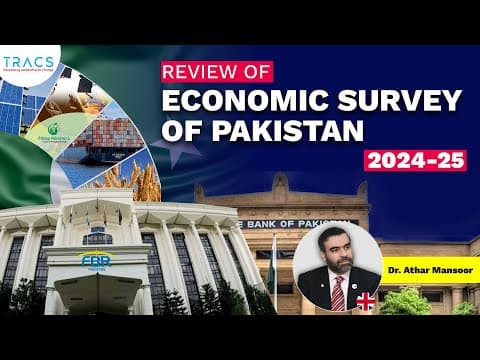
The Economic Survey of Pakistan 2024-25 presents a positive outlook with achievements in macroeconomic stabilization, inflation control, and fiscal performance. However, critical analysis reveals significant challenges, including modest GDP growth, agricultural decline, and structural issues that require urgent reforms for sustainable development.
The Economic Survey of Pakistan is an essential document released annually by the Ministry of Finance, covering the fiscal year from July of one calendar year to June of the next. The latest survey, released on June 9, 2025, encompasses data from July 2024 to April 2025, with some figures extending to May 27, 2025. This review aims to analyze the survey's portrayal of Pakistan's economic performance, highlighting both achievements and persistent challenges.
The 2024-25 Economic Survey presents an optimistic outlook for Pakistan's economy, emphasizing stabilization and reform achievements. Key areas highlighted include macroeconomic stabilization, inflation control, fiscal performance, and external account improvements. However, a critical examination reveals underlying issues that could temper this positive narrative.
The government claims to have achieved macroeconomic stabilization, with real GDP growth reported at 2.68% and a medium-term projection of 5.7%. Per capita income also saw an increase of 9.7%, reaching $1,824.
Inflation has dramatically decreased, reaching a six-decade low of 0.3% in April 2025, down from 17.3% the previous year. The Consumer Price Index (CPI) for July-April was reported at 4.7%, significantly lower than the 26% recorded in the same period of the previous fiscal year. The government attributes this success to monetary tightening, fiscal consolidation, stable food supplies, favorable global commodity prices, and base effects.
The survey highlights a primary surplus of 3% of GDP for July-March, up from 1.5% the previous year. A fiscal surplus of 1.896 trillion PKR (1.7% of GDP) was achieved for the quarter from July to September, marking the first such achievement in 24 years. Total revenues surged by 36.7%, and the fiscal deficit decreased to 2.6%.
The government reported an unprecedented current account surplus of $1.9 billion from July to April, attributed to record foreign remittances of $31.2 billion. Foreign exchange reserves increased to $16.64 billion as of May 27, 2025.
The survey notes improved investor confidence, with Fitch Ratings upgrading Pakistan's sovereign credit rating from CCC to B- with a stable outlook. The Pakistan Stock Exchange also saw impressive returns, with the KSE-100 index growing by 50.2% during the period.
The International Monetary Fund (IMF) acknowledged Pakistan's economic improvements, approving $1.4 billion under the Resilience and Sustainability Facility for climate resilience.
Despite the positive framing, a deeper analysis reveals significant challenges that could hinder sustainable growth.
The actual GDP growth of 2.68% falls short of the ambitious medium-term projection of 5.7%. This gap indicates that substantial reforms are necessary to achieve higher growth rates, suggesting that the projected growth may be more aspirational than realistic.
Pakistan's agricultural sector grew by only 0.56%, with livestock contributing positively while important crops like cotton, wheat, and rice saw declines. This contraction highlights vulnerabilities in agriculture, which is crucial for food security.
The industrial sector showed overall growth of 4.77%, but large-scale manufacturing contracted by 1.5%. Persistent structural bottlenecks have elevated input costs, negatively impacting key sectors, including mining and quarrying, which also contracted by 3.4%.
The trade balance widened by $3.3 billion, with imports growing by 11.8% compared to a mere 6.8% growth in exports. This indicates ongoing structural challenges in trade and competitiveness, as reliance on remittances continues to overshadow export capacity.
The financial account recorded a net outflow of $1.6 billion, reversing the previous year's net inflow due to increased government debt repayments. Foreign Direct Investment (FDI) also saw a slight decrease, indicating that investment-friendly reforms have yet to yield significant results.
Public debt remains substantial at approximately 76 trillion PKR, with the average maturity of domestic debt extended. Despite a reduction in the policy rate, the weighted average lending rate remains high at 15%, indicating a challenging borrowing environment for businesses.
Pakistan faces significant human capital challenges, with a literacy rate of only 60.65% and substantial disparities between urban and rural areas. Approximately 38% of children are out of school, with particularly dire situations in Sindh and Balochistan, where only 31% of children attend school.
While the Economic Survey of Pakistan 2024-25 presents a positive outlook, a critical reading reveals that significant structural reforms are necessary to address core issues in agriculture, manufacturing, trade, and human capital. Without these reforms, the long-term economic benefits may remain elusive, hindering Pakistan's path toward equitable and sustainable growth. The government must prioritize these challenges to ensure that economic gains translate into broad-based improvements for all citizens.