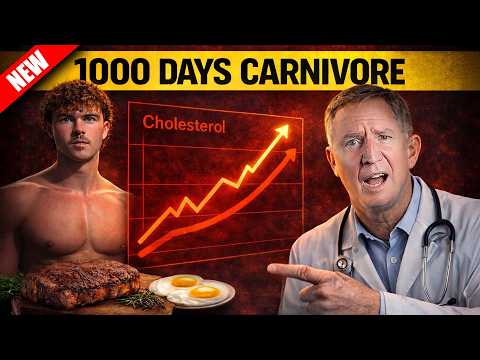
After 1000 days on a carnivore diet consisting only of meat and eggs, a man named Max German from New Zealand shared his blood test results. Dr. Eric Westman reviews these results, finding that despite common concerns, Max's testosterone, liver function, kidney function, iron levels, and cholesterol markers are within healthy ranges, challenging many mainstream beliefs about the diet's risks.
After spending over 1000 days on a carnivore diet, which consists solely of meat and eggs with no fruits or vegetables, a man named Max German from New Zealand shared his blood work results. The mainstream narrative often suggests that such a diet would lead to poor health outcomes, including kidney failure, high "bad" cholesterol, and other metabolic issues. Dr. Eric Westman, a physician who reviews nutritional misinformation, analyzed Max's blood tests to see if these concerns hold true.
Max's testosterone level was measured at 25.6 nanomoles per liter (738 nanograms per deciliter), which is well within the normal reference range of 8.7 to 29 nanomoles per liter (251 to 836 nanograms per deciliter). Despite a relatively low food intake at times, his testosterone remained high.
Dr. Westman notes that many people experience hormonal issues when losing weight due to insufficient saturated fat intake, which is essential for hormone production. Carnivore diet followers often maintain high testosterone levels even at low body fat percentages. This contrasts with other weight loss methods, such as GLP-1 shots, where metabolic health may not be optimized despite fat loss.
Max also shared his follicle-stimulating hormone (FSH) and luteinizing hormone (LH) levels, which were within normal ranges, indicating natural testosterone production rather than steroid use. This counters accusations that he might be using anabolic steroids.
Concerns about the carnivore diet causing liver stress due to low carbohydrate intake and increased glucose production were not supported by Max's liver markers. Four liver markers were tested:
Dr. Westman explains that fatty liver disease is commonly caused by excess carbohydrates and calories, not dietary fat. Diets like carnivore, low-carb, or keto can actually reverse fatty liver.
Despite the high protein intake typical of the carnivore diet, Max's kidney function tests were normal:
Dr. Westman notes that high protein intake does not necessarily harm kidney function in healthy individuals.
Max's ferritin, a measure of stored iron, was 254 micrograms per liter (normal 20-320). Iron is crucial for oxygen transport in red blood cells. Both low and excessively high iron levels can cause health problems, but Max's levels were optimal.
Complete blood count parameters such as hemoglobin, red and white blood cells were also within healthy ranges.
Max is not concerned about having high LDL cholesterol, citing studies that show no correlation between high LDL and heart disease. For example, a 2009 study in the American Heart Journal found that about 50% of patients hospitalized with severe heart complications had low LDL levels.
Dr. Westman discusses the historical context of the cholesterol-heart disease hypothesis, which originated from studies funded by the sugar industry and research by Ancel Keys. Keys selectively reported data from 7 out of 22 countries to support a link between saturated fat and heart disease, ignoring data from 15 countries that showed no such link.
Despite this flawed foundation, the cholesterol hypothesis remains prevalent, partly due to the widespread use of statin drugs, which lower LDL cholesterol and generate over $16 billion annually.
Books such as "Good Calories, Bad Calories" by Gary Taubes and "The Big Fat Surprise" by Nina Teicholz provide detailed accounts of this history and challenge conventional dietary guidelines.
Max German's blood work after 1000 days on a carnivore diet shows that many common concerns about the diet may be unfounded. His hormonal, liver, kidney, iron, and cholesterol markers are all within healthy ranges. Dr. Westman appreciates Max's transparency in sharing his health data publicly and hopes this review helps others understand the potential effects of a carnivore diet.
For those interested in further content, Dr. Westman encourages subscribing to his channel and joining his YouTube membership for exclusive Q&A sessions.
This case highlights the importance of individualized nutrition and the need to critically evaluate mainstream dietary beliefs with scientific evidence and real-world data.