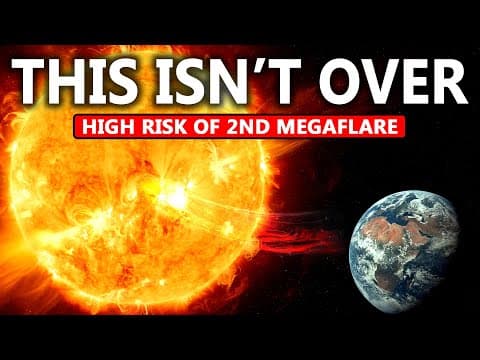
A recent solar storm impacted Earth with near Carrington-class intensity but caused limited disruption due to a favorable magnetic field orientation. The storm featured record-level geomagnetic activity and radiation storms unseen since 2003. However, increased solar activity and sunspot growth suggest another significant solar flare could occur within days, potentially causing more severe effects on Earth's technology and environment.
Geophysicist Stefan Burns reports that Earth recently experienced a historic solar storm impact, which could have been far more severe if not for a fortunate magnetic field configuration. This event was one of the strongest solar storms in decades, rivaling those of 2003 and 1989, but the planet was spared widespread damage due to the nature of the interplanetary magnetic field.
The solar storm arrived with a velocity of approximately 1200 kilometers per second, sustaining around 1000 kilometers per second for an extended period. This storm's magnetic field strength was near Carrington-class levels, a classification reserved for the most intense solar storms.
The key factor that prevented catastrophic damage was the positive orientation of the interplanetary magnetic field's vertical component (BZ). A positive BZ component inhibits the magnetic reconnection process with Earth's magnetic field, thereby reducing the energy injected into Earth's plasmasphere and limiting geomagnetic volatility.
Had the BZ component been negative, the storm would have likely caused the strongest geomagnetic disturbances since 1989, including widespread power grid failures and auroras visible at the equator.
The storm was associated with a 1.9 X-class solar flare, notable for its long duration and high energy output. The energy released by solar flares scales logarithmically with duration, meaning a long-lasting flare releases significantly more energy than a short one of similar intensity.
Recent observations show increased solar activity, including crackling electrical activity and new sunspot growth across the sun's Earth-facing side. This heightened activity suggests the likelihood of another significant solar flare within the next 24 to 72 hours.
These indices, similar to the KP index, measure geomagnetic activity based on magnetic field fluctuations detected by a global network of magnetometers. During the storm's initial impact, the HP30 index surged to 10, exceeding the KP index's maximum of 9, indicating extreme geomagnetic activity.
The KP index reached G5 plus levels for an hour during the initial shock wave, reflecting severe geomagnetic storm conditions. The storm's intensity fluctuated, dropping to G2 levels before rising again to G4, and then gradually declining as the storm subsided.
Solar wind velocity jumped from typical values around 350-400 kilometers per second to over 1000 kilometers per second during the storm. The density of solar wind particles dropped below one particle per cubic centimeter in the storm's wake, a condition associated with increased earthquake activity and ionospheric disturbances.
The magnetic field strength peaked at approximately 90 nanoTesla, an extremely rare and intense value comparable to Carrington-level events. This peak was accompanied by a positive BZ component, which mitigated the storm's potential damage.
The storm triggered an S4 radiation storm, the strongest since the 2003 Halloween storms. Although it did not reach the highest S5 category, it represented a significant increase in proton flux, affecting satellite operations and radiation exposure levels.
If the interplanetary magnetic field had been strongly negative, the storm would have caused:
The positive BZ component prevented these outcomes, making the recent storm a near-miss in terms of technological impact.
Solar wind velocity remains elevated at around 900 kilometers per second, though geomagnetic activity is gradually decreasing to G1 and G2 levels. The sun continues to exhibit increased activity, with new sunspot growth and solar flux pushing out across the Earth-facing side.
This suggests the possibility of another major solar flare, potentially a high M-class or X-class long-duration event, within the next few days. Such an event could produce a second significant impact on Earth, possibly with a less favorable magnetic field orientation.
Stefan Burns also notes planetary alignments and mentions a prophetic dream involving planets and solar activity, hinting at possible significant events in February. While speculative, this adds an intriguing dimension to ongoing solar monitoring.
The recent solar storm was a historic event that tested Earth's magnetic defenses. Thanks to a fortunate magnetic field configuration, the planet avoided severe technological disruptions. However, increased solar activity and sunspot growth indicate that another major solar flare could be imminent, underscoring the importance of continued monitoring and preparedness for potential space weather impacts.
Understanding these solar phenomena is crucial for protecting modern infrastructure and maintaining communication and navigation systems in the face of powerful solar storms.