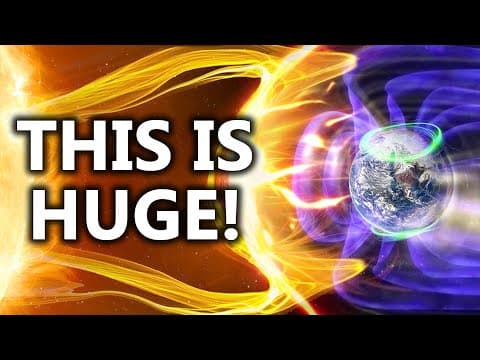
A powerful solar flare combined with a co-rotating interaction region is expected to trigger a severe geomagnetic storm (G4) on Earth, causing strong auroras, potential technological disruptions, and increased geophysical activity. Concurrently, unprecedented electromagnetic signals suggest a possible major earthquake in the coming days, highlighting a critical period of planetary energy shifts.
Geophysicist Stefan Burns reports a significant solar event that is about to impact Earth, marking the beginning of a massive energy shift. On January 18th, coinciding with the new moon, the Sun emitted a powerful 1.9X class solar flare. This solar storm is rapidly approaching Earth and is expected to combine with an existing solar wind structure known as a co-rotating interaction region (CIR). This combination is forecasted to cause a severe geomagnetic storm with widespread effects.
The solar flare launched from the Sun will merge with the CIR, a zone of higher density plasma followed by low-density plasma. This interaction will condense the solar storm further, creating a complex structure that will sweep past Earth, triggering significant geomagnetic volatility.
Space weather organizations such as NASA and NOAA predict the storm will impact Earth on the night of January 19th or early morning January 20th (Eastern Time and Universal Time respectively). The expected KP index is 8, indicating a G4 geomagnetic storm, which is classified as severe on a scale from G1 to G5. This storm is just one step below the highest possible rating and could potentially escalate to a G5.
The storm will trigger strong auroras across the United States and Europe, especially in high latitude regions. The aurora is expected to be visible tonight and tomorrow night, with a distinctive curling pattern as shown in forecast animations.
The geomagnetic storm will cause actual swings in Earth's magnetic field, energizing the planet's geophysical system. This includes:
These changes can lead to more volatile weather systems, increased earthquake activity, and volcanic eruptions.
Power grids, telecommunications, and satellite communications may experience malfunctions during this powerful geomagnetic storm. Such technological issues are common during severe space weather events, so awareness and preparedness are advised.
Before the geomagnetic storm arrives, Earth is already experiencing a proton radiation storm due to highly energized particles accelerated to near light speeds by the solar flare's plasma push. These particles arrive ahead of the main storm, continuously bombarding Earth.
Earth is currently in an S3 radiation storm on a scale from S1 to S5. This is significant, as typically about 10 S3 storms occur per solar cycle. Measurements show:
The radiation storm may intensify further before the solar storm impact, possibly reaching S4 levels, which is uncommon but not unprecedented.
The current planetary geometry is critical, with the new moon, Venus, Mercury, Mars, Pluto, Jupiter, and the interstellar object 3I Atlas all positioned in ways that may influence Earth's energy systems. Additionally, unusual anomalies in Earth's electromagnetic resonances have been detected.
Data from EarthEvolution.com shows highly anomalous signals in the 0 to 40 Hertz range of Earth's background electromagnetic field. These signals have persisted for nearly three days, an unprecedented duration since monitoring began in 2020.
Such signals are often precursors to high magnitude earthquakes (magnitude 7+), typically appearing days to a week before the event. The current signals suggest a major earthquake could be imminent, possibly between January 20th and 23rd, coinciding with Mercury's superior conjunction.
The region near Tomsk, Russia, and Central Asia has seen increased magnitude 5+ earthquakes over the past two months. This area is known for potentially very high magnitude earthquakes (7 or 8+), making it a key location to monitor.
California is also under observation due to regional space weather models indicating potential risks.
The combination of a severe geomagnetic storm, an ongoing proton radiation storm, unprecedented electromagnetic resonance signals, and recent earthquake activity points to a period of significant planetary energy shifts. These events may lead to visible auroras, technological disruptions, and possibly major geophysical events such as earthquakes.
Residents in high latitude regions should watch for auroras tonight and tomorrow. Those in earthquake-prone areas, especially Central Asia and California, should remain alert for seismic activity in the coming days.
For continuous updates and detailed data, visit EarthEvolution.com/energy-analytics or follow geophysicist Stefan Burns' daily video updates on space weather and planetary conditions.
Stay informed and prepared during this critical time of energetic change on Earth and beyond.