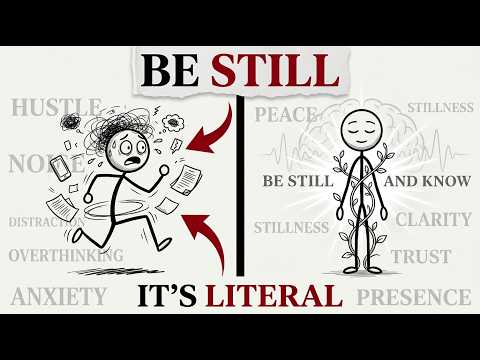
The biblical verse "Be still and know that I am God" is more than poetic; it describes a neurological state called 'rafa' that neuroscientists can measure. Studies show that stillness during prayer or meditation deactivates the thalamus, quiets the default mode network, induces alpha brain waves, calms the amygdala, and synchronizes brain, heart, and gut activity, leading to reduced anxiety and deeper spiritual connection.
"Be still and know that I am God" is one of the most beloved verses in scripture. It is memorized by children, quoted on coffee mugs, and even tattooed on forearms. For many, it is simply a beautiful sentiment or poetic phrase. However, this verse is much more than a spiritual suggestion; it is a literal prescription for the brain.
The key to understanding this verse lies in the Hebrew word "rafa," which is often translated as "be still." But "rafa" does not merely mean to stop moving; it means to sink down, let drop, become weak, abandon, or let go. It is the opposite of striving and is symbolized by a clenched fist finally opening.
Neuroscientists studying the brain during prayer and meditation have discovered that this state of letting go triggers a cascade of measurable neurological changes.
A 2023 study published in BMC Neuroscience examined the brains of people during prayer and found deactivation of the bilateral thalamus compared to secular mental tasks. The thalamus acts as the brain's sensory relay station, routing information from the eyes, ears, and body to the rest of the brain. When it deactivates, it effectively turns down the volume on the external world, creating neurological stillness. This is the "rafa" effect—letting go of sensory noise.
Multiple studies, including a 2025 review in imaging neuroscience, show that meditation and contemplative prayer reduce activity in the default mode network (DMN). The DMN is responsible for mind wandering, self-referential thoughts, and rumination—the "monkey mind" that fuels anxiety. Being still quiets these neural pathways, reducing worry and inner chatter.
Stillness practices shift the brain from high-frequency beta waves, associated with active thinking and anxiety, to alpha waves, which are linked to calm, alert relaxation. One study found that contemplative prayer increases posterior alpha coherence and strengthens heart-brain synchronization. This state fosters creativity, insight, and bodily repair.
A 2020 multimodal MRI study on religious chanting showed significant activation patterns in the amygdala during spiritual practice. Importantly, practitioners exhibited reduced fear responses to negative stimuli. Another study on long-term meditators found reduced amygdala activation and mitigated negative affect. Essentially, the brain learns to be less afraid through these practices.
During deep stillness, the brain, heart, and gut synchronize into coherence. The vagus nerve, the superhighway between brain and body, carries signals of safety and calm. Heart rate variability (HRV) increases, indicating activation of the parasympathetic nervous system—the body's rest and digest mode.
A Baylor College of Medicine study showed that centering prayer, a Christian contemplative practice, increased vagal tone and shifted disorganized theta waves into synchronized alpha coherence. The psalmist's words are not exaggeration; stillness brings the entire being—brain, heart, and body—into physiological worship.
The stillness is not an end but a means to knowledge. The Hebrew word "yada" used here means intimate, experiential knowing—the same word used for Adam "knowing" Eve. This is not intellectual knowledge but union.
MRI studies on prayer show activation in the medial prefrontal cortex and temporal parietal junction, areas associated with social cognition and theory of mind. When you pray, your brain treats it like a relationship. You are neurologically engaging with a person, not just thinking about God. Stillness creates the space for this connection.
Find a quiet space for 5 to 10 minutes. Put away your phone and sit comfortably. This simple act gives your thalamus permission to deactivate.
When thoughts arise, do not fight them. Imagine opening your hand and letting them drop. This literal meaning of "rafa" trains your default mode network to quiet.
Do not try to achieve anything or perform for God. Rest with God. A simple practice is to breathe in saying, "Be still," and breathe out saying, "I know."
Research shows that practicing this stillness leads to reduced anxiety, improved emotional regulation, lower stress hormones, and better cognitive function. More importantly, you begin to know—not just believe. Stillness becomes fullness, presence, and a witness to the world.
The psalm ends with God being exalted among the nations. Your stillness becomes a testimony. When others see you unshaken, they will want to know your anchor.
In conclusion, the verse "Be still and know that I am God" is a profound neurological and spiritual prescription. It invites us to enter a measurable state of stillness that transforms our brain, body, and soul, deepening our relationship with God and ourselves.