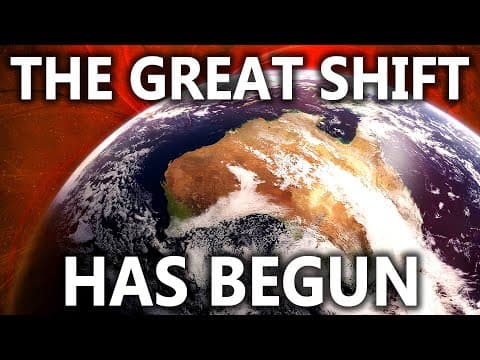
On January 26, 2026, an extraordinary global seismic event occurred with 15 magnitude 5.0+ earthquakes but no stronger magnitude 6+ quakes, a phenomenon rarely seen in over a decade of data. This seismic burst, concentrated mainly along the Australasian plate boundary, coincides with significant planetary alignments, particularly the approaching Saturn-Neptune conjunction, and rising societal pressures reflected in precious metals markets, suggesting a period of intensified geophysical and socio
Geophysicist Stefan Burns reports an exceptionally rare seismic event that unfolded on January 26, 2026. Unlike typical earthquake sequences, this event featured 15 magnitude 5.0 or greater earthquakes distributed globally without any stronger magnitude 6 or greater quake. This unusual pattern, concentrated mainly along the Australasian plate boundary in the Pacific Ring of Fire, has not been observed frequently in the last decade.
On January 26, 2026, seismic activity was marked by multiple magnitude 5 to 5.8 earthquakes scattered across the globe. Notably, there was a heavy concentration along the Kermadec Trench and near Tonga, with clusters of earthquakes measuring between 5.0 and 5.8. Other significant events included a 5.8 magnitude quake on the Mid-Atlantic Ridge and several magnitude 5+ quakes north of Australia.
Usually, a cluster of magnitude 5 earthquakes is either preceded or followed by a stronger magnitude 6 or greater event or occurs as a seismic swarm localized in one area. However, January 26 did not fit these patterns. Instead, the magnitude 5+ events were distributed globally without a dominant larger quake or a localized swarm.
Analyzing 4,045 days of seismic data from January 1, 2015, to January 27, 2026, reveals that only nine days had 15 or more magnitude 5 to 5.9 earthquakes without any magnitude 6 or greater events. This makes such an occurrence extremely rare.
Among these nine days, most were associated with either a preceding large earthquake or a seismic swarm. Only January 24, 2021, and January 26, 2026, showed a similar pattern of distributed magnitude 5+ earthquakes without a stronger quake or swarm. This similarity is significant given the comparable planetary resonances active on both dates.
The current planetary alignment features an approaching Saturn-Neptune conjunction, expected on February 20, 2026. This conjunction is believed to influence seismic activity, as similar alignments coincided with previous seismic bursts.
For example, on July 29-31, 2025, a magnitude 8.8 megaquake occurred near the time of a near Saturn-Neptune conjunction, followed by a record 143 magnitude 5+ earthquakes. This suggests a potential link between planetary geometry and global seismic activity.
Alongside geophysical changes, societal pressures are mounting. Precious metals, especially silver, have surged dramatically, reflecting eroding confidence in governments, financial systems, and official institutions. Gold prices have also reached all-time highs.
These economic signals, combined with increased seismic activity and planetary influences, suggest a period of heightened tension and transformation on multiple fronts.
The convergence of rare seismic activity, significant planetary alignments, and societal pressures indicates that the coming months may be turbulent. While the exact outcomes remain uncertain, the evidence points to intensified geophysical and socio-economic dynamics.
Geophysicist Stefan Burns emphasizes the importance of staying informed about earthquakes, volcanic activity, severe weather, geomagnetic storms, solar activity, and cosmic forces. Monitoring these factors can provide valuable insights into the evolving state of our planet and society.
The seismic burst on January 26, 2026, is a rare and significant event that challenges conventional understanding of earthquake patterns. Coupled with planetary resonances and societal shifts, it underscores the interconnectedness of Earth's physical processes and human systems. As we move forward, vigilance and preparedness will be key to navigating the changes ahead.
This article is based on the detailed analysis and insights provided by geophysicist Stefan Burns.