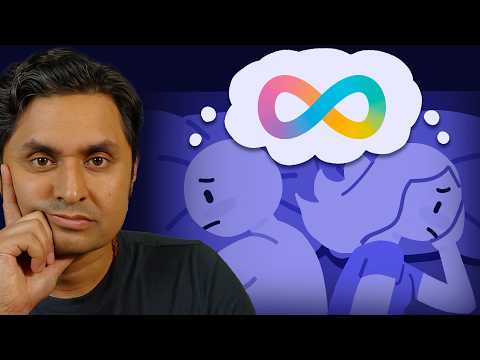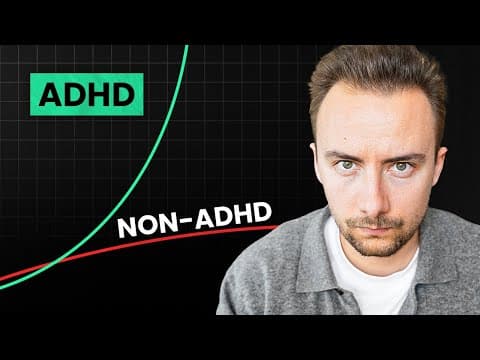
This article explores how ADHD, often misunderstood as a limitation, is becoming a significant advantage in the AI-driven future. It explains the unique cognitive traits of ADHD brains, the shift in societal values due to AI automation, and practical strategies for leveraging ADHD strengths by embracing curiosity, connecting diverse interests, and using AI to overcome executive function challenges.
If you have ADHD and often find yourself starting projects with enthusiasm, becoming obsessed, and then dropping them, this might be the most important read you'll have this year. What if the world you’ve been navigating was never designed for how your brain works? And now, that world is changing — AI is reshaping what society values.
In this article, we will explore why ADHD is becoming an advantage, the role AI plays in this transformation, and how you can start leveraging this new reality today.
People with ADHD experience a paradoxical relationship with time and knowledge. Unlike most who gradually close loops in life — settling into identities, routines, and certainties — ADHD brains keep loops open. This means constantly questioning, exploring, and reopening ideas that others accept as fixed.
This constant curiosity leads to diving down rabbit holes unnoticed by most, accumulating knowledge that may seem unrelated but holds hidden value. From the outside, this behavior might look like distraction or lack of commitment, but internally, the ADHD brain is scanning for patterns and connections.
This broad focus allows for rapid pattern recognition and big-picture thinking, leading to "aha" moments that others might take much longer to reach. For example, you might quickly sense when someone is being insincere or lose interest in movies because you predict the ending early. You might become obsessed with a hobby, master it quickly, and then move on because the challenge is solved.
This cognitive style is known as divergent thinking — the ability to generate many original ideas and perspectives rather than settling on one correct answer. While most people seek certainty, ADHD brains thrive in exploration, which is inherently uncomfortable but necessary for innovation.
Over time, ADHD individuals accumulate not just knowledge but unique perspectives that are difficult to replicate. This makes them generalists — people who sample broadly across life rather than specializing narrowly.
Historically, generalists have been the ones to change the world by connecting ideas from different domains. Johannes Gutenberg, for example, revolutionized printing not by deep scholarship but by combining knowledge of wine presses, metal casting, and ink. Similarly, Steve Jobs and the Wright brothers succeeded by seeing connections others missed.
However, society has long pressured ADHD individuals to "stay in their lane," pick one thing, and stick to it. This advice was suited for a predictable world where doing the same job for decades was the norm. But that world is fading.
Artificial Intelligence is automating predictable, repetitive tasks — the very tasks that have historically been barriers for people with ADHD, such as scheduling, organizing, and managing countless small decisions.
This automation removes the "executive function tax" that ADHD brains have paid their whole lives. As a result, 88% of neurodivergent employees report increased productivity with AI assistance.
In this new era, value shifts to those who can frame meaningful problems, see what others overlook, and create novel approaches. These are precisely the strengths of the ADHD brain.
Companies are recognizing this shift. The CEO of Palanteer noted that the future belongs to vocational training or neurodivergent individuals, as AI enables one person to accomplish what once required entire teams. In this world, your brain — your unique way of thinking — is your greatest leverage.
Think of three things you've been obsessed with in your life, no matter how random they seem. Ask yourself:
Most people stop here, trying to pick one path. But for ADHD brains, the real opportunity lies in the intersection of these interests.
Connecting seemingly unrelated dots creates unique paths that no one else can compete with. For example, combining passions for movies, video editing, and psychology can lead to innovative careers in content creation and coaching.
Stop asking, "Is this important? What should I do?" Instead, ask, "Does this spark my interest right now?" Interest is the activation switch for your brain, not a distraction.
If something pulls you in, dive deep. If not, offload it or use AI to help manage it. Your goal is to spend as much time as possible in your zone of genius.
Generic, one-dimensional paths are outdated. The future belongs to those who combine unexpected perspectives and ideas.
Track what energizes you and what drains you weekly. Double down on energy-giving activities and redesign or eliminate drains. ADHD brains run on energy, not discipline.
Turn your curiosity into output. Write posts, explain concepts to others, build small projects, or share videos. This transforms random interests into compounding assets and career leverage.
A generalist without an execution system is someone with many unfinished ideas. ADHD individuals know this struggle well — half-started projects, ideas shelved for years, and postponed potential.
While AI reduces the executive function burden, it cannot create the internal motivation to start. Building an execution system tailored to your ADHD brain is essential to turn ideas into reality.
The world is entering a new era where AI handles routine work, and the advantage goes to those who explore, adapt, and connect ideas quickly. If you have ADHD, your brain is naturally wired for this.
Start building a life around how your brain works:
Instead of asking what to commit to forever, ask where your interests intersect. That intersection is your unfair advantage.
This is your time to move from potential to achievement and make a unique impact in the post-AI economy. The future belongs to the generalists — and you are perfectly positioned to lead the way.