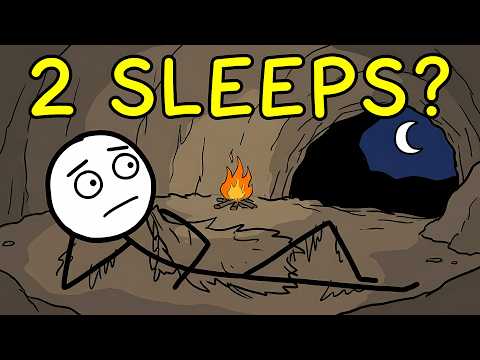
For over 300,000 years, humans lived without artificial light, spending nights around fires telling stories and sleeping in two phases separated by a period of quiet wakefulness. The advent of artificial lighting disrupted this natural rhythm, eliminating a unique state of consciousness and altering human sleep patterns. Understanding this history reshapes how we view sleep, culture, and human evolution.
Tonight, when the sun goes down, you will likely flip a switch and light will flood the room without a second thought. However, for 99.9% of human history, that switch did not exist. When the sun set, the world plunged into darkness so complete that you couldn't even see your own hand in front of your face. Modern humans almost never experience this kind of darkness anymore.
For over 300,000 years, every one of your ancestors spent roughly half their life in near total darkness. They didn't have candles for most of that time, only the black sky, the stars, and whatever fire they could keep alive. So, what did they actually do during all those hours?
Fire was the key to changing the human experience of night. The earliest solid evidence of humans controlling fire comes from Wonderwerk Cave in South Africa, roughly 1 million years ago. Fire did more than keep people warm; it completely restructured the human day.
Before fire, our ancestors behaved like other primates: when the sun went down, they climbed a tree or found shelter and stayed still. Moving at night meant risking becoming prey. Our eyes are poor in the dark compared to predators like leopards, hyenas, and wolves, who could see well at night.
A campfire creates a circle of safety about 30 feet in diameter. Inside this circle, predators would not come; outside, danger lurked. Anthropologists studying modern hunter-gatherer groups have documented that people who wander away from the fire at night are significantly more likely to be killed by predators, even today.
Fire gave humans extra usable hours. Before fire, the useful day ended at sunset, which could be as short as eight hours in winter. Fire added two to four usable hours to every day. Over thousands of generations, these extra hours changed our species.
In 2014, anthropologist Polly Wiessner studied the Ju/’hoansi Bushmen of the Kalahari Desert, one of the last groups living close to the original human lifestyle. She found that about 80% of daytime conversations were practical—discussing hunting, plants, complaints, logistics, and economic negotiations.
However, at night around the fire, 81% of conversations were stories—tales of distant places, adventures, myths about the origins of the world, and jokes that made the whole camp laugh. Wiessner argued that firelight conversation is where human culture was born. The campfire was the original theater, classroom, and church. It was where humans learned to think beyond the immediate present and imagine things that did not yet exist. It was where we became truly human.
The night was not just about stories around the fire. There was another important aspect of ancient human nights that scientists have only rediscovered in the last 30 years: the way humans slept.
In 2001, historian Roger E. Ekirch published a groundbreaking paper revealing that before the industrial age, people did not sleep in one continuous block. Instead, they had a "first sleep" and a "second sleep."
People went to bed shortly after sunset, slept for about four hours, then woke up for one to two hours in the middle of the night. After this wakeful period, they went back to sleep for another four hours until dawn. This was normal and not a sign of insomnia.
During this wakeful period, people did many things. A 16th-century French physician recommended couples conceive children during this time, believing they would do it better. People visited neighbors, interpreted dreams, wrote, or simply lay in bed thinking. A doctor's manual from the 1500s advised patients that the best time to study and reflect was during this quiet watch between first and second sleep, when the mind was calm and the world still.
Historians had been reading references to first and second sleep for centuries but often mistranslated them because they could not imagine people sleeping differently than we do now. Ancient Greek and medieval Latin texts were sometimes altered to fit modern sleep patterns.
In 1992, psychiatrist Thomas Wehr at the National Institute of Mental Health conducted an experiment removing all artificial light from volunteers' lives for one month. They experienced 14 hours of darkness every night, mimicking ancestral conditions before fire extended the evening.
Within weeks, all participants naturally adopted the biphasic sleep pattern: four hours of sleep, one to three hours of quiet wakefulness, then four more hours of sleep. This pattern emerged without suggestion or instruction, as if an ancient program was buried inside them.
During the wakeful period, participants' brains produced elevated levels of prolactin, a hormone released during meditation and after orgasm. They described feeling peaceful, reflective, and almost meditative. This was not just a gap in sleep but a distinct state of consciousness that most modern humans have never experienced.
What ended this natural rhythm? The answer is light.
In the 1600s, cities began installing street lamps. Paris, under Louis XIV, was one of the first, aiming to reduce crime. London followed. Night, once a place of danger and fear, slowly became navigable. Cheaper candles, gas lamps in the 1800s, and finally Thomas Edison's commercialization of the electric light bulb in 1879 transformed the night.
Within a generation, the night as humans had known it for 300,000 years was gone.
Interestingly, the word "curfew" comes from the French "couvre-feu," meaning "cover fire." In medieval towns, a bell would ring at night signaling everyone to cover or extinguish their fires—not for safety but because night was supposed to be dark. Night was when people slept and were vulnerable. Being out at night was suspicious, and walking outside after dark without a lantern was illegal in many medieval European cities. Night belonged to criminals and the supernatural, feared in ways almost impossible for us to understand today.
Modern humans are exposed to artificial light for an average of 7 to 8 hours after sunset. This light, especially blue light from screens, suppresses melatonin production, the hormone regulating sleep. The body cannot distinguish between light from a bulb and the sun. Light hitting the retina late at night delays melatonin release, fragments sleep, and disrupts the circadian rhythm evolved over millions of years.
Research shows that people who go camping for just one week without artificial light reset their melatonin cycles by nearly two hours, producing melatonin at sunset instead of hours later. This simple change reasserts 300,000 years of programming.
We did not just change when we sleep; we eliminated an entire phase of human consciousness. The quiet, reflective state between first and second sleep, described as peaceful and meditative, no longer exists for most people. Instead, we have insomnia, which we treat as a disorder.
But what if waking up at 2:00 a.m. and lying awake is not a malfunction but a remnant of our ancient biology? What if it is our body remembering what it was built to do?
For hundreds of thousands of years, humans spent their nights in a rhythm modern science is only beginning to understand. They gathered around fires telling stories that built civilizations. They slept in two phases with a window of quiet reflection in between. They lived in darkness so complete that the Milky Way was visible every night.
Every night, when they woke in the dark between first and second sleep, they lay in silence thinking about their lives, dreams, and the world they would wake up to. We traded all of that for a light switch, and most of us never even knew it was gone.
Understanding this ancient night life challenges our modern assumptions about sleep, culture, and what it means to be human.