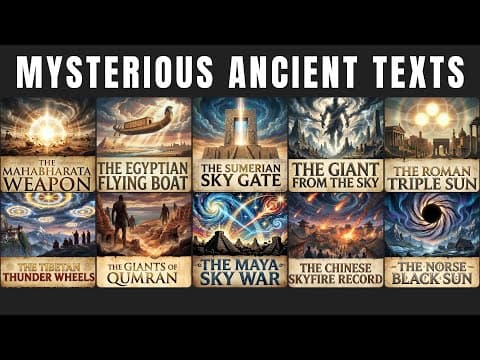
Ancient texts from various civilizations describe extraordinary phenomena—ranging from devastating weapons resembling nuclear explosions to celestial battles and enigmatic beings—that modern science struggles to explain. These accounts, often dismissed as myth, may represent lost knowledge or real events, urging a reconsideration of historical and technological timelines.
Throughout history, ancient civilizations have left behind texts and artifacts that describe phenomena far beyond the technological and scientific understanding of their times. These accounts, often dismissed as myth or allegory, present detailed descriptions of events and objects that resemble modern technological marvels or catastrophic occurrences. This article explores ten such ancient texts that describe mysterious phenomena science cannot currently explain.
The Sanskrit epic Mahabharata, dating back to around 312 BC, describes a devastating weapon used during the Kurukhetra war. This weapon unleashed a projectile glowing with the brightness of 10,000 suns, producing searing heat, blinding light, and a shockwave that toppled elephants and chariots over miles. Birds ignited mid-flight, rivers boiled, and the earth trembled beneath warriors' feet. Survivors experienced symptoms akin to radiation poisoning, such as hair loss and skin peeling.
Modern researchers have drawn parallels between this description and nuclear detonations, especially after the atomic bombings of Hiroshima and Nagasaki in 1945. Archaeological studies in Mohenjo-Daro, Pakistan, revealed skeletons with radiation levels 50 times higher than normal and glassified sand layers indicating exposure to extreme heat. Despite these anomalies, official investigations were limited, and many dismissed the accounts as metaphorical.
If the Mahabharata's weapon was real, it suggests ancient civilizations may have possessed lost technological knowledge.
In 1240 BC, carvings discovered in the temple of Si at Abidos, Egypt, depict an object resembling a modern aircraft with a fuselage, cockpit, and wings. Ancient Egyptian texts refer to the "boat of Rah," a vessel made of fire and light that crossed the sky during darkness, emitting thunderous sounds and shaking the ground.
Accounts describe columns of light descending from this craft, with witnesses often taken away by temple guards. British explorer H. Carter documented a papyrus fragment describing a metallic ark shaped like a bird's wing that spoke in tones shattering stone. While mainstream scholars interpret these as symbolic, others suggest these were real technological crafts later mythologized as gods.
Around 2100 BC, clay tablets from the ancient city of Nippur describe the "Duran key," a structure connecting heaven and earth. This place was accessible only through a door of light surrounded by a vibrating hum, located on land where no wind blows and no birds fly.
The texts detail rituals and celestial alignments required to approach this structure, suggesting contact with a force beyond the physical realm. Similar themes appear in the Enuma Elish and the Epic of Gilgamesh, describing radiant platforms guarded by hybrid creatures. Some interpret these as spiritual allegories, but the detailed physical descriptions hint at lost ancient technologies or gateways.
In 467 BC, an earthquake near Fanagoria exposed a cavern containing a scroll describing a fiery man-shaped entity crashing to earth, creating a glowing crater and poisoning a river. The being was over 30 feet tall, with iron-like skin and eyes emitting blue smoke. Villagers who approached fell ill, and animals fled.
Geological evidence near Tamman, Russia, shows a 600-foot-wide impact crater with high-pressure mineral deformation but no meteorite fragments. Local legends speak of a sleeping god buried there, with electromagnetic interference and radiation spikes reported in 2004. A nearby Greek bas-relief depicts a humanoid descending from a streak of flame, possibly memorializing this event.
Roman historian Pliny the Elder recorded an event in 74 AD near Milan where three suns appeared in the sky, arranged in a triangle, casting shadows at opposing angles. The phenomenon lasted nearly four hours, far longer than known atmospheric illusions like sundogs.
Temples closed, priests declared a rupture in the heavens, and livestock behaved strangely. Emperor Vespasian ordered silence, and references to the event were removed from libraries. The Vatican archives reportedly hold a sealed section labeled "soul triplex, AD 74," contents unknown.
In 826 AD, monks in Tibet discovered texts describing the "drongth thaw," or thunder wheels—devices capable of summoning thunder without clouds and shaking mountains. Activated by aligning with star constellations and using conical horns, these devices emitted vibrations intense enough to split stone and flatten valleys.
Modern acoustic research confirms low-frequency sound waves can cause physical harm, and some military sonic devices resemble descriptions in the manuscripts. The thunder wheels were eventually forbidden and sealed away, with rumors of partial transcriptions kept in private archives.
Discovered in 1947 near the Dead Sea, the Dead Sea Scrolls include the Book of Giants, describing the Nephilim—offspring of sky watchers and human women. These giants possessed extraordinary strength but were tormented and ultimately erased by divine judgment.
The scrolls describe attempts to build a tower of sound to call back the watchers, suggesting advanced knowledge of astronomy, metallurgy, and weaponry. The Vatican and Israeli authorities have not fully released these texts, which echo myths of giants across cultures.
The sacred creation text of the Kichaya, the Popol Vuh, recounts a war in the sky between gods of the underworld and celestial beings of light. The battle involved fires cutting through the heavens, serpents of smoke, and thunder shaking trees.
Descriptions include spears of skyfire and beings in humming shells, resembling technological warfare. Pre-Columbian glyphs depict figures emitting beams from the sky, with fleeing people and spiraling clouds. Spanish priests censored parts of the text, deeming it too dangerous.
The 4th-century BC bamboo annals describe a fire from the sky during Emperor Yao's reign, with a silver object tearing through clouds and splitting a mountain. The land blackened, and a pale, silent figure emerged from the fire.
Geological surveys in the Loess Plateau revealed a buried crater with vitrified quartz and plasma discharge traces. Electromagnetic anomalies and metallic fragments were found, and local legends warn of a "white man from the sky."
Between the 10th and 11th centuries AD, the Norse poem Völuspá describes the black sun, earth sinking into the sea, and hot stars raining down. It mentions a golden hall from which watchers cloaked in ice and fire descend.
A rarely translated stanza speaks of a metal creature with sun-like eyes and cold breath entering through a breach in the sky. Magnetic anomalies and sensory hallucinations have been reported near the glacier-capped volcano associated with the Norse underworld.
These ancient texts from diverse cultures share strikingly similar descriptions of extraordinary phenomena—celestial battles, advanced weapons, mysterious beings, and technological marvels—that challenge our understanding of history and science. While often dismissed as myth or allegory, the specificity and consistency of these accounts suggest they may be cultural memories of real events or lost knowledge.
Re-examining these texts with an open mind could expand our understanding of ancient civilizations and the mysteries they encountered. Ignoring or dismissing these accounts risks losing valuable insights into humanity's past and the enigmatic forces that shaped it.
The past is complex and often resists simple explanations. These ancient writings invite us to remember, question, and explore the unknown chapters of human history.