Mike Collins, Apollo 11 pilot, shares his experiences from the historic moon mission, emphasizing the vital role of Australia in communication, the complexities of spaceflight, and the profound view of Earth from space. He expresses skepticism about returning to the moon, advocating instead for a direct mission to Mars as the next logical step for humanity's space exploration.
Mike Collins, the command module pilot of the historic Apollo 11 mission, recently shared his unique insights and experiences from the first manned moon landing. As the 50th anniversary of Apollo 11 was commemorated, Collins reflected on the mission's preparation, execution, and its significance, while also discussing the future of space exploration.
Collins expressed deep appreciation for Australia’s crucial role during the Apollo 11 mission. He explained that while the spacecraft paid little attention to Australia for most of the flight, for about one-third of the time, Australia was essential. The large antenna at Parkes, often referred to as Goldstone, was a critical source of information and guidance, helping NASA track the spacecraft’s position. This collaboration made Australia a part of the moon mission in a significant way.
When President John F. Kennedy announced the goal to land humans on the moon in 1961, Collins had just graduated from the U.S. Air Force test pilot school. Initially, his focus was more on airplanes than space. The early astronaut selection process was filled with various ideas about what kind of people should be astronauts, ranging from mountain climbers to bullfighters. Eventually, a decisive criterion was established: candidates had to be graduates of an accredited test pilot school. This narrowed the field dramatically and allowed Collins and others to join NASA’s Gemini program in 1963.
Collins described the transition from flying airplanes to spacecraft as not particularly difficult. From the operator’s perspective, flying in space was similar to flying in the atmosphere. However, the lunar equipment was far more complex than anything encountered in aviation.
The tragic Apollo 1 accident, which resulted in the loss of the crew during a pre-launch test, was a sobering moment for the entire team. Collins acknowledged the difficulty of moving on from such a tragedy but emphasized the importance of perseverance.
On launch day, Collins recalled the eerie emptiness of the launch pad and the overwhelming complexity of the machinery. Despite initial hesitation, once aboard the spacecraft, the mission was underway.
Collins’ role as command module pilot involved critical manual flying operations, such as docking with the lunar module and extracting it from its recess. While computers assisted with many maneuvers, manual control was essential for certain phases. He acknowledged that although he knew from the start he would not walk on the moon, he was content with his role, especially since he was the astronauts’ ticket home.
One of Collins’ greatest concerns was whether Neil Armstrong and Buzz Aldrin could successfully lift off from the lunar surface. The ascent relied on a single rocket motor without redundancy, making it a high-risk maneuver. Collins carried a notebook with 18 different contingency plans to handle various scenarios of ascent timing and trajectory. Fortunately, the ascent went smoothly, and the lunar module successfully docked with the command module.
While Armstrong and Aldrin explored the moon’s surface, Collins orbited alone in the command module. Contrary to popular belief, he did not feel lonely but rather at home in the spacious and well-equipped spacecraft. He enjoyed the quiet time behind the moon, where communication with Earth was impossible for about 40 minutes.
Collins described the far side of the moon as rugged and inhospitable, with no appealing landing sites. Looking back at Earth, he saw a tiny, fragile blue planet, about the size of a thumbnail held at arm’s length. This view instilled in him a profound sense of Earth’s fragility and the importance of caring for our planet.
Upon returning, the Apollo 11 crew was quarantined for two weeks in a sealed laboratory alongside a colony of white mice. This precaution was taken to ensure no harmful lunar pathogens were brought back to Earth. Collins humorously noted that the survival of the mice was more important than the astronauts during this period.
Collins left NASA shortly after Apollo 11, choosing not to pursue further moon missions despite being in line for future flights. He cited family reasons and the feeling that the Apollo program had fulfilled its primary goal.
He then served as Assistant Secretary of State and later became the director of the National Air and Space Museum, overseeing the creation of its iconic building.
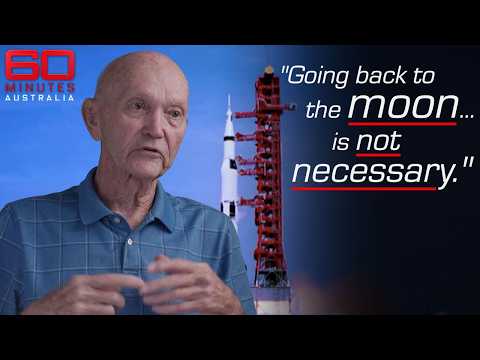
Regarding the future of space exploration, Collins expressed skepticism about returning to the moon. He joked that NASA should be renamed the National Aeronautics and Mars Administration, emphasizing Mars as the next logical destination. He believes that a direct mission to Mars, planned systematically and thoughtfully, is preferable to detouring via the moon.
Collins explained the complexities of a Mars mission, including the long travel time of about nine months each way and the need to wait on Mars for planetary alignment before returning. Despite these challenges, he sees Mars as Earth’s closest sister planet and a vital step for humanity’s exploration.
He estimated that a manned mission to Mars might realistically occur around 2040, cautioning against rushing but advocating for steady progress.
Collins emphasized that space exploration is driven by human curiosity and the innate desire to explore the unknown. He sees this as a fundamental part of being human, akin to ancient explorers venturing into uncharted territories.
He also reflected on the global impact of Apollo 11, noting that people around the world felt a shared sense of achievement, viewing the mission as a triumph for all humanity rather than just America.
Collins highlighted the fragility of Earth as seen from space and expressed concern about how humanity treats the planet. While the moon has remained largely untouched, he cautioned against careless exploitation.
Mike Collins’ reflections provide a rare and insightful perspective on one of humanity’s greatest achievements. His experiences underscore the complexity and risks of spaceflight, the profound beauty and fragility of Earth, and the enduring human spirit of exploration. While he respects the moon’s role in space history, Collins advocates for focusing efforts on Mars as the next frontier, encouraging a direct and well-planned approach to ensure the future of human space exploration.