President Javier Milei's efforts to stabilize Argentina's economy face significant challenges, particularly with the peso's value. Despite initial successes in reducing deficits and inflation, the peso's dual exchange rates complicate his plans for dollarization, leading to a widening gap between official and blue market rates. As inflation persists and political pressures mount, Milei's strategy to unify the currency remains uncertain.
In 2024, Javier Milei's first year in office as Argentina's president showed promise with significant economic reforms. He successfully cut both the fiscal and current account deficits, reduced inflation from its peak at the end of 2023, and pulled the economy out of recession in the third quarter. However, one persistent issue looms over his administration: the value of the peso.
Upon taking office, Milei pledged to eliminate the peso by dollarizing the Argentinian economy. Yet, a year later, this goal seems distant. The peso's real value on the black market continues to decline, and Milei's attempts to simplify Argentina's complex currency regime—a prerequisite for dollarization—are faltering.
To grasp the challenges of fixing Argentina's currency, it is essential to understand its historical context. Unlike most developed nations with free-floating currencies, Argentina has operated with two exchange rates: the official rate, managed by the government, and the unofficial market rate, known as the blue rate.
Before Milei's presidency, the official rate was approximately 370 pesos to the dollar, while the blue rate soared to around 1,000 pesos to the dollar. This discrepancy allowed the government to present a stronger peso value than reality, ostensibly to afford more imports. However, this system led to numerous complications:
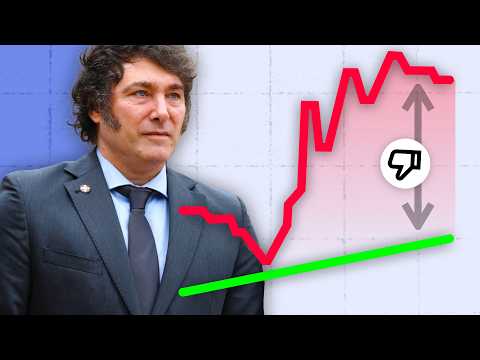
Milei's primary objective has been to unify the two exchange rates, a necessary step toward dollarization. In his first month, he cut the official rate by 50% to 800 pesos to the dollar and planned to devalue it by 2% monthly. The strategy aimed to align the official rate with the blue rate, hoping that reduced government spending and a halt to peso printing would increase the blue rate's value.
However, this plan has not unfolded as expected. While there was a brief moment when the two rates appeared to converge, the blue rate has recently fallen faster than the official rate, widening the gap. This divergence is exacerbated by inflation, which remains above 100% year-on-year, further eroding the peso's real value.
One of the paradoxes of Milei's devaluation strategy is that it has contributed to rising inflation. By devaluing the official rate, imports have become more expensive, fueling inflationary pressures. This situation has left Milei in a difficult position:
As Milei navigates these economic challenges, he must also consider the political landscape. With midterm elections approaching in October, where half of the House and a third of the Senate are up for reelection, Milei's political party holds minimal representation in Congress. To bolster his standing, he recently announced a reduction in the devaluation rate from 2% to 1% per month, a move likely aimed at appeasing voters by mitigating inflation.
Despite a decrease in inflation from its peak of over 25% month-on-month, it still hovers around 3% monthly, translating to over 100% annually. The month-on-month rate even rose slightly from November to December, indicating persistent inflationary pressures.
Milei's administration faces a significant risk: maintaining the official peso value will require substantial foreign exchange reserves, which Argentina lacks. Although reserves have increased from a low of $20 billion in December to $25 billion, this amount is insufficient, especially considering Argentina's debt servicing costs are expected to rise sharply between 2026 and 2028.
External shocks, such as potential tariffs from the U.S., could further complicate the situation, making it more expensive to defend the peso and potentially leading to a destabilizing devaluation.
Much of Argentina's economic future hinges on negotiations with the IMF, which is currently discussing a new program with Milei. While the IMF has encouraged Milei to accelerate the peso's unification, they have also recognized his reform efforts. Securing additional funding from the IMF could provide Argentina with a buffer against external shocks.
As the world watches Javier Milei's unique governance style, the situation in Argentina remains fluid. The challenges surrounding the peso and the broader economic landscape will continue to evolve, with significant implications for the country's future. The interplay between economic reforms, inflation, and political pressures will be critical in determining whether Milei can stabilize the peso and achieve his ambitious goals for the Argentinian economy.