On April 1st, Artemis 2 launched four astronauts on a historic mission to the moon, breaking records and signaling a new era of civilizational competition in space. This mission is not just about exploration but about securing critical lunar resources like water ice and helium-3, which could fuel humanity's future in space. The U.S. and China are racing to establish dominance in lunar territory, shaping the future of astropolitics and galactic order.
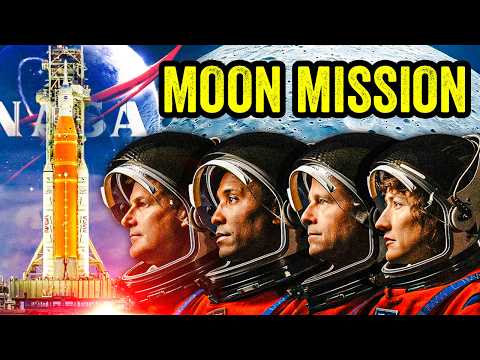
On April 1st, four astronauts embarked on a journey that humanity had not undertaken in over half a century. Commander Reid Wiseman, pilot Victor Glover, mission specialist Christina Koch, and Canadian astronaut Jeremy Hansen launched aboard NASA's Orion capsule atop a 322-foot Space Launch System rocket from Kennedy Space Center. This mission, Artemis 2, is the first crewed lunar mission since Apollo 17 in 1972.
The launch was a spectacular event, shaking the Florida coastline with a tower of fire and thunder. But beyond the awe-inspiring visuals, this mission represents much more than a space story; it is a story of civilizational power and geopolitical significance.
Artemis 2 is set to shatter several records:
These milestones are not mere historical footnotes but represent significant civilizational achievements.
The Artemis 2 mission targets the lunar south pole, a region of immense strategic value. In just a few months, China's Chang'e 7 mission aims for the same destination, specifically the rim of Shackleton Crater, where NASA plans to build a permanent Artemis base.
The lunar south pole harbors water ice deposits, a precious resource in space. Water in space is not just for drinking; it is a critical component for rocket fuel. Through electrolysis, water molecules can be split into hydrogen and oxygen, which serve as propellant.
Moreover, the lunar surface is saturated with helium-3, an isotope that enables the cleanest and most powerful fusion reactions known to science, producing no radioactive neutron waste. Helium-3 does not exist on Earth due to our magnetic field blocking solar wind, which deposits helium-3 on the moon.
Whoever controls the water ice and helium-3 at the lunar south pole will effectively control the "gas station" for the entire inner solar system. This control could power human civilization for thousands of years and enable missions to Mars, the asteroid belt, and beyond.
The Artemis program, backed by the Trump administration with a roughly $20 billion moon-based concept, aims not just for flags and footprints but for permanent bases, resource extraction, and sustained human presence on another world.
China and Russia, meanwhile, are collaborating on the International Lunar Research Station with partners from the Belt and Road Initiative, under a state-directed, sovereignty-focused framework.
United States and Artemis Accords: A coalition of over 50 nations emphasizing transparency, interoperability, peaceful use, and a market-driven framework for space resources. This approach blends private enterprise (e.g., SpaceX) with state power to accelerate civilizational expansion.
China and Russia's Lunar Research Station: A state-directed project emphasizing sovereignty and technological supremacy as part of China's national rejuvenation project. This program is tightly integrated with the civilization-state model.
The competition between the U.S. and China in space is part of a broader geopolitical framework called the "Civcosm" or civilizational cosmocracy. This framework argues that 21st-century conflicts are not just between nations but between civilizations with distinct worldviews, sacred orders, and technological ecosystems.
Artemis 2 and China's Chang'e program are not just scientific endeavors but rival civilizational projects competing to define the grammar of life beyond Earth.
The U.S. and China are racing to determine:
This transformation from geopolitics to astropolitics marks the emergence of a cosmic or orbital order. The question is who will define this order and thus shape humanity's expansion into the cosmos.
Artemis 2 is a visible manifestation of astropolitics and civilizational competition. It reveals a new world that is both ancient in its sacred significance and futuristic in its technological ambition.
The defining question for this century and beyond is not whether humans will become a multi-planetary species—they will—but under whose cosmology and governance this expansion will occur.
As of April 1st, America has fired the opening shot in this new cosmic race.
This historic mission marks the dawn of a galactic age, where space exploration is intertwined with geopolitical strategy, technological innovation, and civilizational identity. The race to the moon's south pole is more than a quest for scientific discovery; it is a contest for the future of human civilization itself.