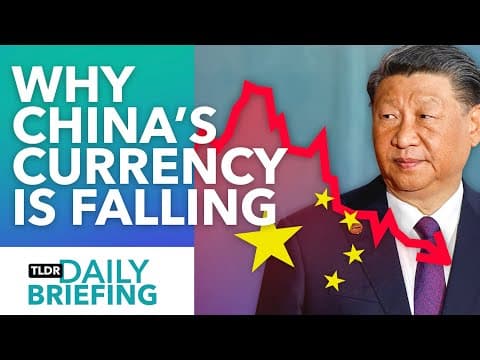
China's Yuan has fallen to a 16-month low due to fears over Donald Trump's trade policies, economic challenges, and a struggling property market. Despite government efforts to stabilize the economy, investor confidence remains low, leading to significant capital outflows and market volatility.
On January 8, 2025, China's currency, the Yuan, fell to a 16-month low, reaching 733.01 per US dollar. This decline marks a significant economic challenge for China, coinciding with rising tensions surrounding US trade policies under President-elect Donald Trump. This blog post delves into the factors contributing to the Yuan's depreciation, the broader economic context in China, and the implications for global markets.
The recent drop in the Yuan's value follows trader unease regarding Trump's impending trade policies. The president-elect has threatened to impose tariffs as high as 60% on Chinese imports, raising concerns among investors. Despite interventions from the Chinese Central Bank and stock exchanges aimed at stabilizing the currency, the Yuan continues to struggle.
Since Trump's election victory, the Yuan has repeatedly hit multi-month lows. With just two weeks until Trump takes office, China's markets are feeling the strain. The CSI 300 Blue Chip index, a key indicator of the Chinese stock market, experienced its largest weekly loss in over two years, dropping by 5% last week. On Monday, the index fell to its lowest level since September, closing with a 0.2% loss after an initial drop of 0.9%.
The currency fluctuations occur against a backdrop of significant economic challenges for China. Economic activity has slowed markedly, lagging well below historical trends. Key issues include:
Household spending, which accounts for approximately 40% of China's GDP, remains considerably below the global average. This lack of consumer confidence is a critical factor in the economic slowdown.
The property market is grappling with a prolonged slump, with prices decreasing by roughly 8% from their peak. This decline has further exacerbated economic woes, as real estate is a significant driver of economic growth in China.
The government's tightening grip on the private sector has led to capital outflows, with an estimated 15,200 Chinese millionaires expected to relocate in 2024. While this does not represent a mass exodus, it signals a concerning trend for the economy, which was home to about 6.2 million millionaires in 2021.
In response to these economic challenges, Beijing has rolled out several stimulus packages aimed at revitalizing struggling sectors. However, these efforts have largely fallen short of expectations. Last year, anticipated major stimulus initiatives were replaced with a significant restructuring of local government debt. While this provided some relief for local governments, it did little to rejuvenate the broader economy.
Many economists believe that Beijing is holding off on announcing more spending plans while awaiting clarity on Trump's tariffs after his inauguration on January 20. The Central Bank appears to be in a wait-and-see mode, maintaining a steady exchange rate to avoid a larger sell-off of the Yuan.
The implications of the Yuan's decline extend beyond China's borders. As the world's second-largest economy, fluctuations in the Yuan can impact global markets and trade dynamics. Investors and policymakers worldwide are closely monitoring the situation, as further depreciation could lead to increased tensions between the US and China.
China's currency crisis highlights the interconnectedness of global economies and the potential repercussions of domestic policies on international markets. As the situation unfolds, all eyes will be on the Chinese government’s response and the impact of Trump's trade policies on the Yuan and the broader economy. The coming weeks will be crucial in determining the trajectory of China's economic recovery and its position in the global market.