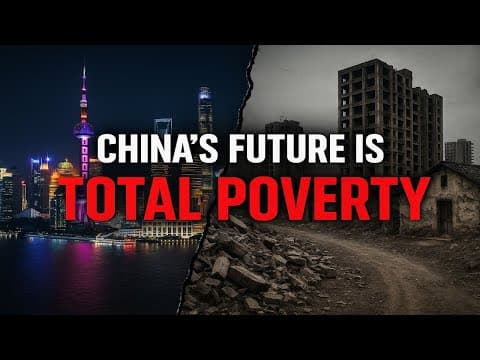
China's economy, despite its apparent wealth, is facing a critical issue of capital mobilization. The lack of legal systems to secure property rights and enforce contracts means that much of China's wealth is trapped and cannot be transformed into productive capital. This could lead to China becoming the poorest nation on earth, as its assets remain unleveraged and its economy stagnates under systemic uncertainty.
Imagine a farmer sitting on a huge pile of grain, enough to feed an entire city. From a distance, he looks rich, prosperous, even powerful. But here's the catch: all that grain is locked in a silo with no door. He can't sell it, can't trade it, and can't even eat it before it rots. This scenario serves as a metaphor for China's economy under Xi Jinping. On the surface, it appears unstoppable, with skyscrapers, ghost cities, and trillions in foreign reserves. However, beneath the neon lights lies a hollow reality. China has money, but it lacks capital. Unless this changes, China is on track to become the poorest nation on earth—not in the traditional sense of poverty, but as a nation unable to transform its assets or money into true productive capital.
During my time in Beijing's finance sector, I encountered entrepreneurs who seemed to have made it big. They owned villas, fancy cars, and stacks of yuan and gold bars hidden away. Yet, behind closed doors, they confessed a terrifying truth: their wealth was fragile. They understood that one wrong political move or a single misstep by the Communist Party could lead to their fortunes evaporating overnight. This fragility is a critical aspect of China's economic landscape.
The insights of Hernando de Soto in his book, "The Mystery of Capital," shed light on the distinction between rich and poor nations. De Soto argues that what separates wealthy nations from impoverished ones is not merely the amount of money they possess, but the invisible legal systems that convert money into capital. These systems secure property rights, enforceable contracts, and the rule of law. When viewed through this lens, China's economic situation becomes clearer. While China is drowning in money, almost none of it qualifies as real capital.
Money serves as a medium of exchange, while capital refers to money that is put to work through secure and recognized systems. For instance, in the West, owning a home allows individuals to mortgage it, sell it, or pass it on to their heirs. In contrast, in China, individuals do not truly own the land; the Communist Party owns everything. Citizens only have a 70-year lease from the state, which can be altered or revoked at any time. This lack of true ownership means that individuals cannot freely mortgage, insure, or use their properties as secure collateral. Thus, while an apartment may appear to be worth millions on paper, it lacks the characteristics of capital.
China is filled with assets that exist physically but cannot be leveraged to generate wealth. Ghost city apartments and entire skyscrapers sit empty, technically valuable but providing no utility to their residents. Rural homes and farmland are similarly constrained; peasants cannot sell or mortgage them due to collective ownership laws that block private transfer. The case of Jack Ma's group, which was poised for a $300 billion IPO until the government intervened, illustrates the structural issues at play. In China, one can build and hoard wealth, but without a legal system that protects and mobilizes assets, it is akin to holding monopoly money.
In successful economies, laws apply equally to everyone. However, in China, laws serve the interests of the Communist Party. Politically connected state-owned enterprises can default on billions and still receive bailouts, while private entrepreneurs risk losing everything for stepping out of line. This creates systemic uncertainty, discouraging innovation and leading to a preference for speculation over productive investment. Instead of fueling creativity, money flows into real estate bubbles, shadow banking, and flashy mega-projects that lack genuine value.
On paper, China appears to be a capitalist paradise, boasting massive infrastructure spending, the world's second-largest stock market, and banks overflowing with deposits. However, much of this is state-directed theater. Banks primarily lend to politically favored state-owned enterprises rather than innovative startups. Stock markets are manipulated for propaganda, and infrastructure projects are built not for return on investment but to showcase GDP performance metrics. This creates an illusion of prosperity while the underlying economic health deteriorates.
According to de Soto's theory, economies without systems that convert money into capital eventually hit a glass ceiling. They may grow rapidly at first by copying technology and mobilizing labor, as China did from the 1980s to the early 2000s. However, growth plateaus when debt accumulates, as seen with China's current debt load of 300% of GDP, not including hidden off-balance-sheet debt. The economy begins to break down because each additional dollar of debt generates only a few cents of value.
Today, small businesses in China face a credit crunch, and households sit on trillions in savings that cannot be deployed productively. Innovation stagnates as entrepreneurs navigate a landscape filled with political landmines. This is why China can have money everywhere but capital nowhere. The paradox is that China is not poor in the traditional sense; it has skyscrapers, luxury malls, and even a space program. Yet, under Xi Jinping's leadership, China's wealth cannot be mobilized effectively.
A rural farmer may own a house but cannot sell it or borrow against it. A middle-class family may own an apartment but lacks true ownership of the land beneath it. An entrepreneur may create a billion-dollar company only to see it vanish at the whim of the party. This is the essence of poverty: when assets can be frozen at any time, when wealth is performative, and when the future is entirely out of one's control.
As China's population shrinks rapidly, local governments will face increasing pressure, and this hollow economic system is likely to collapse under its own weight. When that happens, China will not merely slow down; it will implode into the world's largest poor nation, with hundreds of millions trapped in a legal and economic cage of their own government's making.
The next time you hear someone claim that China is rich, consider its foreign exchange reserves and bustling supply chains. Remember that these are merely the flashing lights of a casino; the chips may look real, but the underlying system is flawed. The Communist Party always wins, and China has constructed an appearance of wealth without the necessary infrastructure of capitalism to make that wealth real. Until it builds the invisible frameworks of property rights and the rule of law, every yuan, every skyscraper, and every ghost city will remain trapped as capital. When the music stops, China will stand exposed as the poorest rich nation the world has ever seen. True wealth is not about the amount of paper money one possesses; it is about the ability to transform that money into lasting capital. Currently, China is failing in this regard.