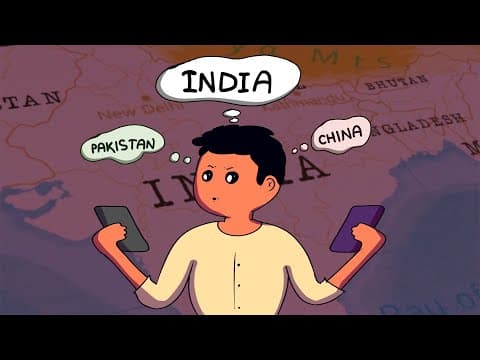
This blog post explores the economic development strategies of India, Pakistan, and China, comparing their historical contexts, growth rates, sector contributions, and human development indicators, highlighting the strengths and weaknesses of each country's approach to development.
In this blog post, we will delve into the economic development experiences of India and its neighboring countries, Pakistan and China. Understanding these comparisons is crucial as it reveals the strengths and weaknesses of India's economic strategies in the context of a highly competitive global landscape.
India, Pakistan, and China share a similar historical backdrop regarding their independence and initial development strategies. Both India and Pakistan gained independence in 1947, while the People's Republic of China was established in 1949. Each country initiated its development planning around the same time:
While Pakistan and China have continued with the Five-Year Plan system, India shifted to a 15-year vision document and a 3-year action plan after discontinuing its last Five-Year Plan in 2015.
By 1980, India, Pakistan, and China exhibited similar growth rates and per capita incomes. However, significant disparities have emerged since then. To understand these differences, we must examine the developmental trajectories of China and Pakistan:
China's economic development has been characterized by a single-party political system since 1949. Key milestones include:
These reforms led to a significant reduction in poverty and an increase in income levels, with a focus on agriculture, foreign trade, and investment.
Pakistan's economic policies have mirrored India's in many respects, adopting a mixed economic model that includes both public and private sectors. Key developments include:
Despite these efforts, Pakistan has faced challenges such as political instability and over-dependence on remittances, which have hindered sustained economic growth.
According to the Human Development Index (HDI) data from 2017-19:
The economic development journeys of India, Pakistan, and China reveal distinct paths shaped by historical contexts, political systems, and economic policies. While India has maintained a strong democracy and made strides in infrastructure and living standards, challenges remain, particularly in agricultural dependency. Pakistan's political instability and reliance on remittances have hindered its growth, while China's authoritarian model has facilitated rapid economic expansion despite concerns over human rights and political freedoms. Understanding these dynamics is essential for learning from each country's successes and failures in economic development.