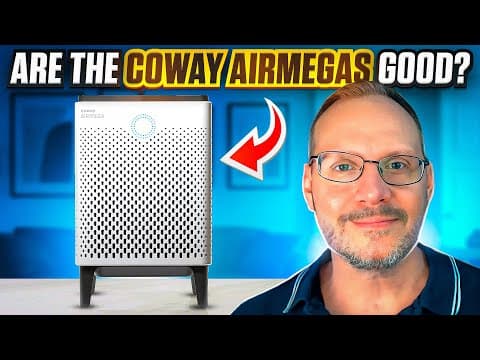
This blog post provides an in-depth review of the Coway Airmega 300 and 400S air purifiers, examining their filtration capabilities, design, specifications, and real-world performance compared to marketing claims. While they improve air quality, they do not meet elite filtration standards, particularly for ultrafine particles.
In this review, we will explore the Coway Airmega air purifier product line, focusing on the 300, 300S, 400, and 400S models. With years of customer feedback and personal experience, we will assess whether these units live up to their claims of elite filtration capabilities.
Coway, headquartered in South Korea, generates approximately $4 billion in annual revenue and offers a range of products, including air purifiers. The Airmega units are marketed as capable of filtering 99.999% of particles down to 0.1 microns, which is a significant claim in the air purification industry.
Coway asserts that their Airmega units utilize advanced filtration technology to capture an unprecedented percentage of ultrafine particles. However, it is essential to scrutinize these claims against real-world performance.
Many air purifiers, including the Airmega, often fail to perform at the HEPA level in practical settings, especially as filters become dirty. The Airmega units have been on the market for about ten years, and while they are manufactured in South Korea, their filtration performance may not align with the marketing claims.
Both models come with a 5-year warranty. The Max2 filters need replacement approximately once a year, while pre-filters can be washed periodically.
The Airmega 300S and 400S are Wi-Fi enabled and can be controlled via the iAire app, allowing users to monitor air quality and filter status. However, the reliability of such apps is often questioned, and many users may prefer to focus on the core function of air purification rather than app features.
The Airmega units utilize a two-in-one Max2 filter, combining a HEPA filter with a carbon filter. The airflow process involves dirty air entering from two sides, passing through the pre-filter, carbon filter, and finally the HEPA filter before clean air is released from the top.
Despite Coway's claims, real-world testing suggests that the Airmega units do not consistently filter at HEPA levels. Observations indicate that dust and debris can escape around the filters, particularly when they become clogged. This raises concerns about their effectiveness against ultrafine particles, which are the most harmful to human health.
When compared to other leading air purifiers, such as the IQAir HealthPro Plus, the Airmega units fall short in filtration performance. The lack of a robust seal between the HEPA filter and the unit's interior allows for potential leakage of unfiltered air.
The Coway Airmega 300 and 400S air purifiers offer decent air quality improvement for general use, particularly for allergens and larger particles. However, they do not meet the elite filtration standards claimed in their marketing. For consumers seeking effective filtration of ultrafine particles, it may be wise to consider higher-end models. Overall, the Airmega units provide good value for their price, but potential buyers should be aware of their limitations.