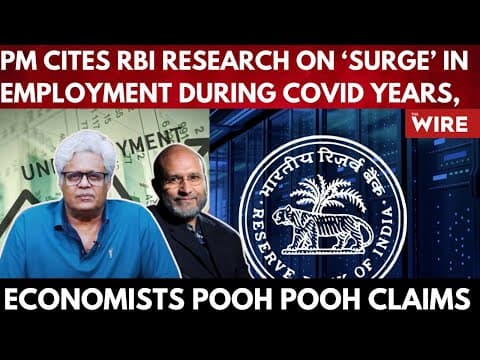
The recent RBI research claiming a surge in employment during the COVID years has been met with skepticism from economists. This blog post explores the discrepancies in employment data, the impact of economic policies, and the realities of job creation in India over the past decade.
In recent discussions surrounding India's employment crisis, a controversial report sponsored by the Reserve Bank of India (RBI) has sparked significant debate. The report claims that there was a surge in employment during the COVID years, a period marked by economic contraction and widespread job losses. This blog post aims to dissect these claims, analyze the underlying data, and provide insights from leading economists on the current state of employment in India.
For the past decade, India has grappled with high unemployment rates, reaching a staggering 45-year high in 2017-18. The Modi government has faced criticism for its inability to create jobs, a promise made during the 2014 elections. The recent RBI report, however, asserts that over 2 crore jobs were created in each of the COVID years (2021 and 2022), contradicting the prevailing narrative of job losses during this period.
The RBI's research suggests that despite the economic downturn, employment surged, with a total of 4.6 crore new jobs claimed to have been created leading up to 2023-24. This assertion has raised eyebrows among economists and the general public alike, especially considering the context of factory closures and lockdowns that characterized the COVID years.
Critics argue that the RBI's methodology is flawed. The report relies on data from the National Sample Survey Office (NSSO) and the Periodic Labor Force Survey (PLFS), which have shown a consistent decline in employment in the non-farm sector. Economists have pointed out that the increase in reported employment is largely due to a rise in agricultural jobs, which do not equate to meaningful employment in terms of productivity and income.
Santos Merra, a prominent labor economist, expressed amusement at the RBI's claims, highlighting the disconnect between the reported data and the lived experiences of the workforce. He noted that the economy contracted significantly during the COVID years, and any claims of job creation must be scrutinized against the backdrop of this contraction.
Merra emphasized that the increase in agricultural employment does not reflect genuine job creation. Instead, it indicates a reverse migration of workers back to rural areas, where they are counted as employed despite contributing little to economic productivity. He pointed out that 60 million workers returned to agriculture during this period, a trend that does not signify a healthy job market.
The discussion revealed that a significant portion of the reported employment increase consists of unpaid family labor and self-employment in agriculture. Merra highlighted that real wages have stagnated, and many of those counted as employed are not earning sufficient income to support themselves or their families. This raises questions about the quality of jobs being created and the overall health of the economy.
The RBI's claims of job growth stand in stark contrast to other data sources. For instance, the unorganized sector has reportedly seen a decline in employment, with many workers losing their jobs due to economic shocks like demonetization and the poorly implemented Goods and Services Tax (GST). The government's narrative of job creation fails to account for these losses and the precarious nature of the jobs that have been created.
The discussion also touched on the impact of government policies on employment. The introduction of the EPFO (Employees' Provident Fund Organization) registration has been cited as evidence of job creation. However, this increase is largely attributed to the formalization of existing jobs rather than the creation of new ones. The reality is that a significant portion of the workforce remains informal, lacking social security and benefits.
The claims made by the RBI regarding job creation during the COVID years have been met with skepticism and criticism from economists and analysts. The data suggests that while some jobs may have been created, they are predominantly low-quality, informal positions that do not contribute to economic stability or growth. As India continues to navigate its employment crisis, it is crucial for policymakers to recognize the realities of the labor market and address the underlying issues that hinder genuine job creation. The upcoming economic survey and budget will be critical in determining whether the government acknowledges these challenges or continues to propagate an optimistic narrative that does not align with the lived experiences of millions of workers in India.