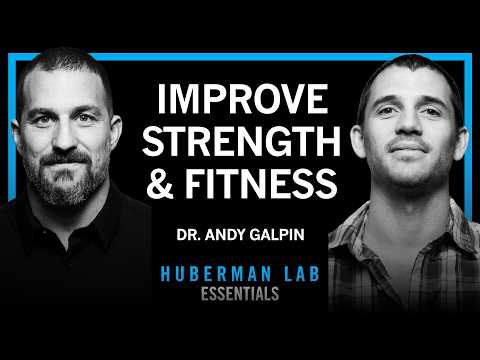
Welcome to a comprehensive guide on building strength, muscle size, and endurance based on insights from Dr. Andy Galpin, a leading expert in exercise physiology. This article distills key principles and actionable strategies to help you optimize your training and achieve your fitness goals.
Understanding the Nine Adaptations from Exercise
Dr. Galpin outlines nine different adaptations that exercise can target:
- Skill: Improving movement mechanics, such as a golf swing, squatting technique, or running form.
- Speed: Moving as fast as possible.
- Power: A function of strength multiplied by speed.
- Strength: The ability to produce force.
- Hypertrophy: Muscle size and growth.
- Muscular Endurance: Ability to perform many repetitions, e.g., push-ups in one minute.
- Anaerobic Power: Producing high work output for 30 seconds to 2 minutes.
- VO2 Max (Aerobic Capacity): Sustaining high-intensity work for 3 to 12 minutes.
- Long Duration Endurance: Sustaining work for 30+ minutes without breaks.
Some adaptations overlap, while others may conflict, so training for one may affect another.
The Principle of Progressive Overload
To improve, you must progressively overload your system by increasing stress over time. This can be achieved by:
- Increasing weight lifted.
- Increasing repetitions.
- Increasing training frequency.
- Adding complexity to movements.
Repeating the exact same workout without progression will maintain but not improve your fitness.
Modifiable Variables in Training
Dr. Galpin identifies key variables you can adjust to influence training outcomes:
- Exercise Choice: Selecting exercises that suit your goals and allow proper form.
- Intensity: Percentage of your one-rep max (1RM) or max heart rate.
- Volume: Total reps multiplied by sets.
- Rest Intervals: Time between sets.
- Progression: How you increase load, reps, or complexity over time.
- Frequency: How often you train a muscle group per week.
Exercise Selection
Choose exercises that allow a full range of motion without compromising safety. Balance your workout with movements covering:
- Upper body press (horizontal and vertical)
- Upper body pull (horizontal and vertical)
- Lower body hinge
- Lower body press
A well-rounded workout might include one exercise from each category.
Intensity and Repetitions for Strength
- Strength training requires high intensity, typically above 85% of your 1RM.
- Low repetition ranges (5 reps or fewer) are typical for strength.
- Warm-up sets should gradually increase intensity before work sets.
- Rest intervals of 2 to 4 minutes between sets help maintain intensity.
Volume and Frequency for Hypertrophy
- Hypertrophy is driven primarily by volume (total work done).
- Effective repetition ranges for hypertrophy are broad, from 5 to 30 reps per set.
- Training to muscular failure or close to it is important.
- Rest and recovery between sessions are crucial, typically 48 to 72 hours.
- Frequency of training a muscle group 2 to 3 times per week is optimal.
Balancing Soreness and Recovery
- Mild soreness (less than 3 out of 10) is acceptable and normal.
- Excessive soreness can impair recovery and reduce total training volume.
- Frequency and volume should be balanced to avoid overtraining.
The Mind-Muscle Connection and Intentionality
- Intent to move fast or challenge muscles enhances strength and power gains.
- Focusing on contracting the target muscle can improve hypertrophy.
- Quality of work and mental engagement during training sessions are critical.
Strategies for Muscle Activation and Overcoming Imbalances
- Awareness and tactile cues can help activate underused muscles.
- Eccentric overload (slowly lowering the weight) is effective for activating difficult muscles.
- Breaking down complex movements into smaller parts can improve control and activation.
Breathing Techniques During Resistance Training
- Hold your breath during the eccentric (lowering) phase.
- Exhale during the concentric (lifting) phase.
- For multiple reps, develop a breathing rhythm, such as exhaling every third rep.
Post-Workout Breathing and Recovery
- Incorporate 3 to 5 minutes of controlled breathing after workouts.
- Use nasal breathing and exhale twice as long as inhale.
- Techniques like box breathing (equal inhale, hold, exhale, hold) help downregulate the nervous system.
- This practice improves recovery and energy levels post-exercise.
Practical Training Guidelines: The "3 to 5" Concept
- Choose 3 to 5 exercises per session.
- Perform 3 to 5 sets of 3 to 5 reps per exercise.
- Rest 3 to 5 minutes between sets.
- Train 3 to 5 times per week.
Adjust intensity based on goals:
- Strength: 85%+ of 1RM.
- Power: 40% to 70% of 1RM, focusing on speed.
Conclusion
Dr. Andy Galpin's insights provide a clear framework for building strength, muscle size, and endurance effectively. By understanding the adaptations, applying progressive overload, manipulating training variables, and focusing on quality and recovery, you can tailor your training to your goals and lifestyle. Intentionality and proper breathing further enhance results, making your workouts more efficient and rewarding.
Start applying these principles today to optimize your fitness journey and achieve lasting improvements.