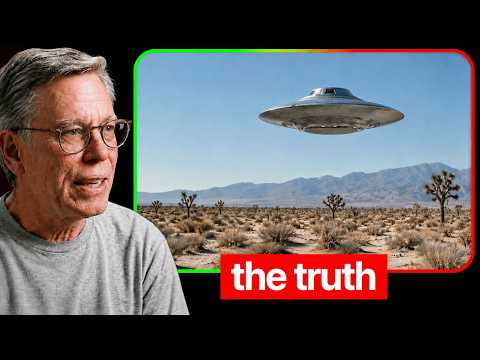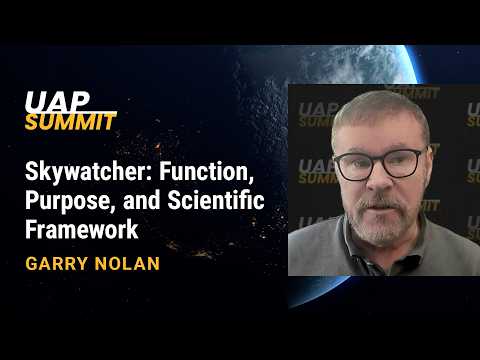
Dr. Garry Nolan, a Stanford professor, discusses the Skywatcher program's multidisciplinary approach to studying Unidentified Aerial Phenomena (UAP). He explains the integration of scientific rigor, military experience, and private funding to collect and analyze multi-sensor data. Nolan also shares insights on Bayesian inference in evaluating evidence and presents findings from material analysis of UAP-related artifacts.
Dr. Garry Nolan, a renowned Stanford School of Medicine professor and translational scientist, recently shared insights into the Skywatcher program, a multidisciplinary initiative focused on rigorous research and policy analysis of Unidentified Aerial Phenomena (UAP). This article summarizes Dr. Nolan's comprehensive presentation on the program's setup, scientific methodology, challenges, and findings.
Dr. Nolan has published over 330 papers and holds around 50 US patents. He has co-founded multiple biotech and technology companies and currently serves as the executive director of the Saul Foundation, which supports multidisciplinary UAP research.
The Skywatcher program was designed to bring scientific rigor to the study of UAP by integrating expertise from three main groups:
Dr. Nolan emphasized that Skywatcher operated as an independent, privately funded initiative, not affiliated with any government or contractor.
The mission was to uncover and deliver accurate, timely, and comprehensive aerial intelligence based on evidence and collaboration with federal, state, and local authorities. The program aimed to collect multi-sensor data, including radar, RF spectrum, movement patterns, heat signatures, and long-range optics, to profile UAP behavior and characteristics.
Dr. Nolan's role was to help design experiments scientifically to ensure reproducibility and peer-review readiness. However, challenges arose due to competing interests among scientific, military, and venture capital groups, as well as operational difficulties such as time synchronization of instruments.
The program emphasized the importance of:
Dr. Nolan clarified the distinctions:
He stressed that science rarely claims absolute proof but works within a Bayesian framework, assigning probabilities to hypotheses based on evidence.
Using Bayesian inference, Dr. Nolan demonstrated that simultaneous observations from three sensors could yield a likelihood ratio exceeding 1400, surpassing the threshold for extraordinary evidence. This statistical approach helps quantify the probability that observed phenomena are real and not misinterpretations.
One intriguing event involved an aerial object seen from the ground but not by a helicopter flying nearby. Pilots reported electronic interference and inability to approach the object, suggesting anomalous behavior. While anecdotal, such events provide valuable evidence for further study.
Dr. Nolan discussed his laboratory work analyzing materials linked to UAP events, focusing on two notable samples:
These findings indicate the materials are engineered and anomalous, warranting further investigation.
Dr. Nolan addressed questions about health symptoms reported by UAP witnesses, including radiation sickness and mast cell activation syndrome. He shared findings from skin biopsies showing inflammation beneath the dermal layer without typical chemical irritation or mast cell involvement, suggesting possible exposure to directed energy.
He also referenced ongoing research related to Havana syndrome and directed energy weapons, acknowledging the complexity and need for further study.
Dr. Nolan expressed willingness to participate in future projects conducted with scientific rigor and proper protocols.
The Skywatcher program represents a pioneering effort to apply scientific principles to the study of UAP. While definitive proof remains elusive, the program has advanced methodologies, highlighted the importance of multi-sensor data, and uncovered intriguing material anomalies. Dr. Nolan's work underscores the need for continued, rigorous research to unravel the mysteries of UAP phenomena.
This comprehensive overview captures Dr. Garry Nolan's insights into the Skywatcher program, emphasizing the intersection of science, military experience, and private funding in advancing UAP research.