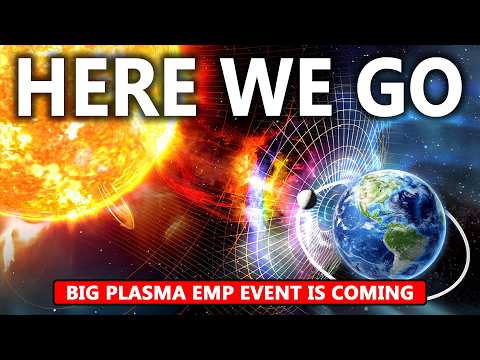
A series of solar storms, including multiple coronal mass ejections and a high-speed solar wind stream from a coronal hole, are expected to hit Earth soon, causing strong geomagnetic storms rated G2 to G4. These storms will affect Earth's magnetosphere, atmosphere, and surface, potentially intensifying weather systems and increasing seismic activity. Significant cyclones are currently active, and auroras will be visible at high latitudes.
Geophysicist Stefan Burns reports that Earth is about to be impacted by a sequence of solar storms. These storms are expected to trigger geomagnetic storms ranging from G2 (moderate) to G4 (severe), with G3 (strong) conditions being very likely. The geomagnetic storm scale ranges from 1 (minor) to 5 (extreme).
Currently, four different coronal mass ejections (CMEs) launched from the Sun are racing towards Earth. Additionally, a trans-equatorial coronal hole near the solar equator is emitting a high-speed solar wind stream. At the front of this stream is a co-rotating interaction region, essentially a dense wall of plasma, which is expected to sweep past Earth around March 21-22.
These solar events are occurring during the border between the solar maximum and the descending phase of Solar Cycle 25, a period known for increased solar activity.
The interaction of these solar storms can cause them to combine, potentially creating a stronger storm than if they arrived separately.
The official forecast from NOAA predicts G2 storming with potential for G3. However, due to the combination of multiple CMEs, the coronal hole stream, the new moon, and the equinox on March 20, stronger G3 to G4 storm conditions are possible.
Several significant cyclones are active globally:
Geomagnetic storms can enhance existing weather systems by energizing the global electric circuit, potentially intensifying these cyclones.
Recent seismic activity has been relatively low, with the strongest earthquake in the past week being a magnitude 6.3 in Chile on March 13. There has been a deficiency of magnitude 5+ earthquakes recently, which is unusual.
However, a burst of six significant earthquakes occurred on the mid-Indian Ocean ridge, a spreading center south of India. This seismic burst is notable because the antipode (opposite point on Earth) of this location is near the coast of Mexico, where increased seismic risk may be expected.
Historically, seismic activity tends to increase during the descending phase of the solar cycle and solar minimum, which we are approaching.
Measurements from an observatory in Tomsk, Russia, show fluctuations in the vertical electric field between the surface and ionosphere, overlapping with frequencies related to human brain waves and heart rhythms. Some unusual signatures were observed, possibly due to local atmospheric weather or data noise.
Earth is entering a period of heightened energetic activity due to solar storms and related space weather phenomena. These events will have tangible effects on Earth's magnetic environment, weather systems, and possibly seismic activity. Monitoring and understanding these impacts are crucial as we navigate this dynamic period.
Stay tuned for updates as these geomagnetic storms develop and impact our planet.
This article is based on the detailed analysis and forecast by geophysicist Stefan Burns.