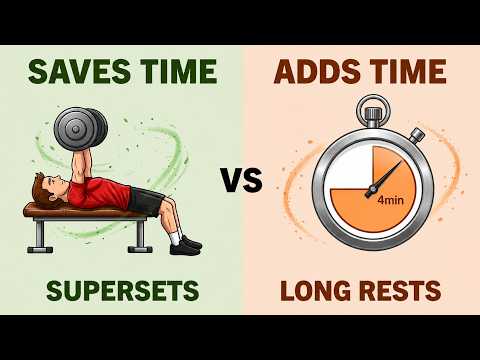
Many people struggle to find time for workouts due to busy schedules. This article explores strategies to improve time efficiency in training by balancing workout duration and hypertrophic stimulus. Key approaches include choosing convenient gym locations, minimizing warm-ups, managing training volume and frequency, optimizing rest periods, using alternate set structures like antagonist supersets, drop sets, and myoreps, and selecting exercises wisely to save time without compromising muscle and
One of the biggest barriers to long-term adherence to training is the time investment. Many people's days are packed with work, school, family commitments, relationships, and social events, making it difficult to find enough time to exercise. Even when time is found, spending the entire leisure time lifting in the gym may not be desirable.
This article covers training strategies to save time during workouts, helping you get more work done in a shorter time frame and maximize time efficiency in the gym.
Time efficiency in training has two components:
Simply reducing workout duration by doing less training may compromise the hypertrophic stimulus. The goal is to reduce workout duration while maintaining an effective hypertrophic stimulus. Sometimes, a small trade-off in hypertrophic stimulus may be acceptable for a large reduction in workout duration. The balance between workout duration and hypertrophic stimulus varies by individual.
Those focused on maximizing muscle growth may accept longer workouts, while those wanting a good stimulus in a short time may accept slightly inhibited hypertrophic stimulus.
The commute to and from the gym can significantly impact total workout duration, sometimes adding up to 30 minutes or more. Factors such as traffic, parking, and proximity to work or school affect this.
Choosing a gym that is convenient to access can minimize total session duration. However, consider other factors like cost, equipment, atmosphere, and gym busyness when selecting a facility.
Extensive warm-ups can add 20 to 30 minutes to workout duration. Typical warm-up components include light cardio, stretching, foam rolling, mobility drills, prehab, activation exercises, and acclimation sets.
For hypertrophy training, most warm-up components may not be necessary. A study with 15 men showed no significant difference in performance with or without various warm-up strategies.
However, some warm-up elements may be helpful:
Practical recommendation: Perform 1-2 warm-up sets before primary compound lifts. Other warm-up components are optional based on individual needs.
Training volume refers to the total number of sets per muscle group per week. More sets increase total training time linearly.
A meta-regression shows that muscle growth generally increases with volume but with diminishing returns at higher volumes.
Training frequency is how many times per week you train. More days mean more total time spent training.
When total weekly volume is equated, fewer workouts with more volume per session can save time by reducing commutes and warm-ups.
A meta-regression found frequency has a marginal effect on muscle growth when volume is equal.
However, training a muscle with more than 10 sets per session may have diminishing returns, so increasing frequency can be beneficial in such cases.
Recommendation: Decrease training frequency if it reduces total weekly time without making workouts unreasonably long or exceeding 10 sets per muscle per session.
Rest periods often make up the majority of workout duration. For example, 20 sets with 30 seconds per set equals 10 minutes lifting, but resting 2 minutes between sets totals 40 minutes resting.
Rest duration scales linearly with workout length.
A meta-analysis of nine studies compared short, moderate, long, and very long rest periods:
Summary: Moderate to longer rest periods favor hypertrophy slightly, but shorter rests significantly reduce workout duration and increase training density.
Reducing rest from 2 minutes to 1 minute can halve resting time, cutting a 50-minute workout to about 30 minutes.
Alternate set structures limit rest periods and improve time efficiency.
Alternate sets of two exercises targeting different muscle groups (e.g., shoulder press and leg extension). This allows one muscle group to rest while the other works, reducing total rest time without compromising recovery.
Studies show antagonist supersets are as effective as traditional training for muscle growth but reduce session duration significantly (e.g., 25 minutes less).
Limitations include equipment availability and gym crowding.
Perform a set to failure, then immediately perform subsequent sets with reduced load and minimal rest.
Drop sets increase training density and reduce total training time. A study showed similar biceps growth with drop sets compared to traditional training but with less time spent.
Not suitable for all exercises, especially high-fatigue compound lifts.
Perform one activation set to near failure, followed by multiple mini sets to failure with short rests (10-30 seconds).
No direct evidence on myoreps for muscle growth, but likely similar to drop sets in effectiveness and time efficiency.
Exercise choice affects warm-up and rest requirements.
Example:
Regarding muscle growth:
Recommendation: Use mostly low-fatigue machines and isolation exercises for time efficiency, but include some compound lifts for global hypertrophy benefits.
By balancing these factors, you can achieve effective muscle growth while significantly reducing workout time.
Thanks for reading, and hopefully, these strategies help you optimize your training time effectively!