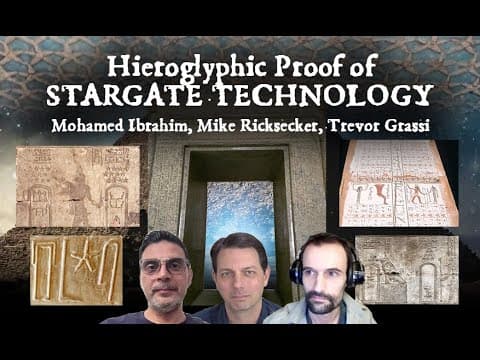
This blog post delves into the fascinating discussion between Trevor Graci, Mike Ricksecker, and Mohamed Ibrahim about ancient Egyptian technology, particularly the concept of Stargates. They explore hieroglyphic evidence, the backgrounds of the speakers, and the implications of their findings on our understanding of ancient civilizations.
In a captivating discussion, Trevor Graci, Mike Ricksecker, and Mohamed Ibrahim delve into the intriguing topic of ancient Egyptian technology, particularly focusing on the concept of Stargates. This conversation not only highlights the hieroglyphic evidence supporting the existence of such technology but also provides insights into the backgrounds of the speakers and their extensive research in Egyptology.
Mohamed Ibrahim, a prominent Egyptian guide, shares his journey into Egyptology. He explains that in Egypt, aspiring Egyptologists typically attend one of two major colleges: one focused on antiquities and the other on tourism. Despite the differences in focus, both paths provide a solid foundation in ancient Egyptian history, language, religion, and art.
Ibrahim emphasizes that while traditional education offers a good understanding of ancient Egypt, it often lacks the depth needed to explore new ideas. His collaboration with alternative researchers has opened new avenues of thought, challenging conventional narratives about ancient civilizations. He stresses the importance of recognizing pre-dynastic cultures that existed before the well-known dynasties of Egypt.
Mike Ricksecker shares his childhood fascination with adventure films like Indiana Jones, which sparked his interest in ancient mysteries. His journey led him to Egypt, where he sought to uncover the truths behind ancient beliefs and technologies. He recounts his first encounter with Mohamed Ibrahim during a tour, which ultimately led to their collaboration on Stargate tours in Egypt.
The discussion shifts to the hieroglyphic evidence of Stargates found in various temples, particularly in Abydos and Edfu. Ibrahim explains that the term "hieroglyphics" is often misused; the correct term is the ancient Egyptian language. He highlights specific hieroglyphs that suggest the existence of Stargates, including the word "sabah," which means star, and "rooti," which means gate. Together, they form the term "Stargate."
Ricksecker and Ibrahim present images of these hieroglyphs, illustrating how they depict not just gates but also the concept of multiple Stargates leading to different star systems. They discuss the significance of these symbols and how they challenge the conventional understanding of ancient Egyptian technology.
Ibrahim elaborates on the role of ancient Egyptian priests, who were not just religious figures but also scientists and scholars. He argues that the knowledge of astronomy and technology was preserved and passed down through generations, often encoded in hieroglyphs to protect it from being lost or misinterpreted. This encoding is evident in the texts found in temples, which often require careful study to decipher their true meanings.
The conversation also touches on the concept of "Stargate Kings," rulers who were believed to have the knowledge or ability to access these ancient technologies. Ibrahim lists several notable kings, including Amenhotep III and Ramses II, who were associated with Stargate technology. He emphasizes that these rulers were not just powerful leaders but also custodians of ancient knowledge.
Ibrahim reveals that he has encountered what he believes to be an instruction manual for using Stargates, detailing potential destinations and the materials required for activation. This manual, found in the temple of Dendera, lists various gates and their corresponding symbols, suggesting a sophisticated understanding of interstellar travel.
The discussion concludes with a call to recognize the advanced knowledge of ancient Egyptian civilization. Both Ricksecker and Ibrahim stress that the exploration of Stargates is not merely speculative but grounded in historical evidence. They encourage further research and open-mindedness regarding the capabilities of ancient cultures, urging a reevaluation of how we understand their achievements.
As we continue to uncover the mysteries of ancient Egypt, the insights shared by these experts remind us of the rich tapestry of history that lies beneath the surface, waiting to be explored and understood.