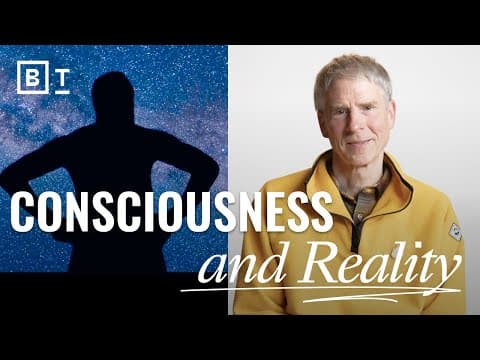
Christof Koch delves into the nature of consciousness, perception, and reality, emphasizing how individual experiences shape our understanding of the world. He discusses the concept of the 'Perception Box' and how expanding it through education, mindfulness, and empathy can lead to a more fulfilling life.
How do you know you exist? This fundamental question leads us into the realm of conscious experience, which encompasses seeing, hearing, loving, fearing, dreading, dreaming, and imagining. Each of these experiences is mediated by our senses and processed by our brains, creating a unique interpretation of reality for each individual. We all live within what Christof Koch refers to as the "Perception Box." When transformative experiences occur, the walls of this box can expand, allowing for new interpretations and a more positive outlook on life.
Christof Koch is a prominent brain scientist, serving as the chief scientist of the Tiny Blue Dot Foundation in Santa Monica and as a meritorious investigator at the Allen Institute in Seattle. His research focuses on consciousness in both humans and animals. From a medical perspective, consciousness is defined as the awareness of self and others, along with arousal. This awareness is facilitated by the brainstem, which is essential for consciousness but does not provide the content of our conscious experiences. Instead, this content arises from the neocortex, the outermost layer of the brain, known for its complexity and excitability.
Most individuals are what Koch describes as naive realists, believing that their perceptions reflect actual reality. While this may hold true in certain contexts—such as agreeing that we are sitting in a room—our interpretations of reality can vary significantly. A notable example is the viral phenomenon known as "The Dress," where half of the population perceived a dress as gold and white, while the other half saw it as blue and black. This illustrates how the same reality can be interpreted differently based on individual perception.
Koch emphasizes that people often make unspoken assumptions about themselves and the world around them. Different cultures have developed various methods to encourage openness and curiosity, which can help expand the walls of the Perception Box. Key strategies include:
These practices can help individuals recognize their biases and foster a more expansive view of reality.
Koch likens our existence to living in the gravitational field of planet ego. Just as astronauts can experience weightlessness, there are moments when we can transcend our ego and become selfless. This can occur during states of flow, meditation, or even through certain psychedelic experiences. Koch shares a personal anecdote of a mystical experience he had on the beach, where he felt a profound connection with the universe, illustrating how such moments can shift our understanding of existence.
The Perception Box is fundamentally shaped by the wiring of neurons in our brains. As we accumulate experiences, our Perception Box evolves, allowing us to reinterpret our experiences and view the same facts from different perspectives. This cognitive flexibility can lead to greater contentment and a sense of belonging in the world.
Koch highlights the importance of mindfulness in our daily lives. Many people find themselves "nowhere" due to distractions from technology and constant notifications. By reinterpreting the word "nowhere" as "now here," individuals can cultivate a sense of presence and focus on their immediate surroundings. This shift in perspective encourages a deeper connection with oneself and the world.
When individuals lose their sense of self and recognize their place among many conscious beings, they develop empathy and positive feelings towards others. This understanding fosters a sense of community and shared experience, reminding us that we are all engaged in the same journey through life, framed by the boundaries of existence.
Christof Koch's exploration of consciousness, perception, and reality invites us to reflect on our individual experiences and the ways we interpret the world. By expanding our Perception Box through education, mindfulness, and empathy, we can cultivate a richer understanding of ourselves and our connections to others. Ultimately, this journey leads to a more fulfilling and engaged life, as we navigate the complexities of existence together.