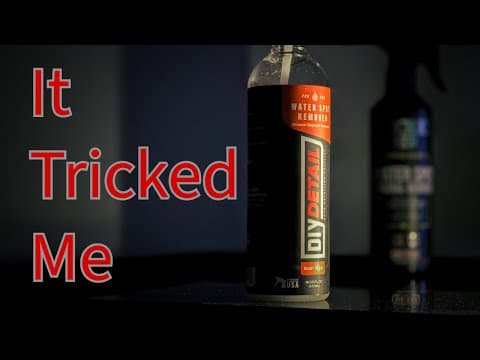
Exploring DIY Detail's Water Spot Remover: A Surprising Hydrophobic Effect
This blog post reviews DIY Detail's water spot remover, highlighting its unexpected ability to restore hydrophobic properties to car surfaces. The author shares their testing process, observations, and thoughts on the product's effectiveness and formulation.
In the world of car detailing, water spot removers are essential for maintaining the appearance of vehicles. Recently, I had the opportunity to test DIY Detail's water spot remover, a product recommended by Ivan at DIY Detail. My experience with water spot removers has been limited, primarily using a strong product from the Maniac line. However, I was intrigued by the claims made about DIY Detail's product and decided to put it to the test.
Testing Process
This past weekend, I undertook a deep cleaning of both my cars, which had not been clayed in a while. The van had never been clayed, while the Prius had not seen a clay treatment in a long time. To prepare the surfaces for testing, I performed the following steps:
- Foam Wash: I applied a full foam wash using Bilt Hamber foam to loosen dirt and grime.
- Clay Treatment: I used a clay block to remove embedded contaminants, ensuring a smooth surface.
- Iron Remover: I followed up with DIY Detail's iron remover to eliminate any remaining impurities.
After these steps, I was ready to test the water spot remover.
Application of the Water Spot Remover
I applied the DIY Detail water spot remover in a damp environment, as it was raining during my testing. Here’s how I used the product:
- I misted the product onto each panel of the Prius, using one spray per panel.
- After applying, I wiped it in with a towel, ensuring even coverage.
- For the van, I sprayed the product directly onto the towel and worked it into the surface.
The results were impressive. The product not only felt slick but also seemed to restore a significant amount of hydrophobic properties to the paint.
Observations and Results
After using the water spot remover, I noticed a remarkable return of hydrophobic properties on the surfaces treated. This was particularly evident on the hood of the Prius, where I had been testing various products. However, I had some reservations about the longevity of these effects:
- Temporary vs. Permanent: While the hydrophobic effect was noticeable, I questioned whether it was a temporary boost or a lasting restoration. After washing the car with a pH-neutral shampoo, the hydrophobic properties diminished, returning to their previous state.
- Product Formulation: I speculated that the product might be adding hydrophobic properties rather than merely restoring them. This raised questions about its intended use—whether it was meant to be a lubricant or if it should be rinsed off after application.