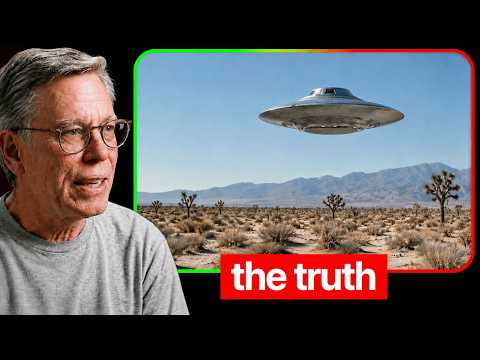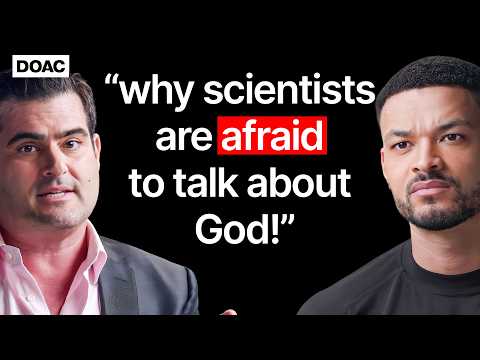
Astrophysicist Brian Keating discusses his groundbreaking research aimed at answering fundamental questions about the universe, existence, and the potential connection to God, backed by a $200 million project. He reflects on the history of cosmology, the implications of the Big Bang, and the intersection of science and spirituality.
In a world where science and spirituality often seem at odds, astrophysicist Brian Keating is on a mission to bridge that gap. With a staggering $200 million project, he aims to explore the fundamental questions of existence and the universe, including the intriguing relationship between science and the concept of God.
Keating's journey begins with a fundamental question that has puzzled humanity for centuries: How did we get here? This question is not just about the origins of the universe but also about the nature of existence itself. For Keating, this inquiry is deeply personal, rooted in his childhood curiosity about the cosmos.
To understand the present, Keating takes us back 400 years to Galileo, who, through his telescope, revealed that Earth is not the center of the universe. This revelation opened the door to a vast cosmos, yet the question of how the universe began remains unresolved. Keating's own research has taken him to the South Pole, where he believed he had discovered the creation of time and space, only to face the disappointment of retracting those findings.
Despite setbacks, Keating's determination has led to the launch of a $200 million project aimed at capturing the earliest moments of the universe. This project seeks to gather exquisite data that could potentially answer whether the universe had a singular origin, as described in various religious texts, or if it follows a different narrative.
Keating emphasizes that science is an infinite game, where the pursuit of knowledge is ongoing and often filled with uncertainty. He discusses the controversial existential questions that arise from his research, particularly the nature of the universe's origin and the existence of God. He notes that these questions are not settled science and that the answers may lie in the data yet to be collected.
One of the most provocative aspects of Keating's work is his willingness to engage with the question of God. While many scientists shy away from this topic, Keating identifies as a practicing agnostic, exploring the implications of faith and the possibility of a creator. He believes that contemplating God adds a rich layer to scientific inquiry, allowing for a deeper understanding of existence.
Keating argues that while science relies on evidence and knowledge, the concept of God introduces an element of faith. He reflects on the biblical creation narrative and its potential alignment with scientific discoveries. For him, the pursuit of truth in science and the exploration of spirituality are not mutually exclusive but rather intertwined.
Delving into the scientific aspects, Keating explains the significance of Edwin Hubble's discovery that galaxies are moving away from each other, leading to the conclusion that the universe is expanding. This expansion points to a singular event known as the Big Bang, which marks the beginning of time and space.
Keating recounts a pivotal moment in his research when he believed he had detected the reverberations of the Big Bang, only to realize that what he observed was cosmic dust. This experience highlights the challenges and emotional toll that scientists face in their quest for understanding.
As Keating contemplates the vastness of the universe, he addresses the question of extraterrestrial life. Despite the billions of stars and planets, he posits that the probability of life existing elsewhere is low, given the specific conditions required for life to thrive. This leads to a profound realization about the uniqueness of human existence.
In a reflective moment, Keating shares his thoughts on the meaning of life. He believes that the essence of life lies in forming deep connections and making choices that have significant consequences. This perspective is shaped by personal experiences, including the loss of loved ones, which have deepened his appreciation for life and the relationships he cherishes.
Brian Keating's exploration of existence is a testament to the power of curiosity and the human spirit. His work not only seeks to unravel the mysteries of the universe but also invites us to ponder our place within it. As he continues his quest with the $200 million project, the intersection of science and spirituality remains a central theme, challenging us to consider the profound questions that define our existence.