This blog post delves into the fascinating world of ultra-high-speed photography, showcasing a camera capable of capturing 2 billion frames per second. It explores the technology behind the camera, the experiments conducted with light, and the peculiar effects observed when recording light's movement. The post explains the intricacies of building the camera, the challenges faced, and the implications of observing light at such high speeds, ultimately revealing how this technology allows us to 'w
In the realm of high-speed photography, the ability to capture events at extraordinary frame rates opens up a world of possibilities. This blog post explores a groundbreaking camera capable of shooting at 2 billion frames per second (fps), revealing the peculiarities of light and its behavior when observed at such rapid speeds.
The camera, an upgraded version of a previous model that shot at a billion fps, consists of a simple yet effective assembly: one mirror, one lens, two tubes, cables, a unique camera flash bulb, and a few hundred lines of Python code. This setup is not just fast enough to watch light move; it can also capture light traveling through time, allowing us to see the past.
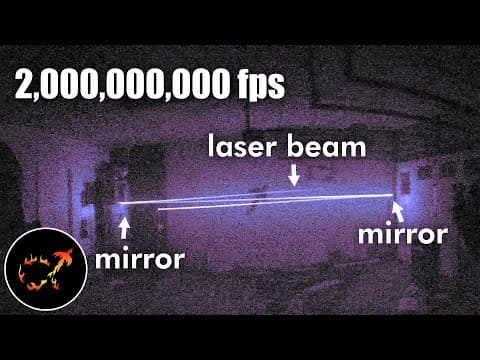
The first experiment conducted with this camera involved a high-power laser focused down the length of a garage. The laser beam ricocheted between mirrors, creating a setup that would allow the camera to capture the light's journey. A long exposure photograph of this setup reveals what the human eye would see, while the footage at 2 billion fps shows light moving approximately 6 inches (15 cm) per frame.
One of the most intriguing aspects of this experiment is the perception of light speed when the camera is moved. When the camera moves away from the light source, the light appears to travel slower, while it seems to travel faster when the camera moves towards it. This observation raises questions about the constancy of light speed, which is traditionally understood to be constant in any reference frame.
To achieve the remarkable frame rate, the camera operates on a unique principle. It records only one pixel at a time, capturing a series of one-pixel videos from different angles. By synchronizing these videos, the camera can create a composite image that resembles a full video. This method, while effective, is not feasible with conventional consumer technology, which is why this setup is considered a cheat.
The new camera features significant upgrades over the original model, including:
The camera's operation relies on a photo multiplier tube (PMT) as the light sensor, which is incredibly sensitive and capable of detecting single photon events. The PMT converts light intensity into electrical signals, which are then processed by an oscilloscope at a rate of 2 billion samples per second. This allows the camera to capture and store data continuously, creating a detailed record of light's behavior.
When light travels through the camera, it undergoes a series of transformations. A photon emitted from the laser travels through the air, reflects off surfaces, and eventually reaches the PMT. The time it takes for light to traverse these distances is critical, as it influences the perceived speed of light in the recorded footage.
The camera's ability to perceive light at different distances leads to fascinating effects. Light from nearby objects reaches the camera faster than light from distant objects, creating a delay that can be observed in the footage. This phenomenon illustrates how the camera captures a slice of time, revealing the complexities of light travel.
The experiments conducted with this ultra-high-speed camera not only showcase the technology's capabilities but also highlight the peculiarities of light itself. As we observe light traveling at incredible speeds, we are reminded of the fundamental principles of physics that govern our understanding of the universe. This camera allows us to explore these principles in a tangible way, making the abstract concepts of light speed and time travel more accessible and engaging.
With plans for further experiments and videos, the journey into the world of high-speed photography continues, promising to unveil even more of light's mysteries. Stay tuned for more insights and discoveries as we push the boundaries of what is possible with technology and science.