Our solar system, a tiny part of the vast universe, hosts astonishing phenomena from Pluto's young icy plains to Saturn's ring gaps. Discover the terrifying lava planet K2-141b, the volcanic moon Io, and the dangers of lunar dust. Learn about the Hubble Telescope's deep space observations, the mysterious disappearance of exoplanet Fomalhaut B, and the universe's potential end in the Big Rip scenario.
Our solar system is just a tiny section of the Milky Way Galaxy, which itself is one of an estimated two trillion galaxies in the universe. Despite its small size in the grand cosmic scale, our solar system is home to some of the most mysterious and shocking phenomena known to science. From distant dwarf planets to terrifying moons and cosmic events, here are 13 insanely cool things in our solar system that will leave you speechless.
Launched on January 19th, 2006, the New Horizons space probe was the first spacecraft to explore Pluto and the Kuiper Belt up close. It brought back images of Pluto that were beyond anyone’s wildest dreams. One of the most remarkable discoveries was Pluto’s heart-shaped region, a surprisingly smooth, crater-free plain.
Astronomers believe this area is very young, having been active within the last 100 million years — a blink of an eye in celestial terms. Pluto’s frozen plains are full of planetary oddities: some areas look like cracked mud flats, others are unusually hilly, and troughs run through the terrain filled with something dark oozing from beneath. Scientists are still unsure about the exact cause of these features, but theories include convection or a contracting crust causing the surface to crack and chip, somewhat like dry paint.
It is well-known that the universe is expanding, but the nature of this expansion remains a mystery. Many scientists believe that dark energy is driving this expansion. A frightening hypothesis called the Big Rip suggests that this expansion could eventually tear the universe apart.
Unlike many end-of-the-world scenarios that occur long after humanity is gone, the Big Rip could happen in about 16 billion years — a time when planets and possibly life might still exist. This cosmic catastrophe could burn everything alive, rip apart matter, or perhaps feed unknown celestial creatures lurking in space. While speculative, it paints a grim picture of the universe’s ultimate fate.
Astronomers recently discovered a truly hellish planet named K2-141b, located roughly 200 lightyears away. This lava planet is unlike anything on Earth. It has a gigantic lava sea about 60 miles deep and winds that blow at over four times the speed of sound.
Due to its orbit around its sun, one side of K2-141b experiences permanent daylight with temperatures soaring as high as 5,432 degrees Fahrenheit. The other side is in endless darkness, with temperatures plummeting to negative 328 degrees. This extreme temperature difference and violent environment make it an uninhabitable and terrifying world.
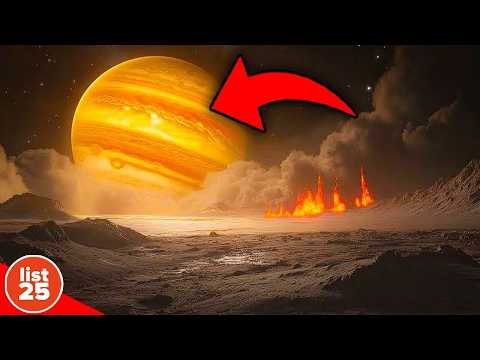
Among all the moons orbiting planets in our solar system, Io stands out as the most terrifying. It is plagued by extreme temperatures and is covered with active volcanoes sitting atop oceans of lava.
Io’s atmosphere is filled with sulfur dioxide, making it toxic and deadly — a place that might resemble what we imagine hell to be. Adding to the danger, intense magnetic fields and high radiation levels ensure that anything landing on Io’s surface would not last long.
The Hubble Space Telescope, about the size of a school bus, is one of the busiest and most important telescopes in the world. It has observed regions of space more than 13.4 billion light years away, effectively looking back in time to see light from the early cosmos.
Orbiting Earth at about 326 miles above the surface and traveling at 17,000 miles per hour, Hubble remains accessible for astronauts who have visited it multiple times to perform repairs and upgrades. Its observations have revolutionized our understanding of the universe.
While space is inherently dangerous, one of NASA’s biggest challenges is moondust. Unlike Earth’s powdery dust, lunar dust particles are razor sharp, never degrade, and consist mostly of meteorite fragments.
In 2018, scientists confirmed that lunar dust can be deadly. Laboratory tests showed that exposure to lunar dust destroyed nearly 90% of lung and brain tissue cells within 24 hours. The surviving cells suffered extensive DNA damage, increasing the risk of cancer and neurodegenerative diseases. This makes moondust a serious hazard for future lunar explorers.
Scientists once believed they had discovered the first exoplanet visible to the naked eye, named Fomalhaut B, captured in images by the Hubble Space Telescope. However, by 2012, the planet had mysteriously disappeared.
Research published in 2020 suggested that what was thought to be a planet was actually a massive dust cloud formed by the collision of two large space bodies made of dust and ice. This revelation showed that Fomalhaut B never existed as a planet, highlighting the challenges of interpreting cosmic observations.
Saturn’s rings are one of the most impressive sights in our solar system. From afar, they appear smooth and unbroken, but up close, they contain several gaps.
One notable gap is the Encke Gap, caused by the moon Pan. First observed by German astronomer Johann Franz Encke, this gap is maintained by Pan’s gravitational pull on the icy and rocky particles in the rings. The gap is large enough for Pan to move through, demonstrating the dynamic interactions within Saturn’s ring system.
Our solar system is filled with wonders and mysteries that continue to fascinate scientists and space enthusiasts alike. From the young icy plains of Pluto to the violent volcanic activity on Io, and from the deadly lunar dust to the vast reaches explored by the Hubble Telescope, these phenomena remind us of the vastness and complexity of the cosmos. As we continue to explore, who knows what other mind-blowing facts await discovery?