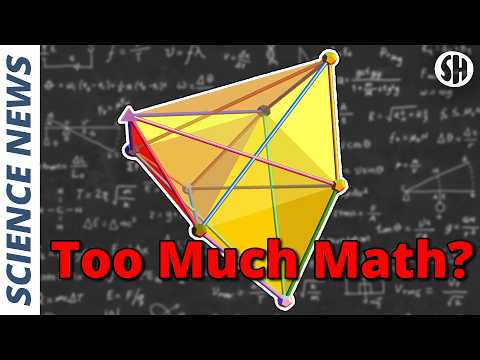
Positive geometry is a novel approach in physics that aims to unify various fields, including cosmology and particle physics. This blog post delves into its concepts, potential implications, and contrasts it with category theory, highlighting the philosophical debates surrounding the role of mathematics in physics.
In recent discussions within the physics community, the concept of "positive geometry" has emerged as a promising new approach that could potentially unify various fields of physics, from cosmology to particle physics. This idea brings to mind the earlier enthusiasm surrounding category theory, which was also heralded as a unifying framework for physics two decades ago. In this blog post, we will explore the fundamentals of positive geometry, its implications for the future of physics, and how it compares to category theory.
Positive geometry is a relatively new concept that has been developing over the past decade. It represents a two-way relationship between physics and mathematics, where physicists have drawn inspiration from existing mathematical ideas, and mathematicians have become increasingly interested in these developments.
To understand positive geometry, we can simplify its definition. It can be described as a pair consisting of a complex algebraic variety defined over the reals and a closed semi-algebraic region whose interior is an oriented d-manifold. While this definition may sound complex, it essentially refers to a generalization of the amplituhedra, which are geometric shapes proposed by physicist Nima Arkani-Hamed and his collaborators. These shapes are believed to have the potential to replace traditional notions of space and time.
In simpler terms, positive geometry can be visualized as a polygon in higher dimensions. The term "positive" refers to the mathematical inequalities that define these shapes, indicating that certain values must be greater than or equal to zero. On these polygons, values can be assigned to the sides and edges, which allows for a description of how physical systems can change.
This characteristic makes positive geometries particularly intriguing, as they can describe not only particle interactions but also the dynamic changes of the universe itself. The potential for positive geometry to unify quantum physics with gravitational theories is a significant aspect of ongoing research in this area.
Recent publications have sought to bridge the gap between positive geometry and more conventional physics. Researchers have begun deriving differential equations and correlation functions from positive geometries, making the concepts more accessible to physicists familiar with these terms. While this development is promising, it is essential to approach it with caution.
On a scale of skepticism, this idea rates a 1 out of 10 on the bullshit meter, indicating that it is both new and likely mathematically sound. However, the lack of concrete predictions raises questions about its practical relevance to the physical world.
Category theory, which gained attention among physicists in the early 2000s, is a general theory of mathematical structures and their relationships. It aims to describe all theories in physics through a unified framework. However, despite initial interest, category theory has not revolutionized physics as some had hoped.
The challenge with category theory lies in its tendency to generalize mathematics to such an extent that it can describe anything, but not necessarily everything. This raises concerns that positive geometry may follow a similar trajectory, resulting in a highly abstract mathematical construct that fails to address real-world problems.
The emergence of concepts like positive geometry prompts deeper philosophical questions about the role of pure mathematics in physics. Some scholars, such as David Lindley in his book "The End of Physics," argue that the stagnation in the foundations of physics may stem from an overreliance on abstract mathematics at the expense of experimental validation and understanding.
In contrast, I view mathematics as a powerful tool that, when wielded effectively, can enhance our understanding of the universe. However, it is crucial to remain grounded and ensure that these mathematical constructs have tangible connections to physical reality.
As we explore the potential of positive geometry to reshape our understanding of physics, it is essential to maintain a critical perspective. While it offers exciting possibilities for unifying various fields, we must also be cautious of its abstract nature and the lessons learned from past mathematical theories like category theory. The ongoing dialogue between mathematics and physics will undoubtedly continue to evolve, shaping the future of scientific inquiry.
For those interested in enhancing their problem-solving skills and critical thinking, platforms like Brilliant offer interactive courses that can help demystify complex topics in mathematics and science. Engaging with such resources can provide valuable insights into the intricate relationship between mathematics and physics, fostering a deeper understanding of these fascinating concepts.