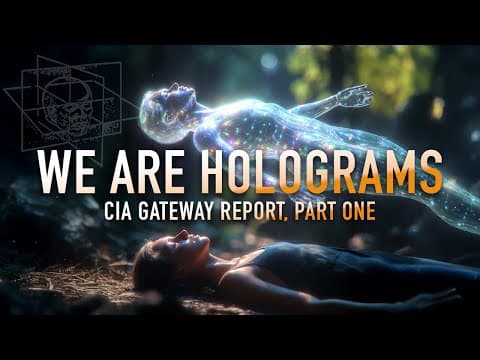
In 1983, the US Army explored consciousness and reality through the Gateway Process, revealing that we live in a holographic universe. This blog post delves into the findings of Lieutenant Wayne McDonald, who discovered that consciousness is separate from the physical body, enabling time travel, astral projection, and communication with nonhuman intelligences. The report outlines techniques like hypnosis, meditation, and biofeedback, emphasizing the power of brain hemisphere synchronization to '
In 1983, during the height of the Cold War, the US Army embarked on a quest to understand consciousness and its implications for military intelligence. This initiative led to the development of the Gateway Process, a program designed to explore the potential of psychic phenomena and altered states of consciousness. Lieutenant Wayne McDonald was tasked with investigating these concepts, ultimately revealing profound insights about our reality.
The US Army, concerned about the Soviet Union's advancements in psychic espionage, sent McDonald to learn about consciousness and its mechanics. His findings were groundbreaking: consciousness is not only real but fundamental, existing independently of the physical body. More astonishingly, he concluded that we inhabit a holographic universe, where our brains act as transducers, capable of receiving and altering reality through focused awareness.
McDonald’s research led to several significant revelations:
The report, titled "Analysis and Assessment of the Gateway Process," was initially classified for over 20 years. It outlines the techniques used to achieve altered states of consciousness, including hypnosis, transcendental meditation, and biofeedback. McDonald emphasized the importance of brain hemisphere synchronization, or Hemisync, as a means to access higher states of awareness.
Hemisync is a core component of the Gateway Process, designed to synchronize the brain's left and right hemispheres. This synchronization enhances focus and coherence, allowing individuals to transcend physical limitations and access intuitive knowledge. McDonald compared the human mind to a laser beam, capable of projecting concentrated energy and information across vast distances.
The Gateway Process utilizes a phenomenon known as frequency following response (FFR), where the brain mimics external sound frequencies. By listening to specific audio patterns, individuals can shift their brainwave states, facilitating entry into altered states of consciousness. This technique allows for profound experiences, including telepathic communication and out-of-body experiences.
The concept of a holographic universe suggests that all matter is composed of oscillating energy grids. McDonald explained that our perception of reality is shaped by the interaction of energy in motion and energy at rest. This interaction creates holograms, which encode vast amounts of information in a compact form.
According to McDonald, the universe is a complex hologram, and human consciousness operates similarly. Our minds are capable of projecting and interpreting holographic images, allowing us to perceive reality beyond our physical senses. This process involves comparing new information with existing memories, enabling us to make sense of our experiences.
The insights gained from the CIA Gateway Report challenge our understanding of consciousness and reality. McDonald’s findings suggest that we are not merely passive observers of the universe but active participants capable of shaping our experiences. As this information continues to emerge, it invites us to explore the depths of our consciousness and the potential that lies within.
The implications of the Gateway Process extend beyond military applications, offering a framework for understanding the nature of reality and our place within it. As we delve deeper into these concepts, we may uncover new pathways to personal and collective transformation.