
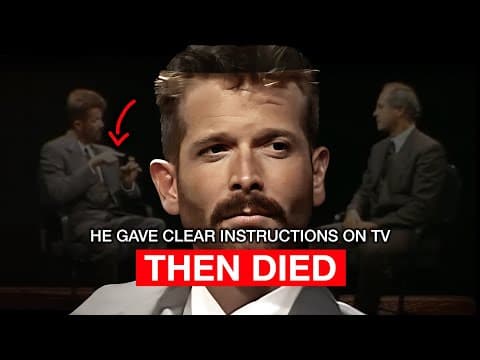
Michael Talbot's groundbreaking ideas on holographic reality challenge our understanding of existence, consciousness, and the interconnectedness of all things. His sudden death raised questions about the nature of reality and the implications of his theories on science and spirituality.
In a world where science and spirituality often seem at odds, Michael Talbot emerged as a unique voice, proposing that our understanding of reality is far more complex than we realize. His theories on the holographic nature of the universe not only challenged conventional scientific thought but also opened doors to new ways of understanding consciousness and existence. Tragically, Talbot's life was cut short shortly after he shared his revolutionary ideas, leaving behind a legacy that continues to provoke thought and discussion.
Talbot's central claim was that our universe is not a singular, solid reality but rather a holographic construct with multiple layers of existence. He suggested that there are parallel realities occurring simultaneously, which we typically cannot perceive. This perspective aligns with findings in quantum mechanics, particularly the double-slit experiment, which revealed that particles behave differently when observed, indicating that the observer is part of the system.
Talbot likened the universe to a hologram, where reality can manifest in two distinct forms: as a concrete image or as an indistinct blur of energy. He used the analogy of watching a television show, where the image on the screen is just one way of perceiving the encoded information transmitted through radio waves. This suggests that our perceived reality is just one layer of a much deeper, interconnected existence.
Talbot's theories imply that every part of the universe is interconnected, and that the division between mind and matter is an illusion. He argued that consciousness plays a crucial role in shaping reality, reversing the common belief that matter precedes consciousness. This idea has profound implications for our understanding of life, death, and the nature of existence itself.
In Talbot's framework, death is not an end but a transition to another layer of reality. He proposed that consciousness moves across different realities, similar to shifting frequencies. This perspective challenges the traditional view of death and encourages a more expansive understanding of existence.
Talbot drew parallels between his theories and quantum phenomena, such as the behavior of entangled particles. He noted that when two subatomic particles are entangled, a change in one instantly affects the other, regardless of distance. This phenomenon raises questions about the nature of communication and connection at a fundamental level, suggesting that our minds may operate through a similar hidden network.
One of the most compelling aspects of Talbot's work is its implications for medicine and healing. He highlighted the placebo effect as evidence that belief and consciousness can directly influence physical reality. In one striking example, a man with terminal cancer experienced a miraculous recovery after believing he was receiving an effective treatment, only to relapse when he learned the treatment was ineffective. This suggests that our expectations and beliefs can shape our physical health in profound ways.
Talbot also explored the phenomenon of near-death experiences (NDEs), where individuals report vivid encounters with alternate realities after being declared clinically dead. Many NDE accounts describe a flexible, responsive reality where thoughts can manifest instantly. Talbot posited that these experiences might offer glimpses into the true nature of reality, free from the constraints of the physical brain.
Talbot believed that as consciousness evolves, individuals may learn to navigate these deeper layers of reality. He suggested that experiences often labeled as paranormal, such as telepathy or UFO encounters, could be manifestations of a more profound understanding of interconnectedness and the plasticity of reality.
Michael Talbot's exploration of the holographic universe challenges us to reconsider our understanding of existence, consciousness, and the nature of reality itself. His untimely death left many questions unanswered, but his ideas continue to resonate, inviting us to explore the profound connections that bind us all. As we delve deeper into the mysteries of the universe, we may find that reality is far more intricate and interconnected than we have ever imagined.



















