Michael Talbert's groundbreaking theories challenge our understanding of reality, suggesting that separation is an illusion and that consciousness is interconnected. His insights into quantum physics, memory, and perception reveal a holographic universe where psychic phenomena are natural. Talbert's work raises profound questions about control, belief, and the nature of existence, urging us to reconsider our perceptions and the hidden structures that shape our reality.
Michael Talbert's theories present a radical rethinking of our understanding of reality, suggesting that the boundaries we perceive are mere illusions. His insights into quantum physics, consciousness, and memory challenge the very foundations of modern science and philosophy, proposing a holographic universe where everything is interconnected.
Talbert boldly claimed that there is no separation between electrons or between people. This assertion has profound implications for our understanding of psychic phenomena and consciousness. If we live in a holographic universe, the traditional view of individuals as isolated entities collapses. Instead, we may be part of a larger, interconnected system where separation is an illusion.
To illustrate his ideas, Talbert often used the aquarium analogy. Imagine an aquarium with fish, where observers only see images on screens without understanding the deeper reality of the fish swimming inside. This metaphor highlights how humans can mistake appearances for reality, suggesting that our daily experiences may be mere projections detached from the full truth. Talbert argued that governments and institutions exploit this blindness, shaping our perceptions and maintaining control by focusing our attention on surface-level divisions.
Talbert's theories are deeply rooted in quantum physics, particularly the concept of entanglement. At the quantum level, particles appear to be connected regardless of distance, challenging the notion of separation. This idea terrifies traditional physicists as it contradicts Einstein's relativity, which states that nothing can travel faster than light. Talbert viewed entanglement as evidence that separation is not real, suggesting that consciousness might also be interconnected across human bodies.
Despite mainstream science dismissing psychic phenomena, Talbert pointed out that intelligence agencies have secretly explored these ideas. Projects like the CIA's remote viewing experiments demonstrate that governments recognize the potential of psychic abilities, even while the public is led to believe they are mere fantasy. Talbert argued that if consciousness is interconnected, then every individual has access to a deeper field of information, making it difficult for authorities to maintain control.
Talbert's exploration of memory further dismantles traditional neuroscience. He referenced the work of Carl Lashley, who found that memory is not localized in specific areas of the brain but is distributed holographically. This suggests that our thoughts and experiences may exist in a field larger than our individual minds, challenging the conventional view of memory storage.
If memory is holographic, then our minds are not confined to our skulls. This raises the unsettling possibility that someone with the right knowledge could access our thoughts. Talbert described memory as a broadcast rather than a localized function, implying that our private thoughts may not be as private as we believe.
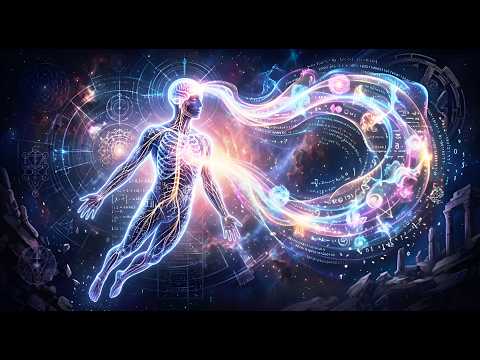
Talbert also highlighted the mathematical principles behind holography, particularly Fourier transforms, which our brains use to interpret sensory information. This suggests that our perception of reality is not a direct reflection of the external world but a reconstruction based on wave patterns. If perception is a projection, then what we see is always filtered and potentially engineered.
Talbert warned that those who understand the holographic nature of reality can manipulate perception through frequency. Ancient rituals and modern media both exploit this principle, shaping our beliefs and expectations. By controlling the code of reality, institutions can maintain their power and keep the masses blind to their true potential.
Talbert's work serves as a call to awaken to the truth of our interconnectedness. If we recognize that reality is a holographic projection, we can begin to break free from the illusions that bind us. The implications of this understanding are profound: every thought, belief, and expectation shapes the projection of our reality.
With the realization that we are co-creators of our reality comes a responsibility to challenge the narratives imposed upon us. Talbert believed that if people understood the holographic nature of existence, they would no longer accept the limitations placed on them by society. The aquarium walls would crack, and humanity would awaken to the deeper truths hidden behind the projections.
Michael Talbert's radical ideas challenge us to reconsider our perceptions of reality. His insights into the holographic nature of existence, the interconnectedness of consciousness, and the manipulation of perception by powerful institutions reveal a hidden structure that shapes our lives. As we explore these concepts, we must confront the illusions of separation and recognize our potential to shape the world around us. The question remains: if the universe is a hologram, who is running the projector? Talbert's sudden death leaves us with more questions than answers, but his legacy serves as a reminder to look beyond the glass and seek the deeper truths of our existence.