This blog post delves into the fascinating world of molecular machines within the human body, explaining their roles in cell division, DNA replication, and the potential future of nanotechnology in medicine.
Every day, within the human body, an astonishing process occurs involving tiny molecular machines that work tirelessly to maintain our health and functionality. This blog post will explore these molecular machines, their roles in cell division, and the implications for future medical advancements.
In an adult human body, approximately 50 to 70 billion cells die daily due to stress, damage, or aging. This phenomenon, known as "programmed cell death," is a normal part of cellular life. To compensate for this loss, billions of cells are simultaneously dividing to create new cells. This process, known as mitosis, relies heavily on an intricate network of molecular machines.
To grasp the complexity of these molecular machines, we must first understand DNA, the double helix structure that carries our genetic information. Each strand of DNA consists of a sugar-phosphate backbone connected to a sequence of nucleic acid base pairs represented by the letters A, T, G, and C. The strands run in opposite directions, which is crucial for the DNA replication process.
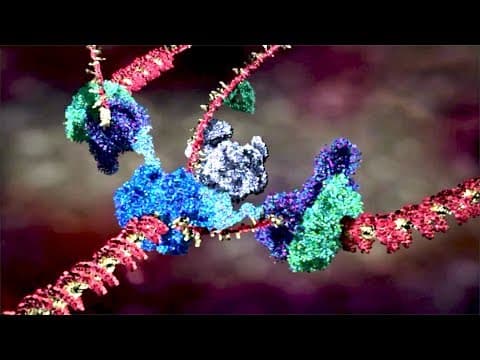
During cell division, the two strands of DNA are unwound and separated by a molecular machine called helicase, which operates at remarkable speeds. As helicase unwinds the DNA, one strand is continuously assembled with its complementary strand, while the other strand is assembled in sections due to its opposite direction. This meticulous process results in two identical DNA molecules, each a few centimeters long but only a couple of nanometers wide.
To prevent tangling, DNA wraps around proteins called histones, forming structures known as nucleosomes. These nucleosomes are further bundled into chromatin fibers, which coil to form chromosomes. Chromosomes, which can be observed under a microscope during cell division, take on a distinct shape only when the cell is preparing to divide.
The entire process of cell division takes about an hour in mammals. During this time, chromosomes align at the cell's equator before being pulled apart into two new daughter cells, each containing an identical copy of DNA. However, this seemingly straightforward process is incredibly complex and involves numerous molecular machines.
Each chromosome consists of two chromatids, which are identical copies of DNA. These chromatids are attached to microtubule fibers that help align them correctly during division. The connection between the chromatids and microtubules occurs at a structure called the kinetochore, which is composed of hundreds of proteins working in unison.
The kinetochore plays a crucial role in the successful separation of chromatids. It establishes a dynamic connection between the chromosome and the microtubules, sending out chemical signals to indicate when the chromosome is ready to divide. The kinetochore also senses tension, ensuring that the chromatids are correctly positioned before division.
As the chromatids prepare for separation, the kinetochore sends a "stop" signal to the rest of the cell, indicating that the chromosome is not yet ready to divide. Once the tension is just right, the stop signal is transported away from the kinetochore down the microtubules by a molecular motor called dynein. This motor has long legs that allow it to navigate obstacles within the cell, showcasing the remarkable capabilities of these tiny machines.
The intricate workings of these molecular machines are not only fascinating but also hold significant implications for the future of medicine. The existence of these natural molecular machines suggests that there may be no physical limits to developing artificial nanobots capable of repairing our bodies more effectively than they can heal themselves.
In science fiction, the concept of tiny nanobots injected into the bloodstream to heal injuries has long been a topic of interest. The discoveries surrounding our body's molecular machines indicate that such advancements may not be far-fetched. As we continue to explore and understand these processes, the potential for creating our own molecular machines becomes increasingly plausible.
The world of molecular machines within our bodies is a testament to the complexity and efficiency of biological systems. From DNA replication to cell division, these tiny machines perform essential functions that sustain life. As science progresses, the possibility of harnessing this knowledge to create artificial molecular machines opens up exciting avenues for medical innovation and healing. The journey of discovery in this field is just beginning, and the future holds immense potential for advancements that could revolutionize healthcare as we know it.