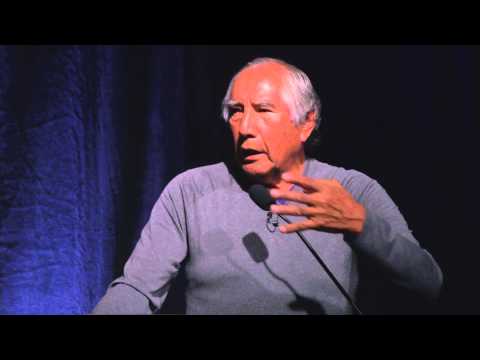
Dr. Leroy Little Bear discusses the fundamental differences and similarities between Indigenous knowledge, particularly from a Blackfoot perspective, and Western science, emphasizing concepts like constant flux, energy waves, and the importance of relationships and renewal in understanding the universe.
In a recent talk, Dr. Leroy Little Bear delves into the often misunderstood realms of science and technology, emphasizing the need to distinguish between the two. He argues that science is fundamentally about exploring the unknown, while technology is the application of what is already known. This distinction sets the stage for a deeper discussion on the foundational principles of Indigenous knowledge, particularly from a Blackfoot perspective, and how they resonate with modern scientific concepts.
Dr. Little Bear begins by clarifying that science is not merely about mathematics or technology but is a pursuit of understanding the unknown. He cites Albert Einstein as a pivotal figure who revolutionized science not through complex equations but by questioning the philosophical foundations of scientific thought. This approach encourages a broader exploration of knowledge, pushing the boundaries of what is understood.
From a Blackfoot viewpoint, the foundational aspects of Indigenous knowledge share similarities with concepts in quantum physics. Dr. Little Bear outlines several key components of this paradigm:
The idea of constant flux is central to Indigenous thought. It suggests that everything is in a state of motion, akin to the principles of quantum physics, which also emphasizes constant movement at the subatomic level.
Another significant aspect is the focus on energy waves rather than matter. In Western science, discussions often revolve around particles and matter, while Indigenous knowledge emphasizes the importance of energy and its spiritual implications. This perspective aligns with the belief that everything is interconnected through energy.
In Blackfoot culture, everything is considered animate. Unlike Western thought, which often categorizes entities as either animate or inanimate, Indigenous belief systems recognize a spirit or life force in all things, including trees and rocks. This holistic view challenges the dichotomous thinking prevalent in Western science.
Dr. Little Bear highlights the importance of relationships in Indigenous knowledge. Everything is interconnected, resembling a geodesic web in motion. This contrasts sharply with the Western approach, which often seeks to isolate and analyze components separately.
The concept of renewal is crucial in Indigenous thought. Dr. Little Bear emphasizes the need for sustainability and maintaining the ideal conditions for existence. This perspective is rooted in a deep respect for the land and the natural world, recognizing that human survival is intricately linked to the health of the environment.
Dr. Little Bear argues that there are multiple ways to understand the universe, and both Indigenous knowledge and Western science offer valuable insights. He critiques the Western scientific pursuit of a Grand Unified Theory, suggesting that the fundamental differences in approach—particle versus motion—make such a theory elusive.
He also discusses the concept of supersymmetry in particle physics, noting that the search for anti-particles has been unsuccessful because it does not incorporate the spiritual dimensions recognized in Indigenous knowledge.
In closing, Dr. Little Bear reflects on the nature of certainty in science. He contrasts the Western belief that the universe operates on predictable laws with the Indigenous understanding that uncertainty is the only certainty. This perspective invites a more fluid and dynamic approach to knowledge, one that embraces the complexities of existence.
Dr. Little Bear's insights encourage a dialogue between Indigenous knowledge and Western science, advocating for a more inclusive understanding of the universe that respects and integrates diverse worldviews. By recognizing the value of both perspectives, we can enrich our understanding of the world and our place within it.