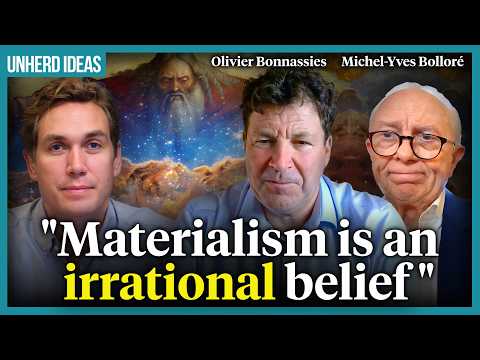
This blog post delves into the arguments presented by authors Michelle Eve Bolore and Olivia Bonessi in their book "God, the Science, the Evidence," which posits that modern scientific discoveries increasingly support the existence of a creator God. The discussion covers cosmology, fine-tuning, and the implications of these findings on the belief in God, alongside the authors' perspectives on the relationship between science and faith.
In recent years, the question of whether science can prove the existence of God has gained traction, particularly with the publication of the book "God, the Science, the Evidence" by French authors Michelle Eve Bolore and Olivia Bonessi. This blog post explores the key arguments presented in their work, which suggests that modern scientific discoveries increasingly point towards the existence of a creator God.
Historically, from the Renaissance to the 19th century, scientific discoveries seemed to support a materialistic view of the universe, suggesting that it could be explained without invoking a creator. Figures like Copernicus and Galileo shifted our understanding of the cosmos, while Newton and Laplace provided mathematical frameworks that explained celestial movements without the need for divine intervention.
However, Bolore and Bonessi argue that the 20th century marked a significant reversal in this trend. They assert that discoveries in cosmology, particularly the Big Bang theory and thermodynamics, indicate that the universe has a beginning and, consequently, a cause. They argue that if the universe has a beginning, it logically follows that there must be a creator.
The authors present several key points that they believe support the existence of God:
A critical distinction made by Bolore and Bonessi is between evidence and proof. They clarify that while they do not claim to provide absolute proof of God's existence, they present a collection of evidence that makes the existence of a creator more plausible. They argue that the accumulation of independent evidence from various scientific fields increasingly supports the idea of a creator God.
In addition to scientific arguments, the authors explore philosophical implications. They contend that if God does not exist, then concepts of good and evil are merely human constructs without objective grounding. This leads to a discussion on morality and the necessity of a divine source for moral truths.
The latter part of the book shifts focus to the historical and theological significance of the Jewish people and the figure of Jesus. Bolore and Bonessi examine the survival of the Jewish people through millennia and their unique claims of a covenant with God. They pose questions about the plausibility of these claims without divine intervention.
The authors acknowledge that many scientists and thinkers may not agree with their conclusions. They recognize that some may find the vastness of the universe and its seemingly indifferent nature at odds with the idea of a personal God. However, they argue that the existence of a beginning and the fine-tuning of the universe cannot be easily dismissed and require serious consideration.
In conclusion, "God, the Science, the Evidence" presents a compelling case for the existence of a creator God based on modern scientific discoveries. While the authors do not claim to provide absolute proof, they argue that the evidence increasingly favors theistic interpretations of the universe. This dialogue between science and faith continues to evolve, inviting readers to explore the profound questions of existence, purpose, and the nature of reality.
As we navigate these complex discussions, it is essential to remain open to various perspectives and engage thoughtfully with the evidence presented. The intersection of science and faith remains a rich field for exploration, reflection, and debate.