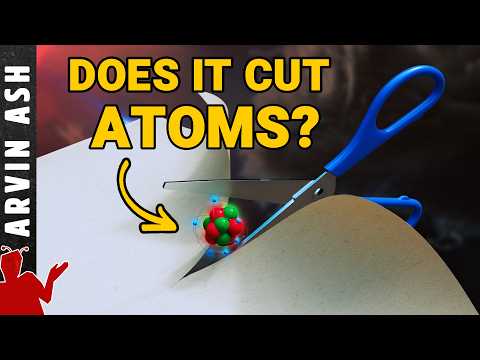
Cutting paper involves breaking various bonds from weak van der Waals forces to strong covalent bonds within cellulose fibers. While scissors can cut down to molecular chains by breaking some covalent bonds, they cannot cut atoms or nuclei due to geometric and energy limitations. Chemical methods are required to break molecules further into smaller units like glucose.
What happens if you keep cutting a sheet of paper smaller and smaller, all the way down to microscopic levels? Could you eventually slice a molecule or even an atom in half? This article explores the fascinating journey of cutting paper, the types of bonds involved, and the physical limits that prevent us from cutting beyond certain scales.
Paper is not a smooth, uniform material. Instead, it is a felt-like mat made of plant fibers primarily composed of cellulose. Zooming in reveals that each fiber is a bundle of smaller strands, which contain long molecular chains called polymers.
Cellulose polymers are large molecules made of repeating glucose units linked together by covalent bonds. Covalent bonds form when electron orbitals of two atoms overlap, allowing them to share electrons. This sharing creates a strong, stable chemical bond.
While covalent bonds hold the glucose molecules together within the fibers, the fibers themselves stick together mainly due to weaker forces:
Hydrogen Bonds: These are weak electrical attractions between neighboring oxygen-hydrogen (OH) groups on cellulose chains. Oxygen's higher electronegativity pulls electron density towards itself, creating a slight positive charge on hydrogen and a slight negative charge on oxygen, resulting in hydrogen bonding.
Van der Waals Forces: Even weaker than hydrogen bonds, these forces arise from tiny, momentary changes in electron distribution creating slight electrical attractions when cellulose surfaces are very close.
Together, these forces create the paper's structure, with hydrogen bonds acting like Velcro hooks and covalent bonds resembling welded steel.
When scissors cut paper, the blades clamp the sheet to prevent slipping and slide past each other, concentrating shear stress in a tiny overlapping zone. This stress initiates a crack that propagates like a zipper along the path of least resistance.
The crack usually travels between fibers, peeling apart hydrogen bonds and other weak contacts. This is why cut edges often appear fuzzy under magnification, with fibers fraying and partially detaching.
Sometimes, the crack splits fibers into sub-strands by breaking hydrogen bonds inside the fiber. When a fiber is severed across its thickness, some covalent bonds in cellulose chains also break, creating fresh molecular chain ends at the fracture surface. This means that cutting paper does indeed cut molecules, but only a tiny fraction of them.
As you continue cutting scraps into smaller pieces, new crack surfaces form, breaking more fiber-to-fiber bonds and some covalent bonds. However, the crack prefers to move between fibers rather than through every polymer chain, resulting in confetti, lint, and dust made of fiber fragments rather than isolated molecules.
There is also a geometric limit: even the sharpest scissors have an edge radius thousands to millions of atoms wide. When the fragment thickness approaches the blade edge thickness, the material bends and smears instead of shearing cleanly, turning the cut into a crush rather than a precise molecular cut.
To understand why scissors cannot cut atoms or nuclei, consider the energy and size scales involved:
Scissors can concentrate enough stress to break some covalent bonds but cannot reach the energy density needed to split atomic nuclei.
An atom is roughly 0.1 nanometers across, while even the sharpest steel blade edge is thousands to millions of times larger. This makes it impossible to focus force on a single atom; instead, millions of atoms are affected simultaneously, causing the material to crack along existing chemical bonds.
Splitting an atom requires ionizing radiation, particle beams, or nuclear reactions—processes involving high-energy physics far beyond the capability of mechanical blades.
To break cellulose molecules down to smaller units like glucose, chemists use chemical reactions such as hydrolysis or enzymes. These methods provide the necessary energy and specificity to cleave molecular bonds that scissors cannot.
Cutting paper is a complex interplay of physics and chemistry, revealing the fascinating hierarchy of bonds from weak electrical attractions to strong chemical links. While scissors can cut down to molecular chains, the atomic and nuclear realms remain beyond their reach.
Hopefully, this exploration has shed light on the microscopic world hidden within a simple sheet of paper and the limits of mechanical cutting.
See you in the next exploration!