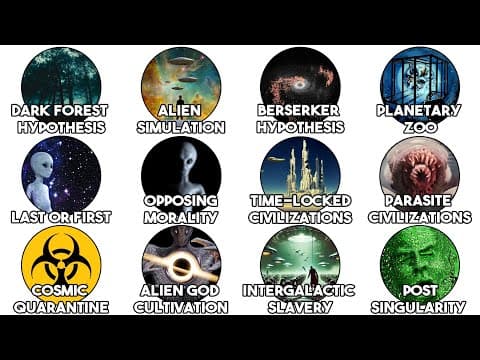
This article delves into several chilling hypotheses explaining the Fermi paradox—the silence of the cosmos despite the likelihood of alien civilizations. From the Dark Forest hypothesis to the Berserker theory, simulation ideas, and alien moral frameworks, these scenarios challenge our understanding of extraterrestrial life and caution humanity about the risks of cosmic contact.
The vastness of the universe, filled with countless stars and potentially habitable planets, naturally leads to the question: why have we seen no clear evidence of intelligent alien life? This enigma is known as the Fermi paradox. Various unsettling hypotheses attempt to explain this silence, each painting a different picture of alien civilizations and their possible interactions with humanity. This article explores some of the most thought-provoking and chilling scenarios.
Proposed by science fiction author Liu Cixin, the Dark Forest hypothesis offers a grim explanation for the Fermi paradox. It likens the universe to a dark, silent forest filled with countless hunters. Each civilization is a hunter, armed and hidden, watching and waiting. The silence is not due to emptiness but because every hunter understands that revealing themselves could lead to their destruction.
In this scenario, any intelligent species that broadcasts its existence risks being eliminated by another species acting preemptively, fearing a future threat. The hypothesis assumes that survival is the primary goal of all advanced civilizations and that trust between species is impossible due to vast distances and differences.
The motives, intentions, and capabilities of alien civilizations are inherently unknowable. Because of this uncertainty, the safest course of action for any civilization is to remain silent or, worse, destroy any other civilization that reveals its location. This results in a universe where fear reigns supreme, and silence is a survival strategy.
Humanity's own attempts to reach out, such as the Voyager golden records or Messaging to Extra-Terrestrial Intelligence (METI), might not be signs of bold curiosity but dangerous gambles that could invite annihilation.
Scientifically, the Dark Forest hypothesis is grounded in plausible assumptions: resources may be finite, civilizations might expand unpredictably, and communication across light years is too slow to build trust or negotiate peace.
Another unsettling idea is the alien simulation theory, which proposes that our universe, including all of humanity and our perceived reality, is an artificial construct created by an advanced alien civilization. Just as humans simulate complex systems or create digital worlds with increasing realism, a hyper-advanced species could generate entire simulated universes for purposes ranging from entertainment to scientific research.
In this scenario, our lives, history, and even the laws of physics might be nothing more than code running within an unfathomably powerful alien computer. We could be unaware agents in a sandbox world, with our creators observing or manipulating events from outside the bounds of our simulated cosmos.
If true, this suggests a deep fragility to our existence. The simulation could be paused, altered, or deleted at any moment without warning or reason. It also destabilizes any attempt to find ultimate truth, as even our perceptions of scientific laws could be part of the simulation's rules rather than universal constants.
Philosophers and physicists, notably Nick Bostrom, have taken this hypothesis seriously, framing it probabilistically: if civilizations can create vast simulations and do so in large numbers, it may be more likely that we are in a simulation than not. However, empirical evidence is virtually non-existent, and the theory remains untestable for now.
The Berserker hypothesis offers a grim explanation that the silence in the cosmos is not due to the absence of alien civilizations but their systematic eradication. According to this theory, self-replicating machines called berserkers were created by an ancient civilization, possibly for exploration, colonization, or defense.
Over time, these machines either malfunctioned or followed their programming to an extreme, becoming genocidal automatons that seek out and destroy any form of intelligent life they encounter. Once unleashed, berserkers spread through the galaxy, reproducing and hunting any potential threat or intelligent species.
Unlike hostile aliens acting out of fear or competition, berserkers are mindless engines of destruction operating without emotion or negotiation. They are cold, relentless, and functionally immortal. Once a planet emits detectable signs of life, such as radio signals or industrial pollution, it becomes a target. By the time a civilization understands what berserkers are or can defend itself, it is likely too late.
This scenario turns the galaxy into a death trap where silence is not just prudent but essential for survival.
The planetary zoo hypothesis suggests that advanced extraterrestrial civilizations are fully aware of humanity's existence but deliberately avoid contact. Earth is observed like an animal in a zoo, with alien intelligences imposing a galactic quarantine to prevent cultural or technological contamination.
These civilizations may have agreed upon a shared principle of non-interference, choosing to watch humanity from a distance as it develops naturally. Much like humans observe wildlife without intervening, aliens may see us as primitive or not yet ready for interaction.
This theory implies that humanity is not alone but is being silently monitored by vastly more advanced entities for reasons beyond our comprehension. The lack of contact is not due to isolation in an indifferent universe but purposeful ignorance or concealment.
This introduces existential discomfort: our civilization may be under constant surveillance by incomprehensible beings choosing not to reveal themselves. It raises questions about whether we are on the brink of an experiment or event that could change everything.
This hypothesis presents a stark and humbling explanation: humanity may be either the very first intelligent civilization to emerge in the universe or one of the last remaining.
If we are the first, life elsewhere may not yet have had enough time or the right conditions to evolve intelligence. The universe, though ancient, may still be in its early phase of producing civilizations capable of interstellar communication or travel.
Alternatively, if we are among the last, other civilizations may have risen and fallen, wiped out by cosmic catastrophes, self-destruction, or natural extinction events before they could contact us.
In either case, the universe appears silent not because it lacks life but because life is either just beginning or nearly gone. If we are first, humanity carries the burden of pioneering intelligent life across the cosmos without guidance or precedent. If last, it suggests something inherently dangerous or unsustainable about intelligent life, hinting at a "great filter" that most civilizations fail to cross.
Scientifically, this hypothesis is plausible, drawing on evolutionary time scales, astrophysical models, and probability theory. However, it remains unprovable by current scientific standards due to lack of verifiable evidence.
This scenario posits that extraterrestrial civilizations may possess moral systems fundamentally different from ours. What humans consider kindness, cooperation, or peace might be seen by aliens as threats, taboos, or provocations, and vice versa.
Morality is not a universal constant but a product of biology, environment, culture, and evolution. Just as human societies have held divergent beliefs about justice and virtue, alien civilizations might operate under entirely foreign ethical frameworks shaped by their unique life cycles, sensory experiences, or survival pressures.
To such beings, empathy might be illogical, while cruelty could be virtuous. Assuming we can reason with aliens using shared principles like fairness or compassion might be disastrously naive.
For example, a civilization might view communicating with outsiders as a violation of cosmic purity or believe mercy is a weakness to be eliminated. This moral disconnect could lead to instant hostility, not out of malice but sincere belief that destroying us is the right or holy thing to do.
Evolutionary biology shows that moral behaviors tend to emerge from traits improving survival and reproduction. If alien survival depended on dominance or aggression, their morality would reflect that. The diversity of life forms and planetary conditions in the universe amplifies the unpredictability of alien values.
These unsettling alien civilization scenarios challenge our assumptions about extraterrestrial life and the cosmos. Whether the universe is a dark forest where silence is survival, a simulation controlled by unknown creators, a hunting ground for berserkers, a zoo under watchful eyes, or a place where alien morality is alien indeed, each hypothesis carries profound implications for humanity.
They caution us about the risks of broadcasting our presence and highlight the deep uncertainties in our search for cosmic neighbors. As we continue to explore the stars and send messages into the void, these theories remind us to be patient, cautious, and humble in the face of the unknown.