This blog post delves into the concept of six degrees of separation, exploring how interconnectedness affects the spread of information, diseases, and social behaviors. It discusses the mathematical models behind this phenomenon, the implications of network structures, and the role of hubs in various systems, ultimately highlighting the power of individual actions within these networks.
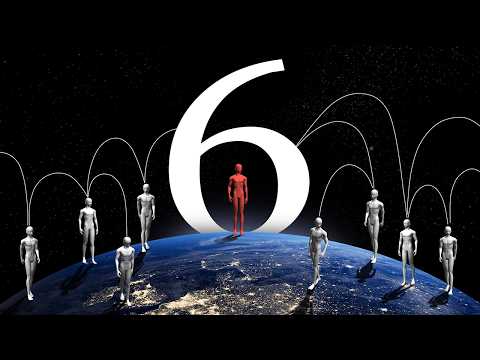
In 1999, a fascinating experiment conducted by the German newspaper "Die Zeit" revealed the concept of six degrees of separation. Salah ben Ghaly, a falafel salesman, was asked to connect himself to his favorite actor, Marlon Brando. Through a series of acquaintances, it was discovered that he could connect to Brando in just six steps. This experiment raised intriguing questions about the nature of our connections in a world of over eight billion people. How can we be so closely linked, and what implications does this have for our lives?
The idea of six degrees of separation suggests that any two people on Earth can be connected through a chain of acquaintances that does not exceed six intermediaries. This concept challenges our understanding of social networks and raises questions about how information and diseases spread in our interconnected world.
Mathematically, if each person has 100 friends, and each of those friends also knows 100 people, the number of connections grows exponentially. After just five degrees of separation, the potential connections exceed the global population. However, this model assumes a random distribution of friendships, which is not reflective of reality. In practice, people tend to cluster geographically and socially, leading to a more complex network structure.
To illustrate this, consider a model where all eight billion people are arranged in a circle, with each person knowing their 100 closest neighbors. In this scenario, the furthest person would be 50 connections away, making it nearly impossible to connect globally in just six steps. This paradox highlights the tension between local clustering and global connectivity.
In the mid-1990s, mathematicians Duncan Watts and Steve Strogatz sought to understand the small-world phenomenon. They created a model that began with a regular network and introduced random shortcuts. Their findings revealed that even a small number of shortcuts dramatically reduced the average degree of separation, demonstrating that networks can be both clustered and small-world.
Watts and Strogatz's model was tested on various networks, including the neural connections of the C. elegans worm and Hollywood actors. They found that many networks exhibit small-world properties, which have significant implications for how information and diseases spread. For instance, the introduction of shortcuts in a network can lead to rapid disease transmission, as seen in simulations of infection spread.
Albert-László Barabási later expanded on these ideas by studying the internet and discovering that networks often contain hubs—highly connected nodes that play a crucial role in maintaining connectivity. Hubs can be found in various systems, from airports to biological networks, and their presence can significantly influence the behavior of the entire network.
Hubs can facilitate rapid information flow and connectivity, but they also create vulnerabilities. For example, disruptions at a hub can have cascading effects throughout the network. This phenomenon is evident in both man-made and natural systems, where the removal of a keystone species or a major airport can destabilize the entire network.
The structure of our social networks can also influence our behavior and beliefs. Watts and Strogatz explored this through the lens of the prisoner's dilemma, a game theory scenario that illustrates the tension between cooperation and defection. Their simulations showed that the presence of shortcuts in a network could lead to a breakdown of cooperation, highlighting the importance of network structure in shaping social dynamics.
Interestingly, the concept of weak ties—acquaintances rather than close friends—can play a significant role in spreading information and fostering cooperation. Individuals often find job opportunities or new connections through these weak ties, emphasizing the importance of expanding one's social network.
Understanding network science reveals that while our connections shape us, our actions also shape the networks we inhabit. The interplay between individual choices and network structure can lead to significant changes in behavior and social dynamics. As we navigate our interconnected world, recognizing the power of our actions and the importance of fostering positive connections can lead to more cooperative and resilient communities.
In summary, the exploration of six degrees of separation not only uncovers the mathematical and social intricacies of our connections but also emphasizes the profound impact we can have on each other and the world around us. By choosing our connections wisely and engaging positively within our networks, we can contribute to a more connected and cooperative society.